Background
In South Africa (SA), virological failure on dolutegravir (DTG)-based regimens is often driven by suboptimal adherence. Next-generation sequencing (NGS) may detect resistance mutations more sensitively than conventional Sanger sequencing. We investigated the added value of NGS in samples with and without detectable DTG drug pressure.
Methods
We established an IonTorrent AmpliSeq HIVDR NGS workflow (ThermoFisher Scientific) for in-depth genotyping of HIV-1 pol protease (PR), reverse transcriptase (RT), and integrase (IN). Resistance interpretation was automated using ARUPHIVGenotyper v1.5.2 (ARUP Laboratories), based on the Stanford HIVdb v9.8. Plasma HIV RNA was sequenced from 45 persons with HIV (PWH) with ≥400 cps/mL, on DTG-ART ≥3 months, from two prospective cohorts enrolled from the SA public health system. DTG plasma levels were measured using an enzyme immunoassay (ARK Diagnostics, USA), and matched Sanger results were available for 42 individuals.
Results
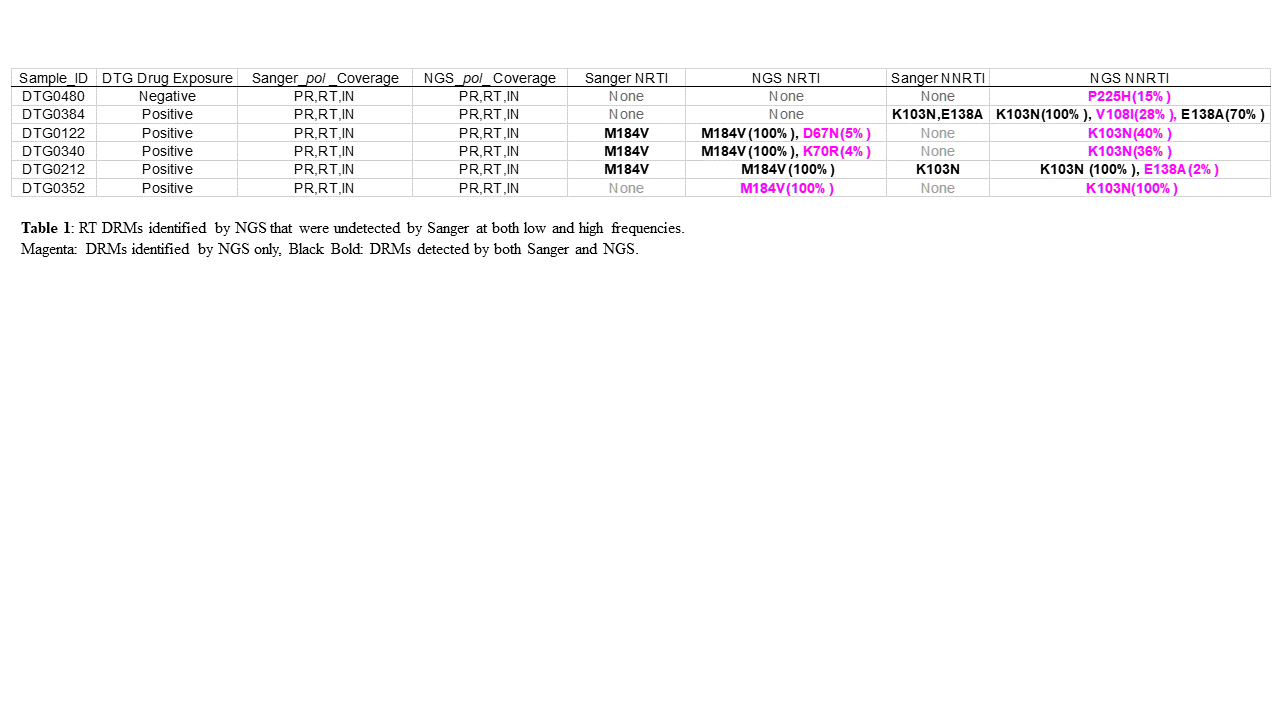
Among 45 PWH, 27 (60%) had detectable DTG drug levels. At the ≥10% variant frequency threshold (VFT), DTG resistance mutations (DRMs) were present in 10/45 (22.2%) cases, and in 12/45 (26.7%) at the ≥1% VFT. Among DTG-drug positive cases, DTG DRMs were identified in 10/27 (37%), but in none of the DTG-drug negative cases at the ≥10% VFT. DTG DRMs were only detected in DTG-negative cases at the ≥1% VFT (2/13; 15.4%). At the ≥10% VFT, NGS detected all DTG DRMs identified by Sanger, and additional DRMs detected by NGS that were unidentified by Sanger were either at low frequencies, or occurred in cases already predicted to have DTG resistance; thus, the number of DTG resistant cases was identical between NGS and Sanger. For RT, all DRMs identified by Sanger were detected by NGS, but NGS identified additional DRMs, including some at high frequencies (Table 1). Notably, M184V was more common in DTG-positive cases (15/27, 55.5%) compared to DTG-negative cases (3/13, 23.1%; p=0.09, OR 4.2, 95% CI 0.9–18.6), consistent with a trend toward higher prevalence under drug pressure.
Conclusions
NGS-based HIVDR genotyping detected additional DRMs compared to Sanger sequencing. For DTG, additional DRMs identified by NGS were mostly at low-frequencies and in DTG-negative PWH. For RT, NGS identified both low- and high-frequency additional DRMs. Further studies are needed to elucidate the clinical utility of NGS HIVDR testing, particularly in DTG-drug positive unsuppressed PWH with no DTG DRMs, and unsuppressed PWH with undetectable drug levels.
Table or Figure