Background
The HVTN 703/HPTN 081 and HVTN 704/HPTN 085 Antibody Mediated Prevention (AMP) trials demonstrated that broadly neutralizing monoclonal antibodies (bnAbs) could prevent acquisition of bnAb-sensitive HIV-1. Ensuring timely linkage to care and antiretroviral therapy (ART) initiation for participants who acquire HIV during clinical trials is critical. However, barriers to ART initiation in HIV prevention efficacy trial settings remain poorly understood.
Methods
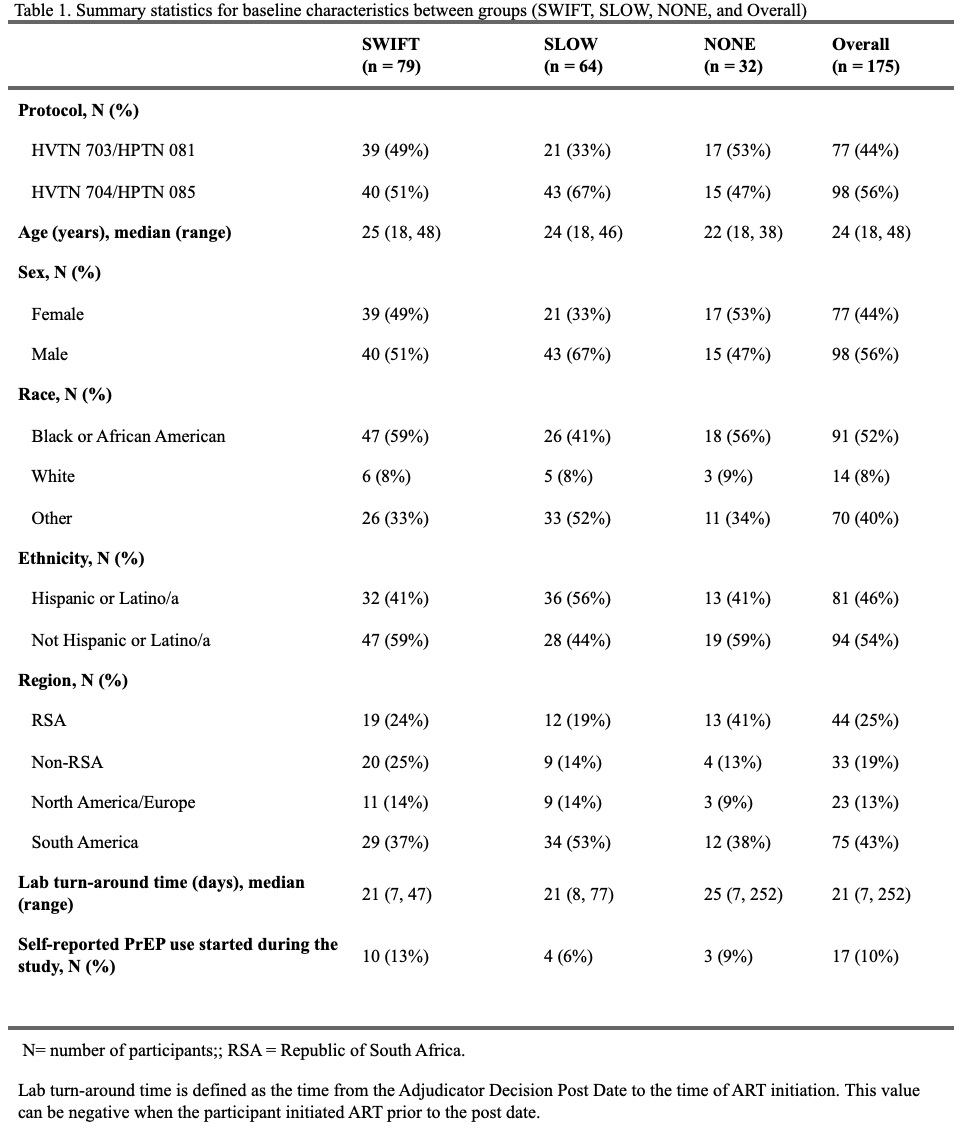
A retrospective post-hoc analysis was conducted of AMP trial participants who met the primary efficacy endpoint of documented HIV-1 acquisition. The trials were conducted at 46 sites across Africa, the Americas and Europe. ART initiation timing was categorized as: SWIFT (start within study interval-fast, ≤4 weeks post-adjudication), SLOW (start later within study observation window), >4 weeks post-adjudication), or NONE (no onset by study end). Participants were allowed to continue or initiate pre-exposure prophylaxis (PrEP) after enrollment, and post-enrollment PrEP use was evaluated as a potential correlate of ART initiation. Kaplan-Meier estimates and Cox proportional hazards models assessed initiation timing. Sites were surveyed to assess barriers to ART initiation.
Results
Among 175 participants with HIV-1 acquisition, 143 (82%) initiated ART, of which 79 (45%) were SWIFT, 64 (37%) SLOW, and 32 (18%) NONE. Median adjudication time was 21 days, with ART initiated a median of 7 weeks after diagnosis. Regional variations were observed, with 88% ART initiation (median 3 weeks; 62% SWIFT) in Africa outside of the Republic of South Africa (RSA), compared to 84% in South America (5 weeks; 39% SWIFT), 71% in RSA (5.7 weeks; 43% SWIFT), and 78% in North America/Europe (6 weeks; 50% SWIFT). Post-enrollment PrEP use was higher among SWIFT initiators (13%) vs SLOW (6%) or NONE (9%). We conducted 37 site surveys, which showed that 58% of participants were informed of their HIV diagnosis in clinic at interim visits, 4% via phone call, and 24% reported other. Identified barriers to ART initiation included transportation costs, time lost from work, and distance to the nearest care.
Conclusions
Timely ART initiation in HIV prevention trials can be influenced by trial-related processes and local healthcare infrastructure. Streamlining diagnostics, enhancing communication, and establishing clear HIV treatment linkage pathways with local providers may increase SWIFT ART initiation in HIV prevention trials.
Table or Figure