Background
Single tablet regimens (STRs) are widely used to treat HIV infection. STRs are sometimes substantially more expensive than multi-tablet regimens (MTRs). Few data exist comparing the effectiveness of STRs to contemporary once-daily MTRs.
Methods
We used Link Plus to merge data on persons with HIV (PWH) insured through WA State Medicaid to the state’s enhanced HIV/AIDS registry (eHARS). eHARS includes all HIV RNA test results reported by laboratories to the state department of health; HIV RNA reporting is legally mandated in WA State. We defined participants as virally suppressed (HIV RNA <200 copies/ml) based on their last HIV RNA test result in 2023 and defined their antiretroviral therapy (ART) regimen based on the most recent prescription refill prior to that HIV RNA test. We used Poisson regression with cluster-robust standard errors to estimate the relative risk (RR) of viral suppression associated with different ART regimens, adjusting for sex assigned at birth, age, race, ethnicity, time since HIV diagnosis, housing status, clinic providing care, region of the state, and receipt of any Ryan White service. Additional analyses grouped ART regimens into 3 groups: 1) STRs, 2) 1st-line MTRs (DTG+FTC/TAF, DTG+FTC/TDF, DTG+3TC), and 3) other MTRs.
Results
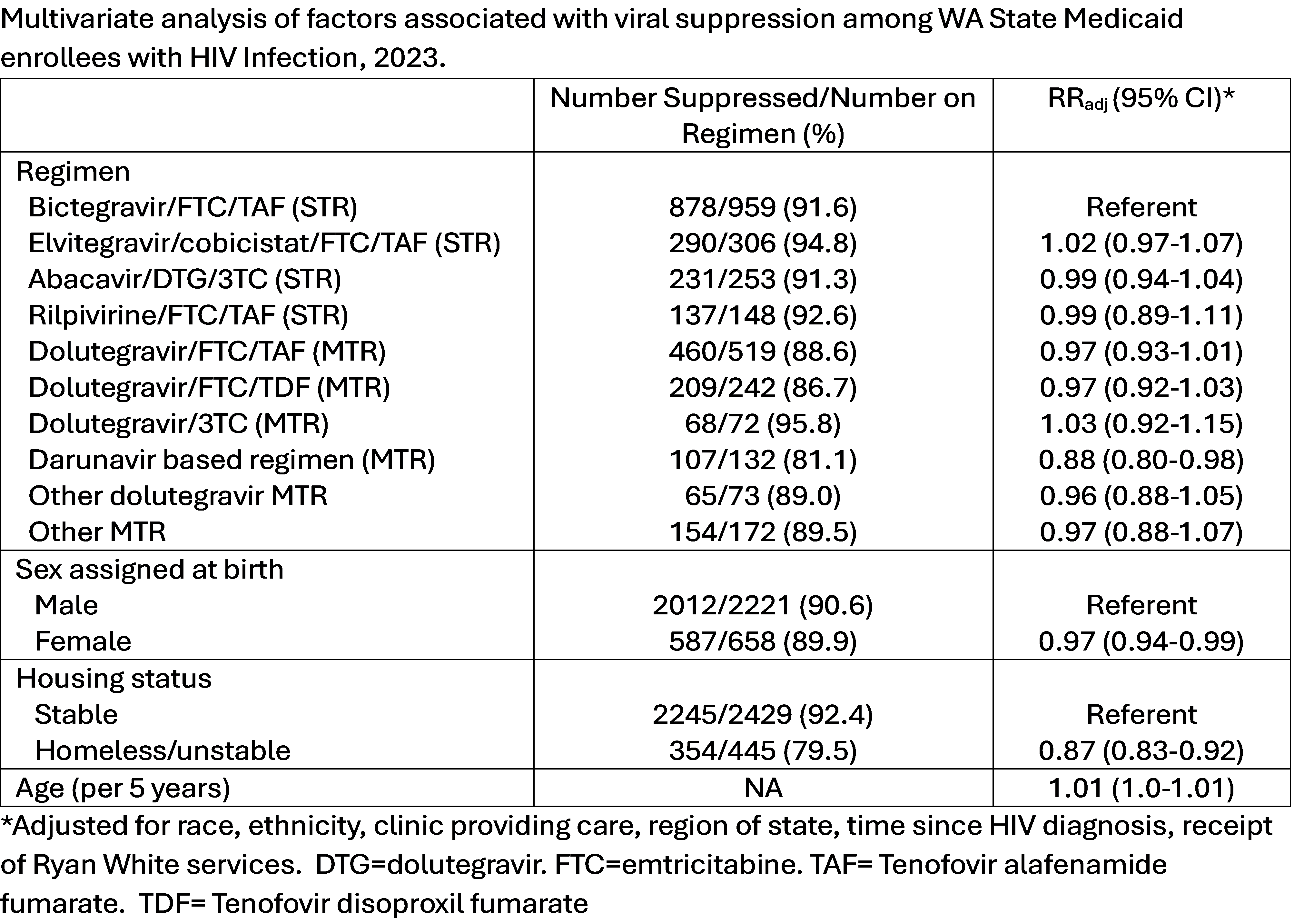
The study population included 2,874 PWH among whom 2,599 (90.4%) were virally suppressed. On multivariate analysis, lower levels of viral suppression were significantly associated with female sex at birth, younger age, being unstably housed, and use of darunavir containing MTRs, but not other ART regimens (Table). Viral suppression was lower among persons treated with 1st-line MTRs than STRs, though this difference was not significant (88.7% vs. 92.2%, RRadj=0.98, 95% CI 0.95-1.0, p=0.07). Among unstably housed persons – the population with the lowest level of viral suppression – viral suppression did not significantly vary between persons on 1st-line MTRs and STRs and (78.4% vs. 81%, RRadj=0.95, 95% CI 0.82 – 1.11, p = 0.387).
Conclusions
STRs and 1st-line MTRs are associated with similar levels of viral suppression, and STRs do not appear to improve viral suppression among unstably housed persons. Factors other than drug efficacy – including cost – should inform the clinical decision to use STRs vs. 1st-line MTRs.
Table or Figure