Background
The optimal timing of antiretroviral therapy (ART) initiation in hospitalized people with advanced HIV and opportunistic infections (OIs) remains a critical dilemma. While immediate ART could prevent immunodeficiency progression, conventional practice recommends deferring initiation after OI control to mitigate immune reconstitution inflammatory syndrome (IRIS) risk. We present the 48-week efficacy and safety results of a randomized trial comparing these strategies.
Methods
In this open-label, randomized controlled trial, adults with confirmed advanced HIV (CD4 <200 cells/μL) and an active OI were stratified by CD4 count and randomized 1:1 to initiate ART either 48 hours of admission (iART, n = 58) or after OI control (between 6-12 days, cART, n = 56). The primary outcome was to evaluate the proportion of participants achieving HIV RNA <50 copies/mL at 48 weeks (intention-to-treat analysis). Secondary outcomes included change in CD4+ count, IRIS incidence, and all cause mortality.
Results
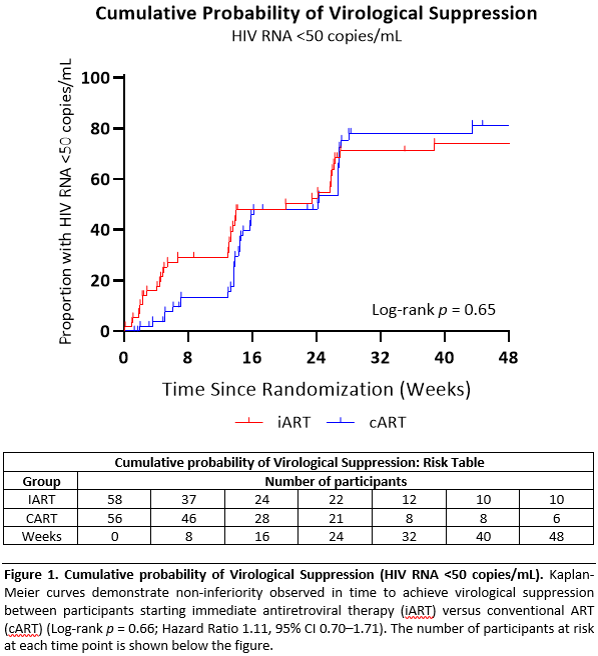
Participants had severe immunosuppression at baseline (median CD4+: iART 29 vs. cART 35 cells/μL). At 48 weeks, the primary outcome of virological suppression was nearly identical between groups (69% vs. 71%; RR = 0.97, 95% CI = 0.76-1.23; p = 0.77). The median increase in CD4+ count was also comparable (+184 vs. +185 cells/μ, p = 0.89). Crucially, the incidence of IRIS was not significantly different (10% vs. 13%, p = 0.72), directly countering the primary safety argument for treatment delay. Mortality was also not different between groups (12% vs. 7%, p = 0.37). The cumulative probability of virological suppression was nearly identical over the 48-week study period (HR 1.11, 95% CI 0.70–1.71; Log-rank p=0.66), as shown in the Kaplan-Meier curves (Figure 1).
Conclusions
The robust findings from this trial demonstrate that immediate ART initiation is non-inferior to a conventional deferred strategy in terms of virological efficacy, immunological recovery, and IRIS risk at 48 weeks. This provides high-level evidence supporting a paradigm shift towards rapid “test-and-treat” in hospitalized people with advanced HIV, simplifying care without compromising safety.
Table or Figure