Background
Heavily treatment-experienced (HTE) people with HIV (PWH) are at increased risk of suboptimal virological suppression and immune recovery. Our aim was to assess these outcomes longitudinally in individuals with 4-class drug resistance (4DR).
Methods
Repeated cross-sectional analyses were conducted in the PRESTIGIO Registry, an ongoing multicenter cohort that prospectively collects data and provides multidisciplinary evaluation of adults on antiretroviral therapy (ART) with documented resistance to nucleoside/nucleotide and non-nucleoside reverse transcriptase, protease and integrase inhibitors. We analyzed data at 3 predefined timepoints, 1, 4, and 7 years after registry initiation (January 1 2019, 2022, and 2025). For each timepoint, the last available measurement within the preceding 12 months was used. As PRESTIGIO is an open cohort, individuals could contribute data at one or more timepoints. Trends across years were assessed using logistic regression with generalized estimating equations, assuming a linear trend and accounting for within-patient correlation.
Results
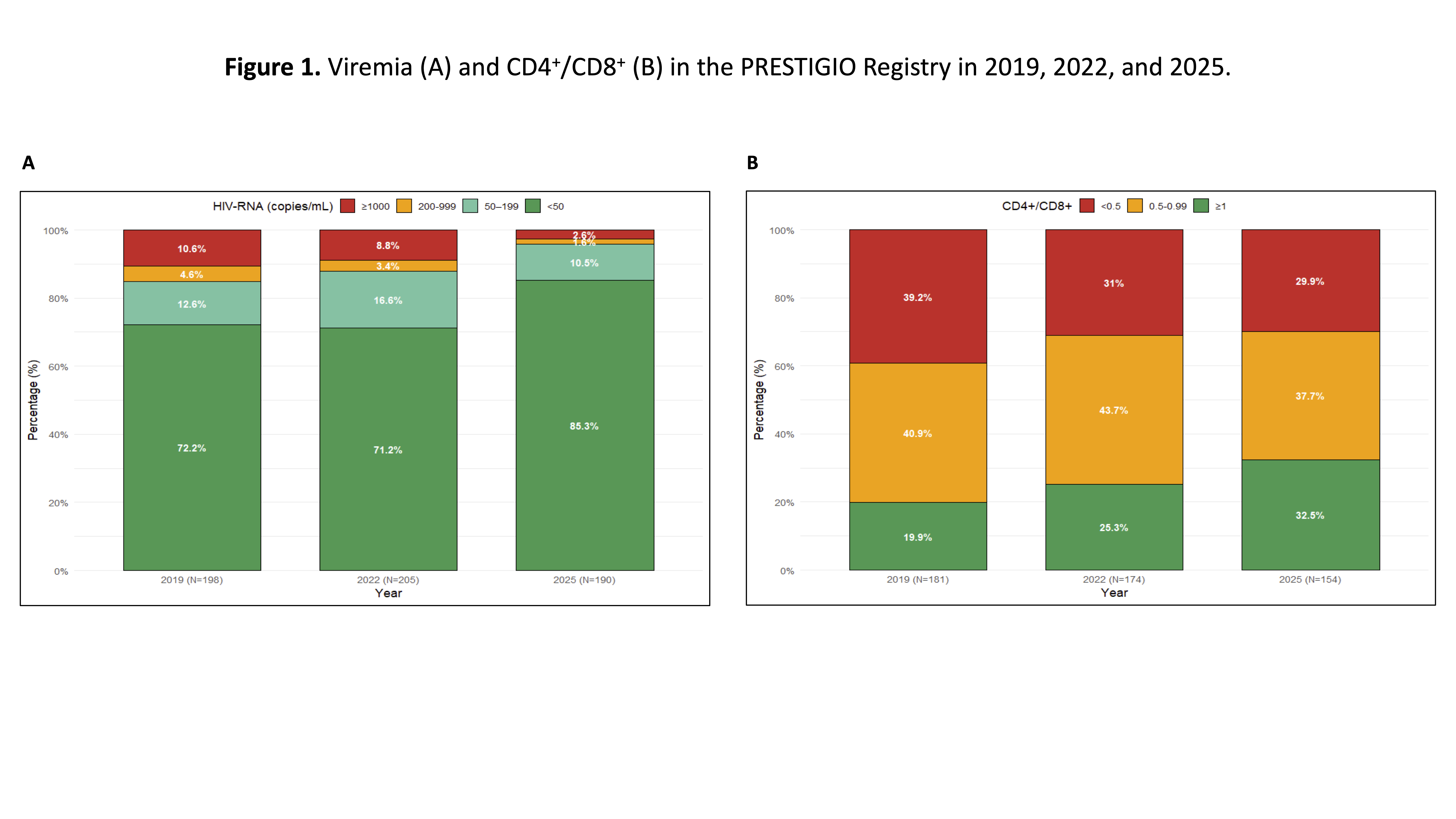
Overall, 255 4DR-PWH contributed ≥1 visit at the 3 snapshots: 31 (12.2%) developed 4DR and entered after the 2019 snapshot, and 38 (14.9%) ended follow-up before 2025 (23 deaths, 6 lost, 9 transfers). At the last available visit, 184/255 (72.2%) were assigned male at birth, the median age was 60.3 [interquartile range (IQR)=56.0-63.9] years, and the median ART duration was 28.5 (IQR=26.0-31.6) years. Virological suppression (<50 copies/mL) was achieved by 72.2% in 2019 and increased up to 85.3% in 2025 (p<0.001) (Figure 1A). Immunological recovery also improved: CD4+ >500 cells/µL rose from 57.3% to 67.0% (p=0.013) and CD4+/CD8+ >1 from 19.9% to 32.5% (p<0.001) (Figure 1B). Use of new drugs increased (fostemsavir: from 4.8% to 18.9%, p<0.001; lenacapavir: from 0% to 6.5%, p<0.001). In individuals with visits at all 3 timepoints, results were consistent (suppressed viremia: p=0.018; CD4+ >500 cells/mL: p=0.099; CD4+/CD8+ >1: p<0.001). Among the 38 who ended follow-up before 2025, 65.8% had virological suppression, 41.7% had CD4+ >500 cells/mL, and 5.4% had CD4+/CD8+ >1 at last visit.
Conclusions
In this cohort of PWH with extensive drug resistance, virological suppression and immune recovery improved over seven years, coinciding with multidisciplinary care and wider use of novel agents. Although challenges persist in managing HTE populations, viro-immunological success can be achieved.
Table or Figure