Background
Doravirine (DOR) is a non-nucleoside reverse transcriptase inhibitor (NNRTI) used in treatment-experienced and naïve people living with HIV (PLWH). This study evaluated the long-term effectiveness of DOR-based antiretroviral therapy (ART) among treatment-experienced PLWH who were virologically suppressed (VS) prior to switch.
Methods
This retrospective cohort study included all VS (viral load (VL) <50 copies/mL) PLWH ≥18 years, switched to DOR/3TC/TDF or DOR + ≥1 NRTI and/or 1 INSTI between September 2019 and February 2024. Exclusion criteria included pregnancy, ART regimens likely indicating intensification or highly treatment experienced PLWH (e.g., DOR + DRV/c/TAF/FTC), end stage renal disease, and primary or secondary DOR resistance mutations at baseline. The primary outcome was proportion of PLWH maintaining VS (<50 copies/mL) at 5 years. Secondary outcomes included the proportion of PLWH maintaining VS (<50 copies/mL) at 1, 2, 3, and 4 years; and reasons for discontinuation: virologic failure (VF); and toxicities defined in the medical chart as including PLWH-reported adverse effects and medical reasons. VL measures +/- 90 days of the respective time point were included. VF was defined as two consecutive VL >200 copies/mL or 1 VL >200 copies/mL and DOR discontinuation. PLWH were censored if they switched to another ART regimen, died, were lost to follow-up (no observations ≥10 months after the last prescription), or study end of March 31, 2025.
Results
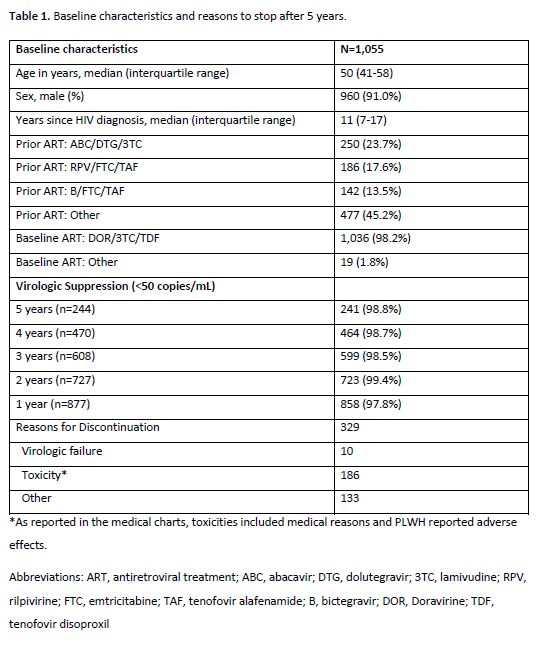
Of 1,126 PLWH initiated on a DOR-based regimen, 1,055 were included in the analysis with a median follow-up of 43 months (interquartile range [IQR] 19-59). The median age was 50 years (IQR 41-58) and 960 (91.0%) were male. The most common ART combinations prior to switching to DOR were ABC/DTG/3TC (23.7%), RPV/FTC/TAF (17.6%), and B/FTC/TAF (13.5%). At baseline, 98.2% switched to DOR/3TC/TDF. At year 5, 244 PLWH had an observation in the window and continued a DOR based regimen; of these, 241 (98.8%) had a viral load of <50 copies/mL. Over the entire study period, 11 (0.1%) PLWH died and 94 (8.9%) were lost to follow-up. Throughout the study, a total of 329 PLWH discontinued a DOR-based regimen, of whom 10 discontinued due to VF over the entire study period (Table 1).
Conclusions
The rate of virologic suppression remained high among PLWH with 5 years of follow-up on DOR-based regimens, while modest discontinuation numbers were observed. These results support the long-term effectiveness of DOR in treatment-experienced individuals.
Table or Figure