Background
Doravirine (DOR), a non-nucleoside reverse transcriptase inhibitor, is approved for use in both antiretroviral therapy (ART)–naïve and –experienced people living with HIV (PLWH). We assessed the durability of virologic suppression in virologically suppressed, treatment‑experienced adults switched to DOR‑based regimens in routine care.
Methods
We performed a retrospective study in the large French DAT’AIDS cohort including PLWH aged ≥18 years with plasma HIV RNA <50 copies/mL who switched to either the single‑tablet DOR/3TC/TDF or DOR plus ≥1 nucleoside reverse transcriptase inhibitor (NRTI) and/or an integrase strand transfer inhibitor (INSTI) between April 2019 and June 2024. Exclusions were pregnancy, regimens suggesting intensification or highly complex salvage therapy, end‑stage renal disease, and presence of primary/secondary DOR resistance at baseline. The primary endpoint was the proportion of individuals maintaining virologic suppression (<50 copies/mL) at 4 years. Secondary endpoints included suppression rates at 1, 2, and 3 years and reasons for stopping DOR, including virologic failure (VF) and other reasons (e.g., adverse effects). Viral load results within ±90 days of each annual timepoint were used. VF was defined as two consecutive plasma HIV RNA >50 copies/mL or a single >200 copies/mL followed by discontinuation of DOR. Participants were censored at regimen switch, death, loss to follow‑up, or study end (December 2024).
Results
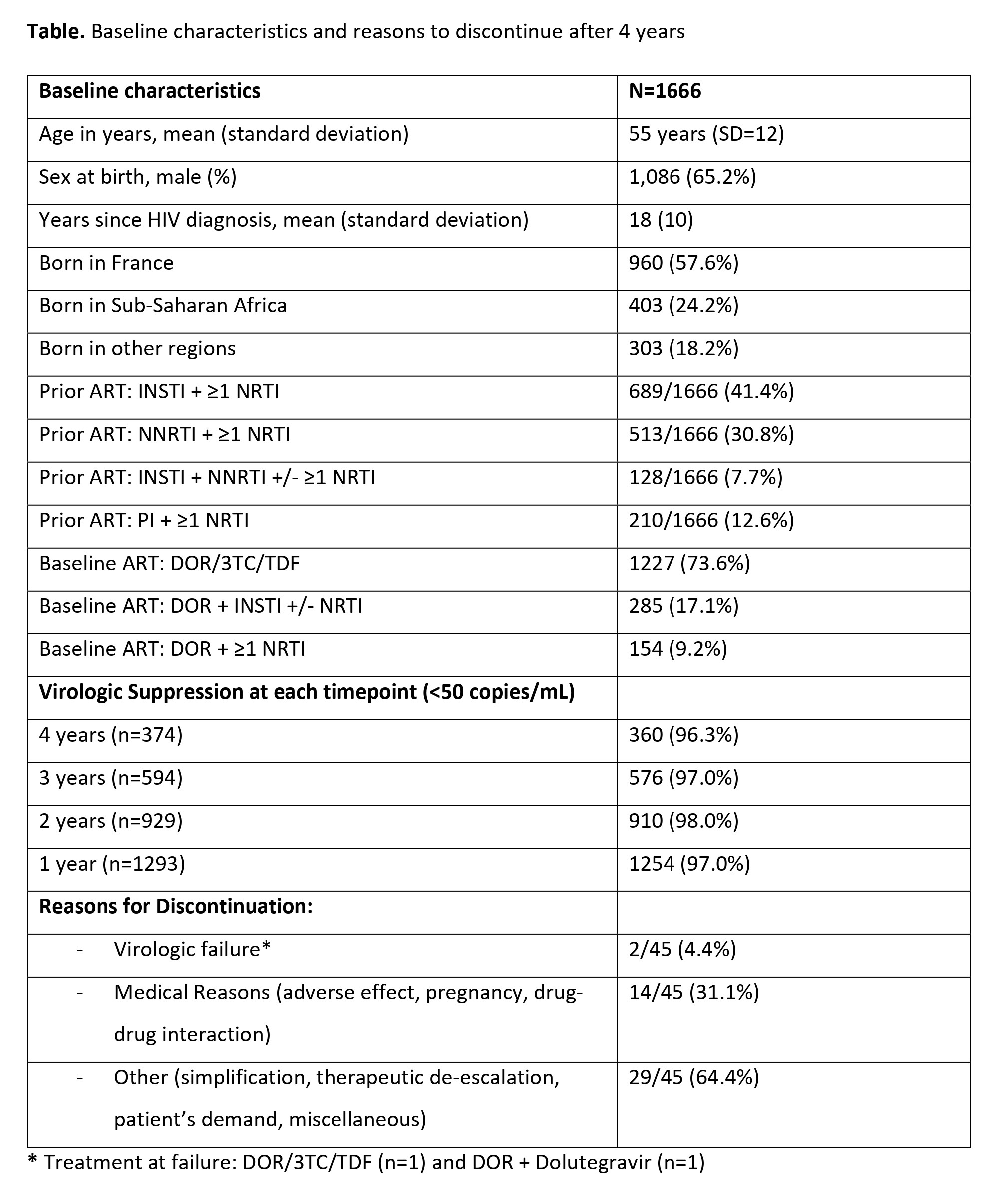
Of 2,114 PLWH who initiated a DOR‑containing regimen during the study period, 1,666 met inclusion criteria and were analyzed (see characteristics in Table). Most of the PLWH (1227; 73.6%) switched to DOR/3TC/TDF at baseline. At each annual assessment, the proportion of those with an evaluable viral load remaining on a DOR regimen who had HIV RNA <50 copies/mL was: year 1 — 1254/1293 (97.0%); year 2 — 910/929 (98.0%); year 3 — 576/594 (97.0%); and year 4 — 360/374 (96.3%). During follow‑up, no participants died. Overall, 45 participants discontinued DOR; 2 of these discontinuations were attributable to VF (with no resistance to ART regimen) and 43 due to other reasons (see Table).
Conclusions
In this real‑world cohort of virologically suppressed, treatment‑experienced adults, switching to DOR‑based therapy was associated with high-level of sustained virologic suppression and low numbers of discontinuations. These findings support the long‑term effectiveness and acceptable tolerability of doravirine‑containing regimens in routine clinical practice.
Table or Figure