Background
In a Phase 2 study (NCT05052996), once-weekly oral islatravir (ISL), a nucleoside reverse transcriptase translocation inhibitor, plus lenacapavir (LEN), a capsid inhibitor, maintained a high rate (94.2%) of virologic suppression at Week (W) 48 in virologically suppressed (VS) adults with HIV-1. We report efficacy, safety, and adherence outcomes in all participants receiving ISL+LEN during the extension phase through W96.
Methods
This randomized, open-label, active-controlled study enrolled VS adults on daily bictegravir/emtricitabine/tenofovir alafenamide (B/F/TAF). Participants were randomized 1:1 to switch to weekly oral ISL 2 mg + LEN 300 mg (ISL+LEN group) or to continue daily oral B/F/TAF for 48 weeks. Thereafter, participants on B/F/TAF were given the opportunity to switch to weekly ISL+LEN (B/F/TAF-to-ISL+LEN group) in an extension phase. Baseline values were defined as last measurement prior to the first dose of ISL+LEN. Outcomes assessed at W96 included HIV-1 RNA ≥50 copies/mL, adherence by pill count, adverse events (AEs), CD4+ T-cell and lymphocyte counts, weight, and body mass index (BMI).
Results
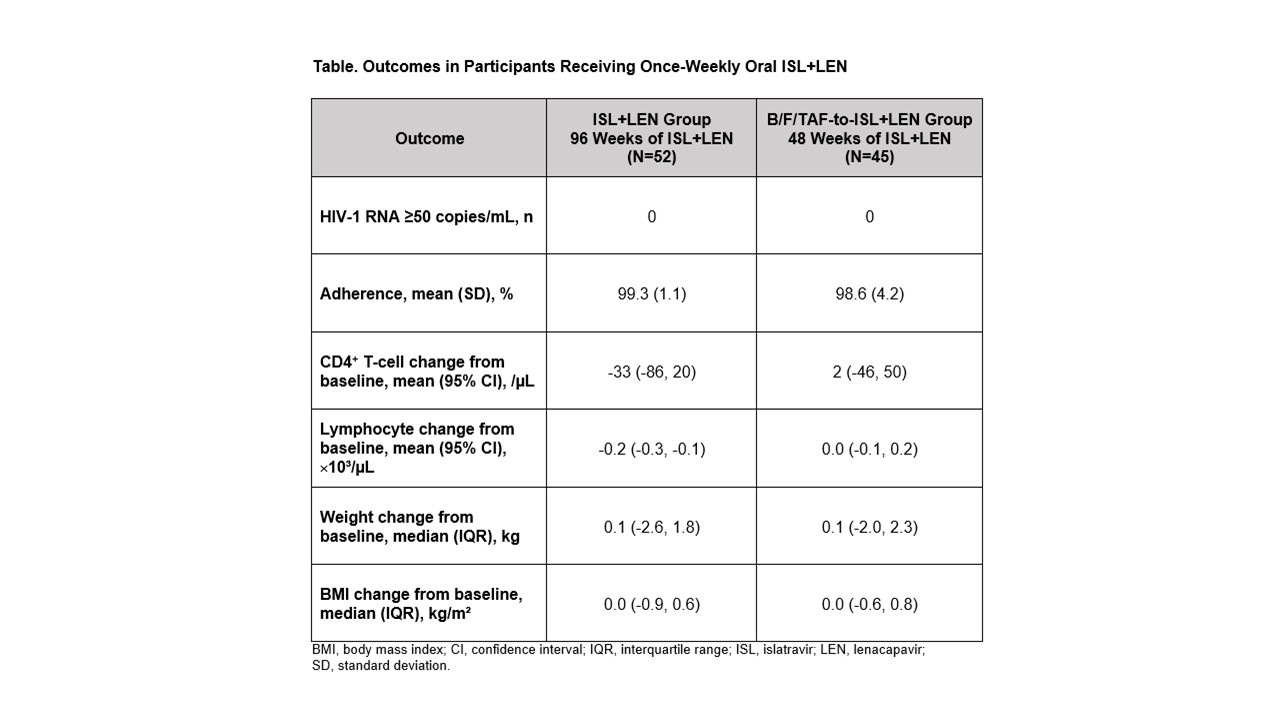
Ninety-seven participants received ISL+LEN (median age 40 years; 18.6% female), including 52 in the ISL+LEN group and 45 in the B/F/TAF-to-ISL+LEN group. No participants had HIV‑1 RNA ≥50 copies/mL at W96 or at discontinuation, and no emergent resistance to ISL or LEN was detected. Mean adherence was high (99.3% and 98.6%, respectively). Overall, 12 participants (12.4%) experienced study drug–related AEs with ISL+LEN, including 10 participants in the ISL+LEN group (most commonly dry mouth [n=2] and nausea [n=2]) and 2 participants in the B/F/TAF-to-ISL+LEN group (fatigue [n=1] and sleep disorder [n=1]). Two participants discontinued due to unrelated AEs in the ISL+LEN group and no participants in the B/F/TAF-to-ISL+LEN group discontinued due to AEs. There were no serious drug-related AEs or deaths. CD4+ T-cell counts, lymphocyte counts, weight, and BMI showed no clinically significant changes during the extension phase in either group (Table).
Conclusions
Once-weekly oral ISL+LEN maintained high rates of virologic suppression and was well tolerated. These results support ISL+LEN as a potential first oral once-weekly complete treatment regimen for HIV-1. Phase 3 studies (ISLEND-1, NCT06630286; ISLEND-2, NCT06630299) are ongoing.
Table or Figure