Background
A point-of-care lateral flow assay that detects recent tenofovir (TFV) adherence in urine specimens has been developed and validated. Our objective was to assess the validity of the urine TFV assay to differentiate viremia versus suppression among people taking tenofovir-lamivudine-dolutegravir (TLD).
Methods
We conducted a nested case-control study using data and specimens from the DISCO study, which followed adults with HIV in Uganda and South Africa who were on TLD as first-line antiretroviral therapy (ART). Cases were individuals with ≥1 episode of viremia (viral load ≥50 copies/mL) after ≥24 weeks on TLD. Controls were never viremic on TLD. Cases and controls were propensity score-matched 1:1 using the optimal pair method. Propensity score models included sex, age, duration of ART, and ART regimen prior to TLD, if any. Pair assignment was restricted by exact matching on country and ART-experienced versus ART-naïve status at TLD start. A conditional logistic regression model was fit with presence or absence of TFV in the urine as the predictor and viremia as the outcome of interest. We then calculated test performance characteristics of the urine TFV test to differentiate viremia versus viral suppression and estimated the positive and negative predictive values (PPV and NPV), assuming population viremia prevalences ranging from 1 – 30%.
Results
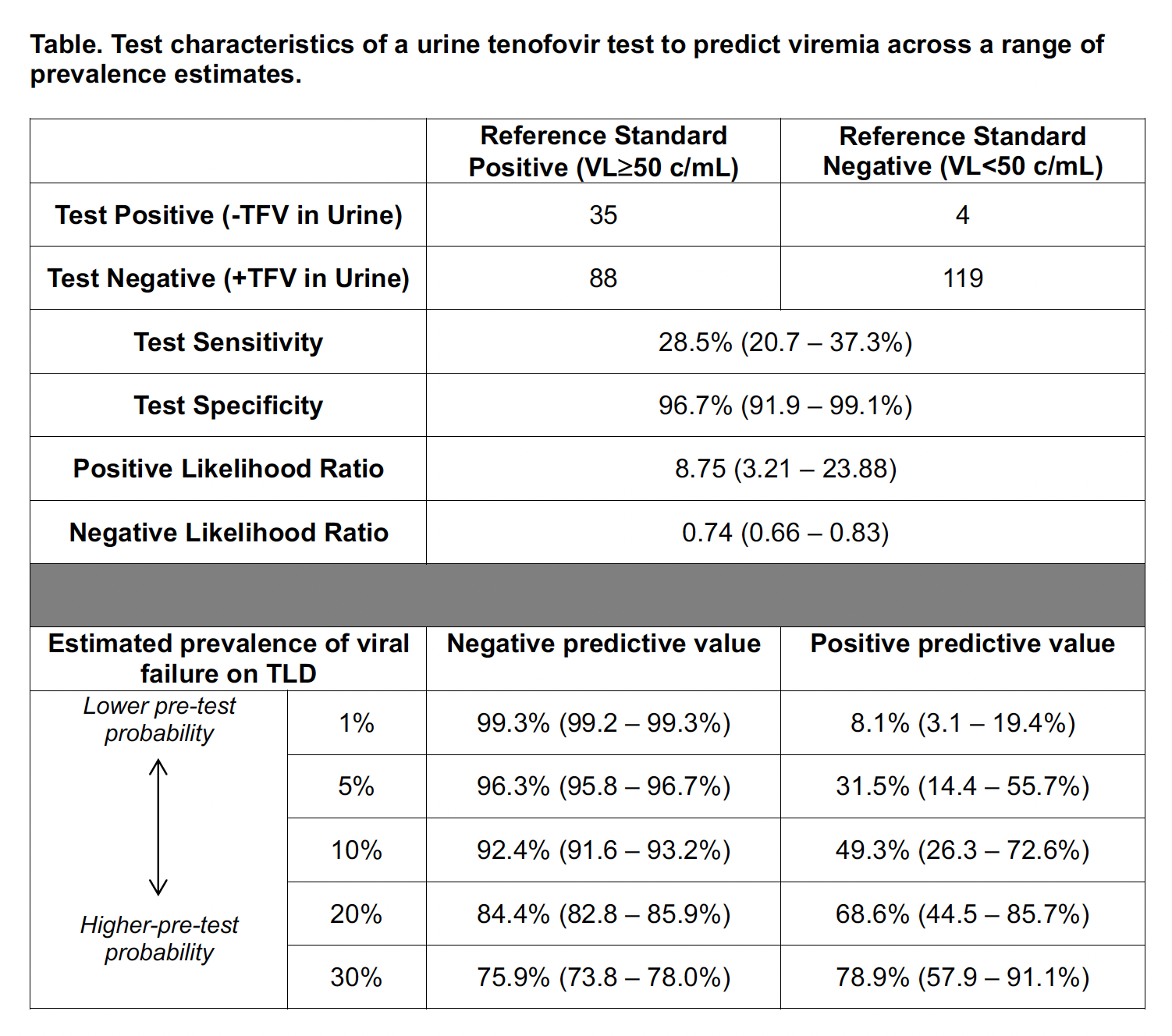
We identified 123 total cases with viremia and 123 matched controls from a study population of 1,173 participants. Of the 246 participants analyzed, 44% were female. The median age was 38 years (IQR 31 – 46). The median duration on ART was 4.0 years (IQR 0.0 – 7.6). The most common regimen prior to TLD, if any, was lamivudine (or emtricitabine)-tenofovir-efavirenz (54%). In the conditional logistic regression model, individuals with absent urine TFV were significantly more likely to have viremia than those with TFV present (90% vs 43%, OR 11.33, 95% CI 3.48 – 36.90, p<0.001). The absence of TFV in urine had a specificity of 97% and sensitivity of 29% to detect viremia (Table). NPV is >95% for all scenarios in which prevalence of viremia is <5%, while PPV is optimized when prevalence is higher (Table).
Conclusions
Absence of TFV in urine was associated with >11 times increased odds of viremia while on TLD. For groups with high pre-test probability of viremia, absence of TFV in urine is suggestive of viremia. However, for groups with low pre-test probability of viremia, there is a very high likelihood of viral suppression if TFV is present.
Table or Figure