Background
The current gold standard for diagnosing Mpox involves molecular testing of lesion swabs, which, although highly sensitive, is invasive and often challenging to obtain given the disease’s diverse clinical presentations. During the 2024 Mpox outbreak in Uganda, we assessed the diagnostic performance of three non-invasive specimen types: saliva, urine, and anal swabs, against paired lesion swabs. Whole-genome sequencing was performed on a subset of positive samples to characterize viral diversity and evolutionary dynamics.
Methods
A total of 480 matched samples (lesion swabs, saliva, anal swabs, and urine) were collected from 120 patients with suspected Mpox during a recent outbreak, alongside wastewater samples from manholes and septic tanks. All samples were tested for Mpox virus DNA at the Central Emergency Response and Surveillance Laboratory (CERSL) using the Bioperfectus Real-Time PCR Kit. Statistical analysis was performed using the McNemar test, Spearman correlation coefficients, and equivalence was evaluated with two one-sided tests using R. A subset of patient samples (n = 20) was sequenced using the Illumina MiSeq and Oxford Nanopore GridION platforms and analyzed with the ARTIC Nextflow pipelines.
Results
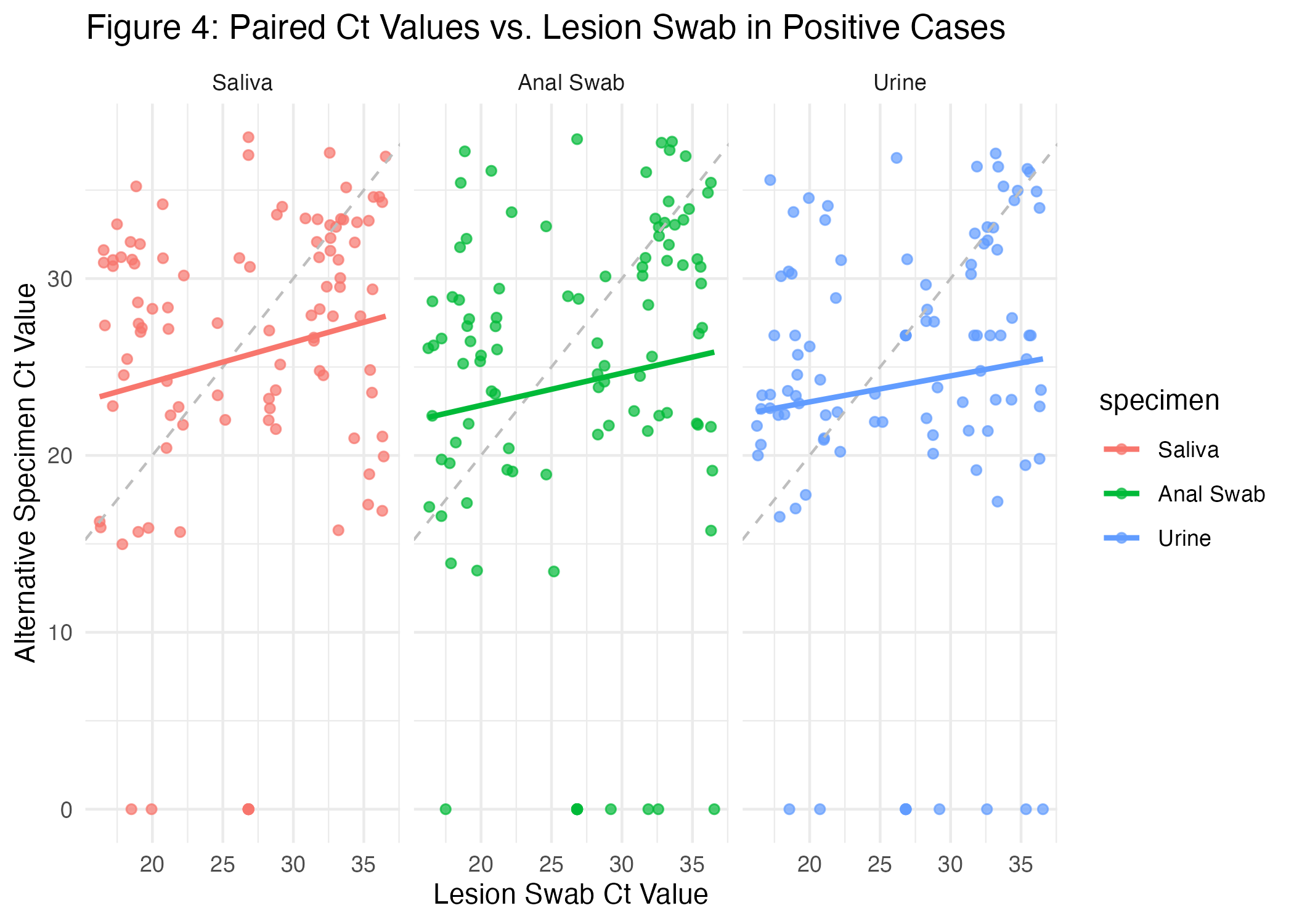
Overall, 79.8% (383/480) of samples were Mpox positive. Positivity rates were highest in lesion swabs at 83.3% (100/120), followed by saliva at 81.7% (98/120), anal swabs at 78.3% (94/120), and urine at 75.8% (91/120). Median Ct values did not differ significantly across specimen types (P>0.05). Viral load stratification showed consistently high positivity in saliva and urine, and the MPXV was also detected in wastewater. Sequencing confirmed Mpox reads in 20 patient samples, with ≥80% genome coverage most frequently achieved in lesion and anal swabs (60%), followed by saliva (40%) and urine (20%), with no source-specific SNPs identified. Spearman correlation revealed weak positive associations between lesion swabs and alternatives (saliva: p=0.15; anal: p=0.30; urine: p=0.29). McNemar’s tests indicated diagnostic agreement for saliva and anal swabs (P>0.05), but urine showed discordance (P = 0.0067). Using lesion swabs as the reference, saliva showed the highest sensitivity (93%), while urine showed the highest specificity (95%). Equivalence testing confirmed that both saliva and anal swabs were diagnostically comparable to lesion swabs.
Conclusions
Saliva and anal swabs show promise as non-invasive alternatives for Mpox diagnosis when lesion sampling is impractical.
Table or Figure