Background
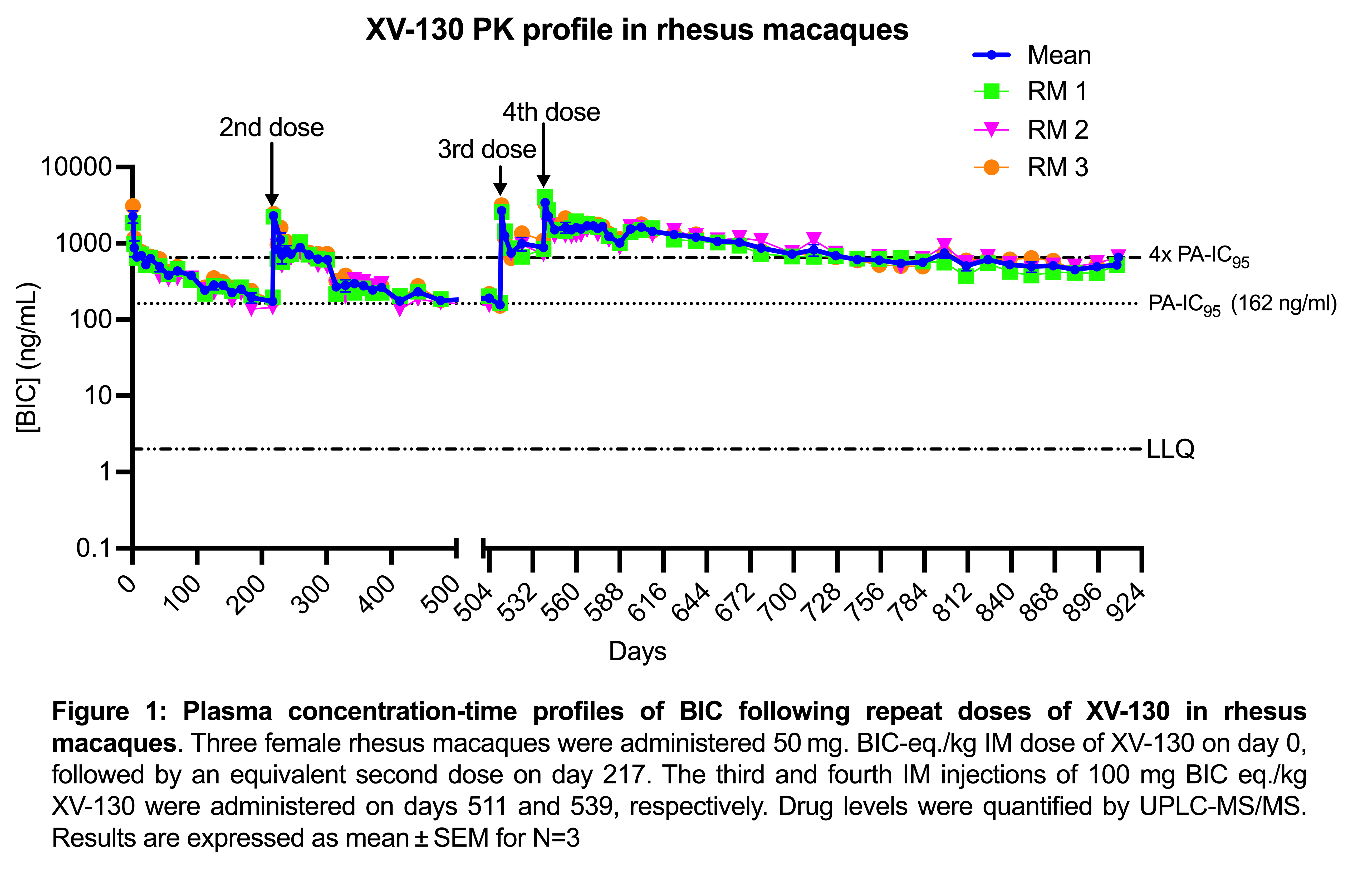
Long-acting (LA) antiretroviral therapies (ART) have transformed HIV care through reductions in dose frequency and regimen adherence. The significant preference for ultra-long acting (ULA) ART led to the development of monomeric and dimeric integrase strand transfer inhibitor prodrug nanosuspensions. For bictegravir (BIC), a single injection of the dimeric prodrug nanosuspension (XV-131) into rodents and rhesus macaques (RM) led to sustained plasma BIC levels ≥4x PA-IC95 for six months, followed by a shorter terminal elimination phase. By contrast, the monomeric prodrug nanosuspension of BIC (XV-130) produced lower (<1.5x PA-IC95) but substantially prolonged BIC levels. The current study evaluated the effect of repeated low and high dose IM injections on the pharmacokinetic profile of XV-130 in RM over 132 weeks.
Methods
XV-130, a nanocrystalline aqueous nanosuspension of bictegravir stearate (NM2BIC), was produced by high-pressure homogenization. Three female rhesus macaques (RM, 10–13 years; 14–15 kg) received IM injections (quadriceps) over a period of 132 weeks. Two doses of 50 mg BIC-eq./kg were administered to RM on days 0 and 217, followed by 100 mg BIC-eq./kg doses on days 511 and 539. Visual and histopathologic assessments of the injection sites were conducted by a certified pathologist. In addition to complete blood counts and serum chemistry tests, plasma and tissue samples were collected for BIC and prodrug quantitation by validated LC–MS/MS methods.
Results
After the first 50 mg BIC-eq./kg dose, plasma BIC peaked at 2,254 ng/mL on day 1, and stabilized above the PA-IC95 through day 217 in two of three animals (Figure 1). A second 50 mg BIC-eq./kg dose resulted in a 1.3-fold higher exposure to BIC but exhibited a similar drug decay curve. Two sequential high doses of 100 mg BIC-eq./kg administered when BIC levels were either below the PA-IC95 or >4x PA-IC95 produced modest Cmax increases (≤1.5-fold). However, administration of the final two injections four weeks apart sustained plasma BIC concentrations ≥4x PA-IC95 for up to a year. Macroscopic and histopathological assessments confirmed local injection safety.
Conclusions
Repeated dosing of XV-130 (bictegravir stearate nanosuspension) in rhesus macaques sustains BIC concentrations above 4xPA-IC95 for up to a year after the last dose. The injections were well tolerated. These findings support further evaluation of XV-130 as an ultra-long acting candidate for HIV-1 treatment and prevention.
Table or Figure