Background
A5388 is an ongoing phase II, randomized, double-blind, placebo-controlled study evaluating VRC07-523LS and PGT121.414.LS. These novel HIV-1 broadly neutralizing antibodies (bNAbs) are administered at antiretroviral therapy initiation in adults with acute or early HIV and an analytical treatment interruption (ATI) is planned after bNab clearance to evaluate for a vaccinal-like effect characterized by sustained virologic suppression. We conducted pharmacokinetic (PK) analyses among a sentinel subgroup of participants to optimize bNab dosages and ensure adequate clearance before ATI.
Methods
Population PK analyses using maximum a posteriori estimation determined optimal dosing and time to initiate ATI. A Bayesian strategy was utilized for PK model development based on previously determined bNAb PK values and inter-individual variability. Correlations, covariates, and HIV RNA levels were included in a stepwise manner. Using clinical trial simulations, we evaluated the time to reach trough concentrations of 1mg/L to optimize dosing for each bNAb and predict ATI initiation. A two-compartmental PK analysis was applied to the first six participants (82 samples) in an interim sampling analysis at 24 and 36 weeks.
Results
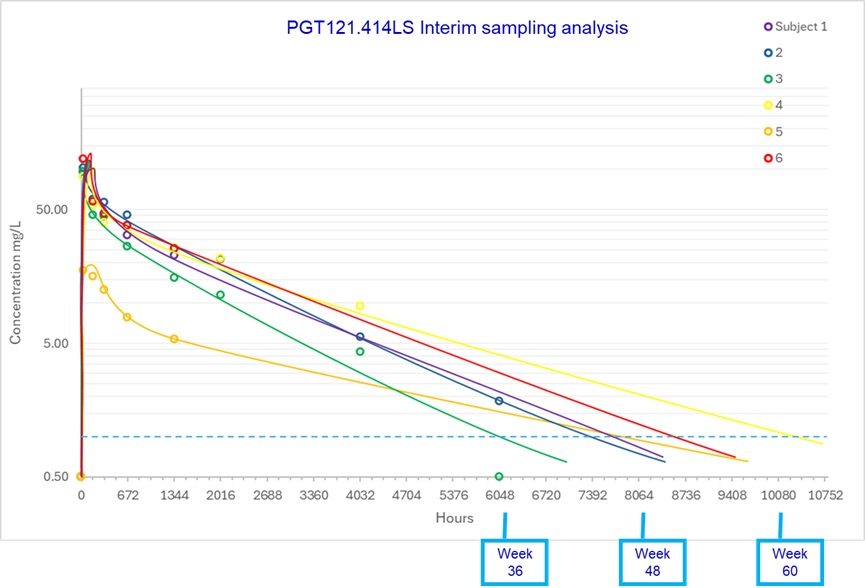
VRC07-523-LS and PGT121.414.LS serum concentrations were adequately described by a two-compartment model with first order absorption. Estimated clearance of PGT121.414.LS was 71.4 mL/day with a half-life of 81.4 days, while VRC07-523-LS was 99.3 mL/day with a half-life of 47.9 days and was increased up to 6.46-fold higher with viremia. Clinical trial simulations revealed VRC07-523LS at 10 mg/kg and PGT121.414.LS at 5mg/kg resulted in 90% of predicted concentrations to reach 1 mg/L by week 48. Interim PK analysis of the initial cohort confirmed that 83% (5/6) would reach 1 mg/L by week 48, whereas 27% (1/6) would remain above this level until week 61 due to slower clearance of PGT121.414.LS. Based on these findings, we adjusted the initiation of ATI from the originally planned week 48 to week 60.
Conclusions
A dynamic PK approach was utilized for dosage optimization and determination of timing of ATI initiation for a bNAb combination by using clinical trial simulation with adjustments from real-world initial PK data. This approach provided insight into the dosing of new therapeutics with long half-lives and the design of clinical trials that evaluate them.
Table or Figure