Background
ACTG A5359/LATITUDE demonstrated long-acting CAB/RPV was superior to oral ART in PWH with prior adherence challenges. Evaluating relationships between virologic suppression (VS) and objective adherence measures (i.e. tenofovir-diphosphate [TFV-DP] concentrations in dried blood spots [DBS]) in this vulnerable population is essential to understanding the findings among those on oral ART. Additionally, newer INSTIs may have improved adherence-forgiveness than older INSTIs and PIs and boosted TAF can increase TFV-DP in DBS, necessitating evaluations by regimen. Here, we examined associations between TFV-DP in DBS, other clinical/demographic factors and VS among PWH on TAF-based ART.
Methods
DBS samples in LATITUDE were collected throughout Step 1 (induction with oral ART; weeks 0, 8, 12, and up to 24) and Step 2 (randomized to oral ART for 52 weeks; weeks 0, 8, 24, 36, and 48). TFV-DP in DBS was quantified via LC-MS/MS in participants on TAF-based ART. Generalized estimating equations with a logit link were used to estimate the adjusted odds ratio (aOR) of VS (<200 c/mL) by five TFV-DP adherence categories, regimen (unboosted TAF 25mg, boosted TAF [b/TAF] 10mg, b/TAF 25mg), sex, age, weight, race, eGFR, and CD4 category.
Results
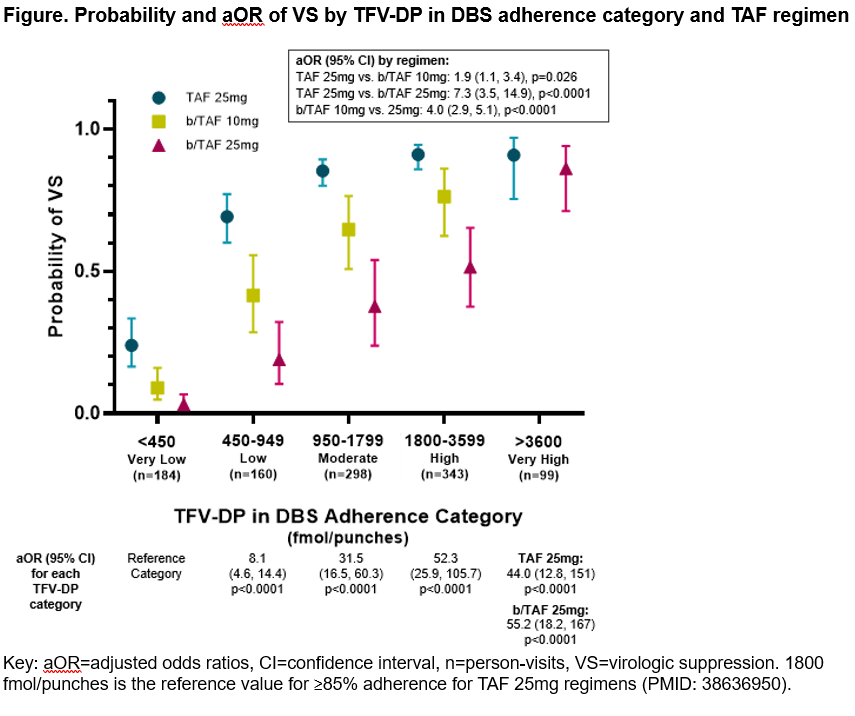
A total of 1084 DBS results in 292 participants were analyzed (70% male; 60% Black, 19% white, 21% Hispanic/Latino; median [IQR] age 40 [32, 52] years; weight 74.8 [65.4, 87.1] kg). 73% of participants were on TAF 25mg (806 visits with BIC [52%] or DTG [48%]), and 27% were on either b/TAF 10mg (131 visits with DRV [79%] or EVG [21%]) or b/TAF 25mg (148 visits with DRV [59%] ± BIC or DTG [39%]). The odds of VS were significantly higher for all TFV-DP categories ≥450 vs. <450 and increased by category (Figure). For TFV-DP <3600, TAF 25mg had higher odds of VS than both b/TAF 10mg and 25mg, and b/TAF 10mg had higher odds of VS than b/TAF 25mg. However, for TFV-DP ≥3600, there was no significant difference between unboosted and b/TAF 25mg (no data for b/TAF 10mg). Higher CD4 count and weight were the only other factors significantly associated with higher VS odds (p<0.05 for both).
Conclusions
TFV-DP in DBS was associated with higher VS odds by adherence category. The odds of VS were higher in those on TAF 25mg regimens versus b/TAF 10mg and b/TAF 25mg, when comparing within TFV-DP adherence categories <3600 fmol/punches. These data support differences in adherence-forgiveness patterns between TAF regimens, which may be driven in part by INSTI vs. PI use.
Table or Figure