Background
Long-acting cabotegravir (CAB-LA) is highly effective for HIV prevention. In Phase 2 trials, males had higher CAB pharmacokinetic (PK) trough concentrations than females after the first injection and lower troughs than females after subsequent injections. In the HIV treatment setting, in a large European cohort of LA CAB/rilpivirine after oral lead-in, CAB troughs were also lower in men than women. Sex differences in CAB PK could impact protective efficacy, yet data are limited on CAB PK in PrEP implementation settings. We report the first analysis of sex differences in CAB PK using a direct-to-inject strategy in Kenya and Uganda.
Methods
In the SEARCH Dynamic Choice HIV Prevention study (NCT05549726), CAB-LA 600 mg IM was given at weeks (wk) 0, 4, 8, then every 8 wk. 274 participants received CAB-LA. We measured CAB trough concentrations by LC-MS/MS in plasma collected at wk 4, 8, 16, 24, 48 among randomly sampled participants. Among participants with injections <28 days after target dates, CAB levels were compared by sex, and analyzed in relation to published PK targets of protein-adjusted concentrations required for 90% inhibition of virus (PAIC90).
Results
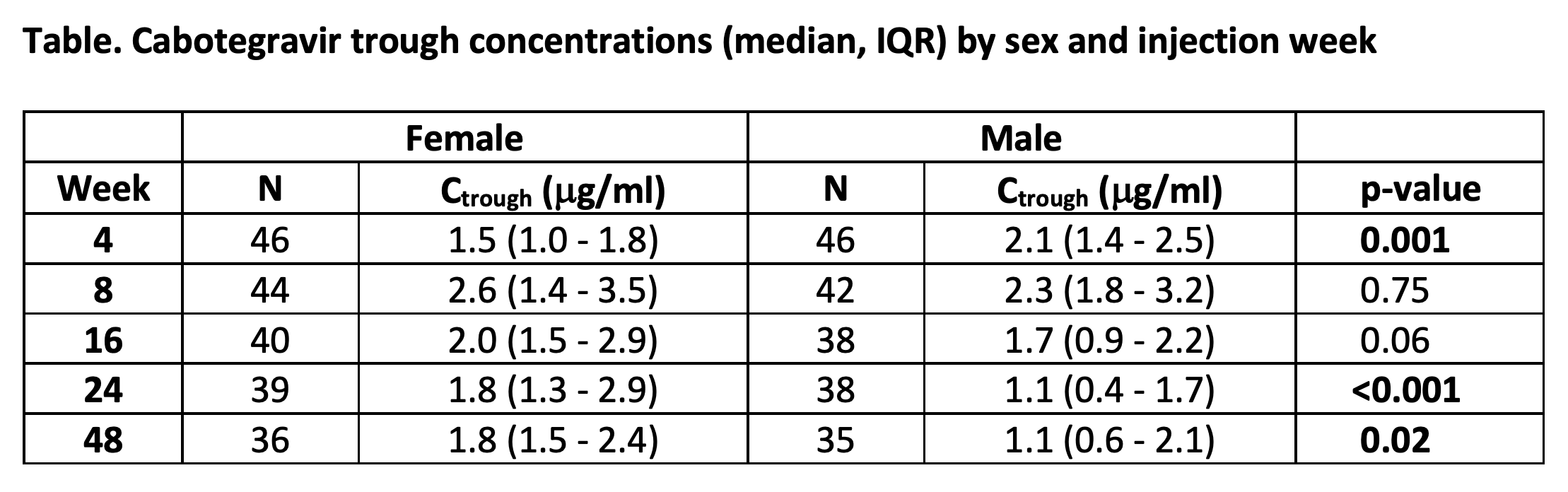
Among 49 women included in this analysis: median age 33 years (IQR 28-39), BMI 24.1 kg/m2 (20.7-26.8), weight 61 kg (56-68). Among 48 men: median age 33 (24-41), BMI 23.6 kg/m2 (21.0-26.0), weight 65 kg (57-72). 97.5% (women) and 96.4% (men) of injections were given within 14 days of target date. At wk 4, median CAB trough concentrations were higher among men vs. women (men: 2.1 [1.4-2.5]; women: 1.5 mg/ml [IQR 1.0-1.8)], p=0.001). In contrast, at subsequent injections, median CAB troughs were lower among men vs. women at wk 24 (1.1 [0.4-1.7] vs. 1.8 [1.3-2.9], p<0.001) and 48 (1.1 [0.6-2.1] vs. 1.8 [1.5-2.4], p=0.02). At least 80% of participants had CAB levels >4x PAIC90 at wk 4, 8, 16. At wk 24 and 48, CAB levels were >4x PAIC90 among 92% of women and ≥68% of men and >8x PAIC90 among ≥74% of women and ≥45% of men.
Conclusions
In the first PK study of CAB-LA PrEP in East Africa, CAB trough concentrations were higher among men than women after the first injection and lower among men than women after subsequent injections. At weeks 24 and 48, fewer men than women had CAB troughs above published PK targets. Despite these findings, no HIV infections occurred in the trial, including among men. These results highlight the importance of examining sex differences in PK and real-world PK forgiveness of current and forthcoming LA-PrEP.
Table or Figure