Background
In people with HIV (PWH), gut dysbiosis impair epithelial barrier function and promote microbial translocation, sustaining systemic immune activation implicated in peripheral nerve injury. The interplay between dysbiosis and cytokine profiles in HIV-associated distal sensory polyneuropathy (DSP) is underexplored. We tested whether microbiome–cytokine signatures are associated with DSP in PWH.
Methods
We studied 163 virally suppressed PWH (mean age 51.1 ± 11.9) and 75 people without HIV (PWoH). Gut microbiota was profiled via 16S rRNA and 22 serum cytokines were profiled. DSP was defined by ≥2 clinical signs: bilateral distal vibratory, sharp, or touch loss in the legs/feet, or reduced ankle reflexes. Differential abundance used BIRDMAn, a Bayesian hierarchical framework with shrinkage; taxa were classified as enriched/depleted when 95% highest-density intervals excluded zero. Canonical correlation analysis (CCA; scikit-learn) identified maximally correlated linear combinations of microbial and cytokine features (joint signatures). Random forests assessed DSP discrimination within PWH.
Results
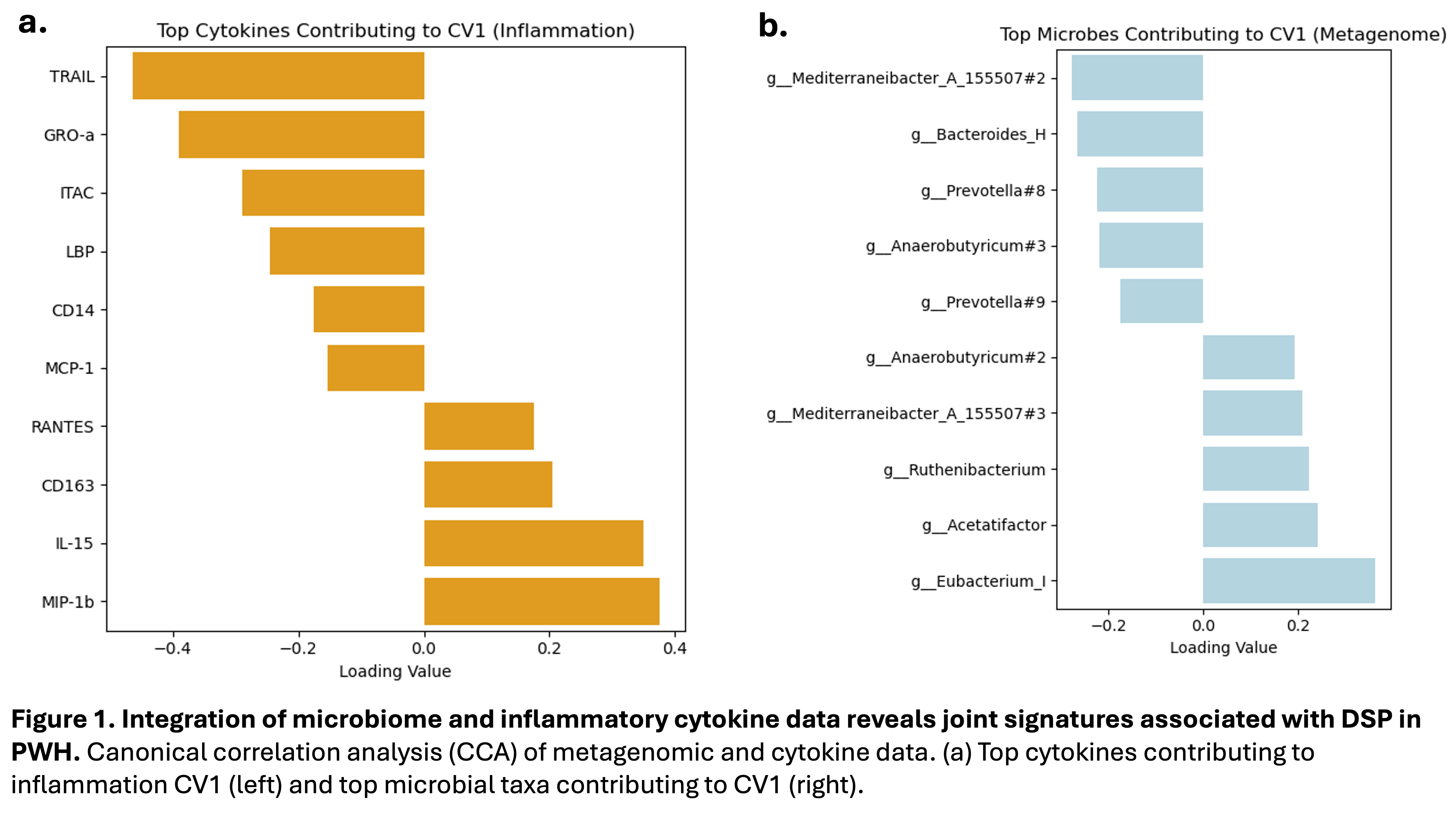
DSP prevalence was higher in PWH than PWoH (p = 0.007). Within PWH, those with DSP showed inflammatory shifts versus those without DSP. BIRDMAn revealed depletion of butyrate-producing commensals (Faecalibacterium, Bifidobacterium) and enrichment of Clostridium and Enterocloster in PWH with DSP. CCA identified joint microbial–cytokine signatures distinguishing PWH with versus without DSP; leading contributors included CCL4, IL-15, and TRAIL on the cytokine axis, and Eubacterium on the microbial axis (figure-1). Random-forest models combining clinical, microbial, and cytokine domains achieved moderate discrimination (AUC ≈ 0.74); age was the strongest predictor, followed by ARV exposure duration and enrichment of g_Enterocloster. Mediation analysis indicated a modest but significant indirect pathway whereby age-related microbiome variation partially mediated DSP risk (16.8%).
Conclusions
PWH with DSP exhibit coordinated enrichment of pathobiont taxa and depletion of SCFA-producing commensals, a pattern consistent with barrier dysfunction, monocyte activation (CD14–LBP–TLR4 axis), and reduced SCFA-linked neuroprotection. This dysbiosis pattern parallels signals reported in neuroimmune disorders such as multiple sclerosis. While causal inference cannot be drawn from cross-sectional data, longitudinal studies are warranted to confirm these associations and evaluate microbiome-targeted interventions.
Table or Figure