Background
Antiretroviral (ARV) efficacy in the central nervous system (CNS) is hindered by poor penetration across the blood–brain barrier (BBB). Current in vitro BBB models are limited by non-human or immortalized cells, few relevant cell types, and static conditions that restrict pharmacokinetic/pharmacodynamic (PK/PD) sampling. We developed a microfluidic BBB model with primary human brain cells and physiologic flow, offering a more clinically relevant platform for preclinical drug development and CNS pharmacology in HIV.
Methods
A master mold was generated using an in-house 3D printer and fabricated with PDMS to construct a functional microfluidic BBB chip. The system was seeded with primary human BBB component cells: including brain microvascular endothelial cells (hBMECs), astrocytes, pericytes, and neurons, and integrated with a pressure-controlled recirculating circuit connected to inlet and outlet ports to better replicate the anatomical and physiological properties of the human BBB. The device was optimized for repeated sampling under a constant-flow regimen of dolutegravir (DTG), emtricitabine (FTC), and tenofovir disoproxil fumarate (TDF), each maintained at clinically relevant maximum plasma concentrations. Media from the outlet tubing was collected at multiple time points over 48 hours, and drug concentrations were quantified using our established liquid chromatography with tandem mass spectrometry methods.
Results
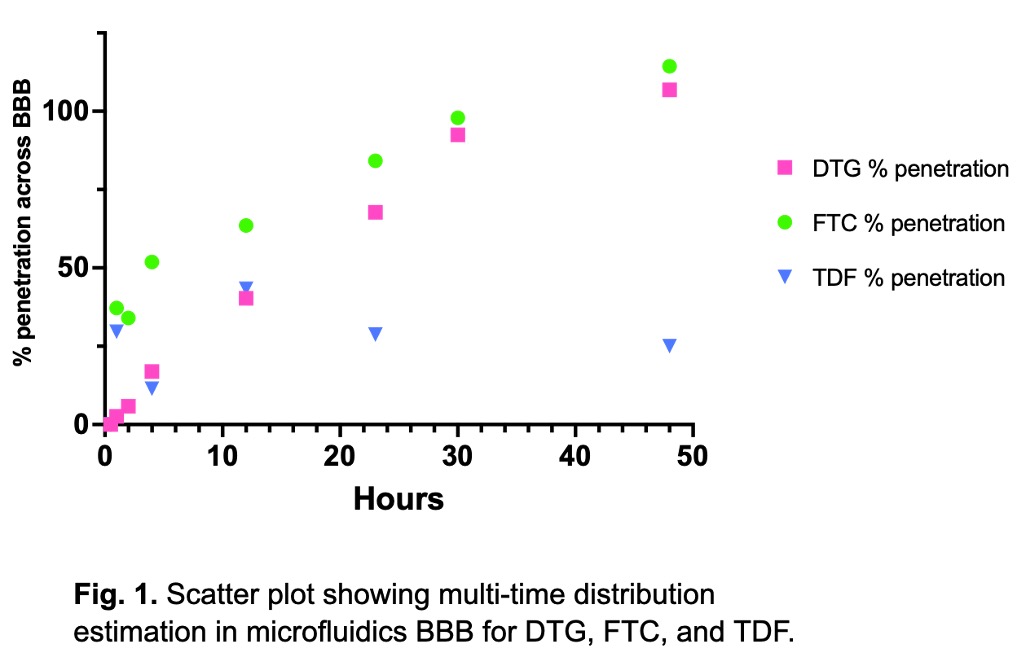
As shown in Figure 1, all three ARVs exhibited distinct distribution profiles across the BBB. DTG and FTC demonstrated sustained distribution, which peaked after ~30 hours. In contrast, TDF displayed consistently lower distribution compared to DTG and FTC, with only modest increases over time and no clear peak in distribution.
Conclusions
Clinical assessment of ARV CNS distribution is limited by reliance on lumbar punctures, typically restricted to single time-point CSF collections that do not capture the dynamic processes of BBB transport. Our microfluidic human BBB “organ-on-a-chip” model overcomes these barriers by enabling repeated PK/PD sampling under physiologic flow conditions, providing a more accurate and mechanistic understanding of ARV distribution across the BBB. By bridging the gap between preclinical models and human physiology, this platform offers a clinically translatable tool for optimizing CNS-targeted ARV regimens, which could be used to guide therapeutic strategies to reduce HIV persistence and neurologic complications in the CNS.
Table or Figure