Background
In nonsuppressible HIV viremia (NSV), individuals have persistently detectable viral load despite adherence to ≥2 fully active ART. NSV represents an area of clinical uncertainty and an opportunity to understand the mechanisms of HIV persistence. We performed in-depth virologic characterization to identify distinct NSV phenotypes.
Methods
We enrolled 15 NSV participants with high-level ART adherence, as determined by drug level testing across multiple time points and receiving ≥2 active antiretroviral drugs. The IPDA was used to quantify the frequency of intact HIV proviruses. PBMC DNA were used for near-full length single genome sequencing of the provirus and plasma RNA was used for single-genome pol-env extended-length viral sequencing. The sequences were analyzed for viral diversity by average pair-wise distance and viral evolution by root-to-tip distance.
Results
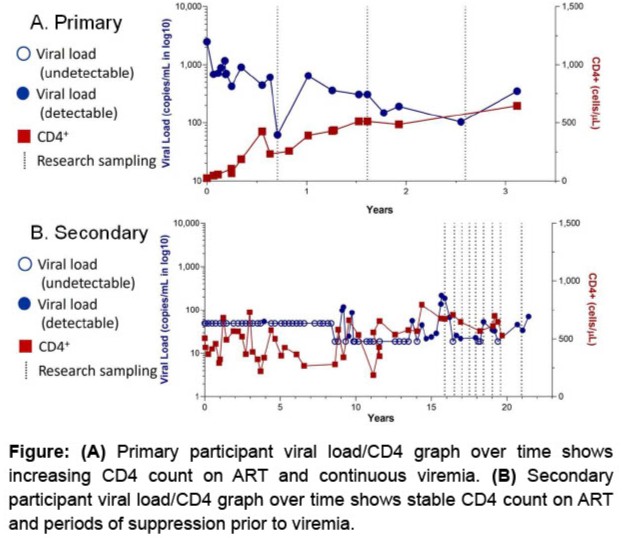
The NSV participants had a median CD4 count of 598 cells/mm3 and viral load of 113 [IQR, 71‒516] copies/mL. We obtained a total of 2,964 single-genome provirus and plasma sequences. We categorized participants into those who had persistent viremia after ART initiation (primary NSV, Figure) and those who had NSV after a period of virologic suppression (secondary NSV). Despite the prolonged viremia, there was no significant evidence of active viral replication in either the primary or secondary NSV groups. Primary NSV participants had >10-fold higher levels of intact proviral DNA (median 4497 vs 153 copies/106 CD4+ cells, P<0.01). While the plasma of secondary NSV participants were dominated by a few large HIV clones, primary NSV participants had far more diverse plasma quasispecies with few clones (median percentage of plasma HIV RNA sequences within clones for primary vs secondary NSV: 14% vs 64%, P<0.01). However, we detected no significant increase in root-to-tip distance in the phylogenetic tree during primary and secondary NSV, suggesting no significant viral evolution despite prolonged viremia. Primary NSV participants were also found to harbor distinct deletions within vif-vpr and other accessory HIV genes.
Conclusions
Nonsuppressible viremia is comprised of two distinct subsets of individuals, including a novel group with primary NSV characterized by prolonged viremia after ART initiation, an exceptionally large intact reservoir, and a diverse group of plasma viruses without evidence of ongoing evolution. These findings have implications for understanding of HIV reservoir clearance and persistence on ART.
Table or Figure