Background
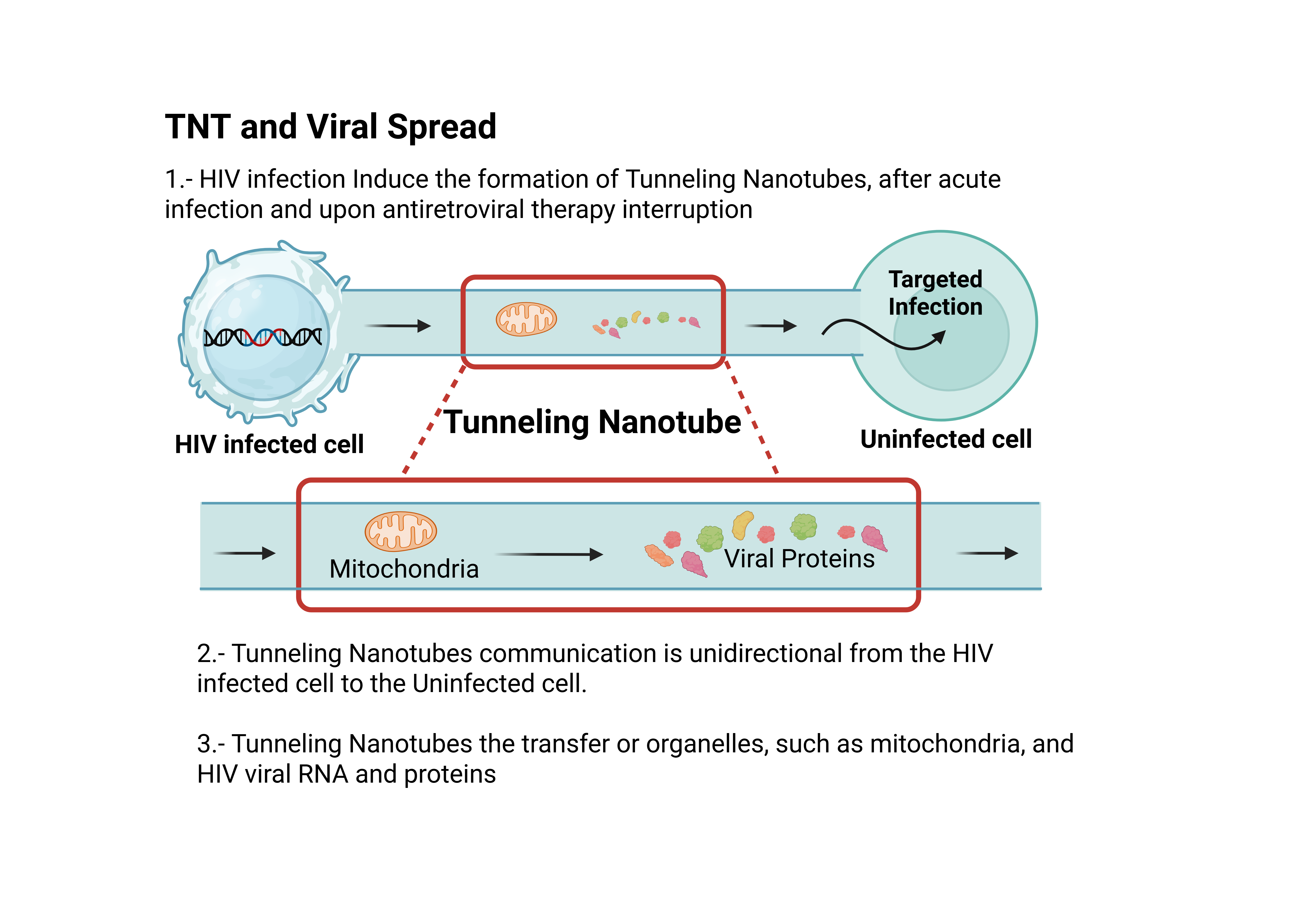
HIV infection is initiated through the interaction of the viral envelope protein with host cell receptors CD4 and CCR5/CXCR4, facilitating viral entry. However, the mechanisms underlying viral spread after entry particularly when soluble virus is undetectable or minimal remains poorly understood. We propose that tunneling nanotubes (TNTs), a long-range intercellular processes, mediate early viral dissemination . TNTs are induced following CD4 and CCR5 /CXCR4-mediated entry and enable the direct transport of viral components from infected to uninfected cells. Here, we characterize this mechanism of viral amplification.
Methods
To investigate TNT dynamics acute HIV infection (HIVADA,JR-CSF, or BaL; MOI, 0.01) of primary human CD4+ T lymphocytes, macrophages, and PBMCs were perform. Also, PBMCs from people living with HIV (PLWH) under successful ART and reactivated were examined. TNT formation was assessed by live-cell imaging every 30 sec or 1 min for up to 28 days post-infection, in the presence or absence of ART (100 nM efavirenz, 180 nM zidovudine, and 200 nM raltegravir). Parallel cultures were fixed and stained for nuclei, HIV-p24, F-actin, and the TNT marker TTHY1 to quantify TNT formation and viral protein localization at multiple time points (3, 6, 9, 12, 14, 21, and 28 dpi). To assess TNT-mediated transfer of viral components, we employed a co-culture model using U87CD4CCR5 cells (susceptible to extracellular HIV) and U87MG cells (lacking CD4/CCR5, resistant to extracellular infection but capable of replication after intracellular transfer). Laser capture microdissection, RNA-seq, proteomics, and immunofluorescence were used.
Results
Our results show that TNT formation is unidirectional, originating from the HIV-infected cell and targeting uninfected cells, enabling the transfer of viral proteins such as Gag, HIV-p24, and integrase, as well as viral RNA. TNT-formation amplifies infection by facilitating the spread of viral RNA and proteins. Also, TNTs help infected cells to evade immune recognition (via gp120 neutralizing antibody binding and Fas expression) and apoptosis.
Conclusions
In conclusion, HIV-induced TNTs play a critical role in viral amplification and immune evasion by transferring infectious viral components rather than complete virions. Targeting TNT formation or function may represent a promising therapeutic approach to prevent viral amplification or spread, contributing to HIV cure strategies.
Table or Figure