Background
Although ART has improved survival rates and quality of life for people living with HIV-1 (PLWH), these drugs require lifelong adherence and are not a cure. Reservoirs of HIV persist in B cell follicles of lymphatic tissues even during ART treatment. This reservoir is driven by a paucity of HIV-specific cytotoxic cells in these locations, as they largely do not express the follicular homing receptor CXCR5. Our group pioneered the development of HIV-specific CAR/CXCR5 T cell therapies, which kill HIV-Env-expressing cells and migrate to B cell follicles. CAR T cell therapies are typically autologous, as treatment with allogeneic T cells can cause graft-versus-host disease. However, developing autologous CAR T cells from immunocompromised PLWH poses an engineering challenge. We are now exploring CAR/CXCR5 NK cells as an alternative to T-cell therapy, as they can be used as allogeneic treatments and play a role in endogenous immunosurveillance of HIV.
Methods
Here, we engineered HIV-specific CAR/CXCR5 NK cells armored with IL-15 and PD-1 KO. We assessed the efficacy and safety of these therapies by treating HIV-infected humanized DRAGA mice 3 days post ART interruption with CAR or control NK cells, or PBS. HIV viral loads, CD4+ cell counts, NK cell levels, and adverse symptoms were monitored for 56 days post-treatment.
Results
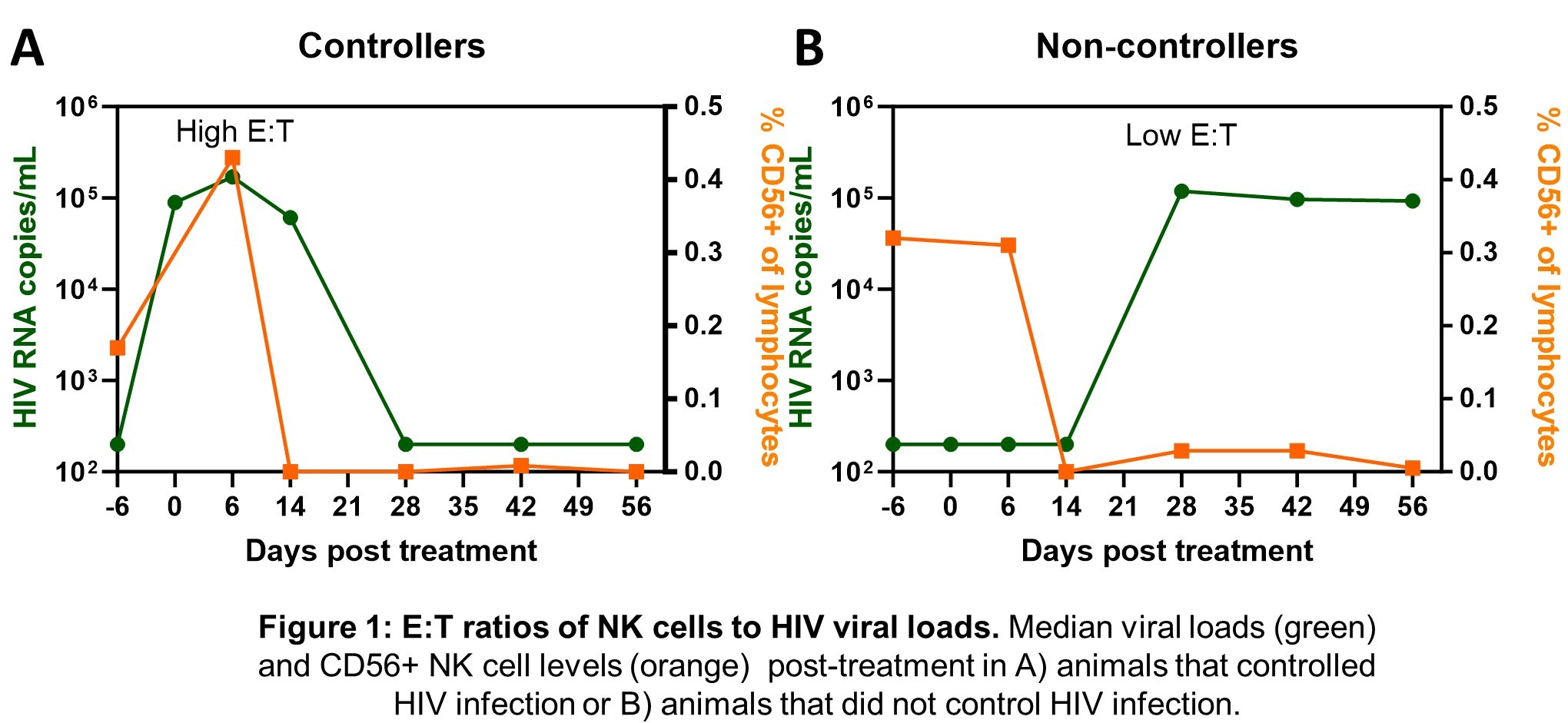
Subsets of CAR NK-treated (5/8) and control NK-treated (2/4) but no PBS-treated animals (0/6) controlled HIV infection below the limit of detection at 56 days post-treatment, with a statistically significant difference in the number of animals that controlled HIV between the combined NK treatment groups and PBS group (P=0.0377). We also observed a difference in the time to viral rebound between animals that controlled and did not control infection (P=0.0278). In controllers, median viral rebound occurred at the time therapeutic cells were infused, resulting in relatively high in vivo E:T ratios at viral peak (Fig. 1a). Conversely, in non-controllers, viral rebound occurred after the infused NK cells declined to very low levels, resulting in relatively low E:T at viral peak (Fig. 1b).
Conclusions
These findings indicate that NK dosing at the time of viral rebound was important for treatment efficacy. Additional doses of NK cells could further improve efficacy by improving the odds of treating at the time of viral rebound in all animals, including those with delayed viral rebounds. This work supports further study of NK therapies for long-term suppression of HIV.
Table or Figure