Background
The fraction of infected cells within CD4+ T-cell clones that have intracellular HIV RNA is not well characterized across clones or across people with HIV (PWH). Understanding these fractions and levels of HIV RNA may reveal features that influence proviral latency and reactivation during ART. Here, we measured single-cell HIV RNA levels across 139 infected T-cell clones in 16 PWH on ART.
Methods
PBMC were collected from 16 PWH enrolled in either the SCOPE, ACTG A5341, or the U. Pittsburgh cohorts. Participants were on ART with undetectable levels of viremia (<50 copies/mL) for an average of 9.3 years. We used cell-associated RNA and DNA single-genome sequencing to estimate the fractional proviral expression and the levels of HIV unspliced RNA (usRNA) in each of 139 different infected T-cell clones that persisted on ART (N=13,800 single infected cells; median 377 infected cells per donors).
Results
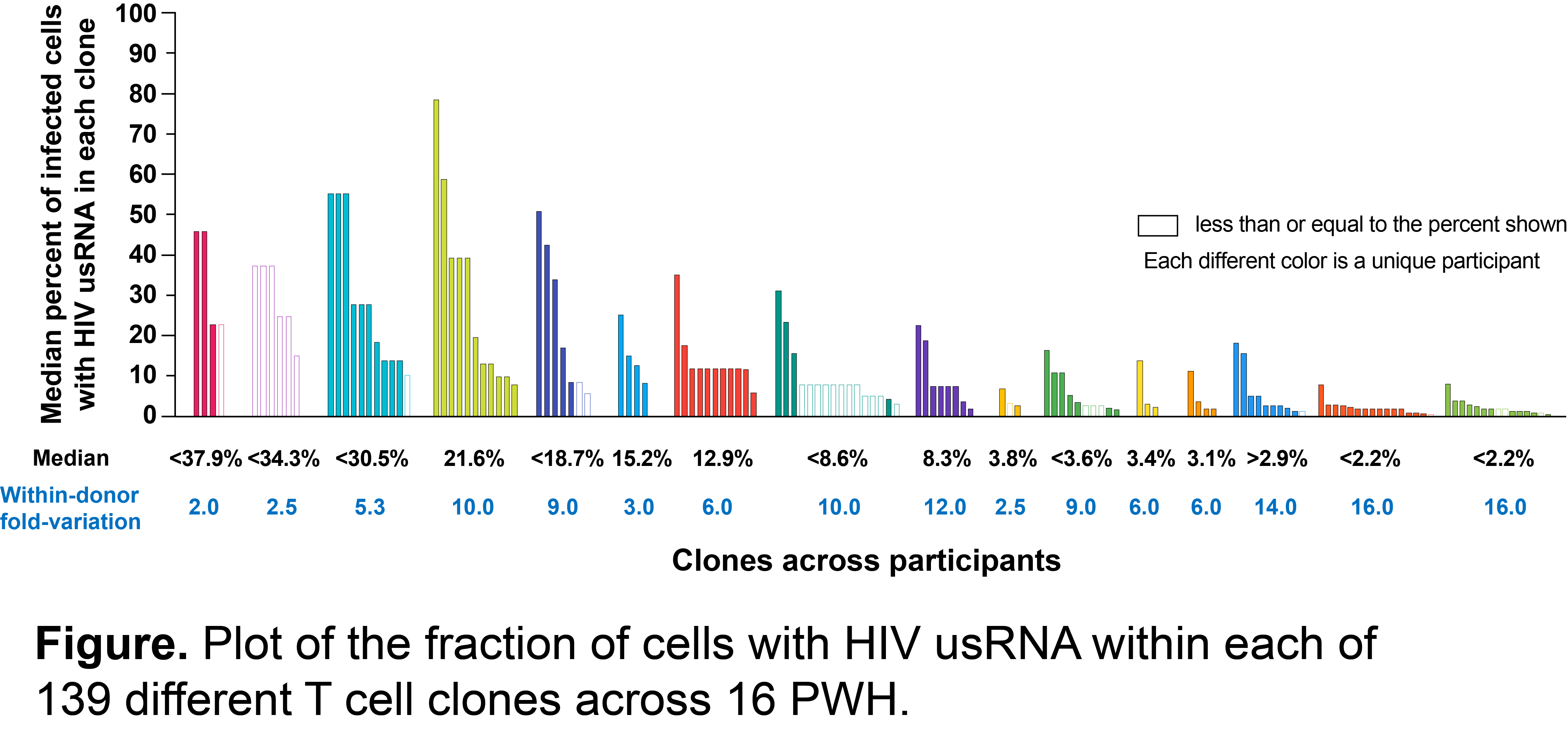
Across the different T-cell clones, the median fraction of infected cells with HIV usRNA was 8.5% (range 0.5–86.5%) (Figure). Most cells with HIV usRNA contained only a single detectable copy (70.5%), with rare cells having >10 copies (1.3%). Neither the fraction of HIV usRNA-containing cells within clones nor the HIV usRNA copy number per cell correlated with ART regimen, time on ART, CD4 count, or total HIV DNA copies, but did correlate with clone size—as the relative clone size increased, the fractional proviral expression decreased (r= -0.27, p= 0.001). We found a larger variation in the fraction of infected cells with HIV usRNA in clones across donors (average of 17.6-fold difference across donors) than across clones within the same donor (average of 6.5-fold difference). To illustrate, in one donor, 11 T-cell clones had a median of 12.9% of cells with HIV usRNA (range 6.5–38.6%), whereas in another donor, 16 clones had a median of 2.2% (range 0.5–8.6%).
Conclusions
By investigating the fraction of infected cells within CD4+ T-cell clones that have transcriptionally-active proviruses, we were able to show that there was greater variation across donor samples than across different clones within the donors, highlighting the importance of host-specific influences on proviral latency and expression rather than proviral integration site and/or sequence heterogeneity. We also show that the fractional proviral expression is inversely proportional to T-cell clone size, indicating that expression may result in host recognition and subsequent cellular clearance for the majority of clones.
Table or Figure