Background
Antiretroviral therapy (ART) has significantly improved the lives of people living with HIV. However, a cure remains elusive due to the formation of a pool of latently infected cells, known as the latent reservoir. While most of the reservoir is defective, a small fraction is replication-competent and can give rise to viral rebound upon ART interruption. We measured the intact and defective proviral DNA reservoir for a longitudinal cohort of South African women followed from pre-infection up to five years post-ART, using the Cross-Subtype Intact proviral DNA Assay (CS-IPDA).
Methods
Peripheral blood mononuclear cells from up to two time-points from 150 CAPRISA 002 cohort women with sustained viral suppression of at least 1.5 years were used. CS-IPDA was performed using minimally sheared genomic DNA extracted from cells. Restriction enzyme-digested DNA was quantified using droplet digital PCR (BioRad QX200), with reaction mixes for HIV targets (LTR-gag, pol and env) and cellular reference genes (RPP30 and deltaD). Quantification of intact and defective proviruses was performed (QX manager and R). Spearman’s rank correlation analysis was conducted to compare intact proviral copies with cumulative viral load (AUC), nadir CD4 T-cell count and time on ART.
Results
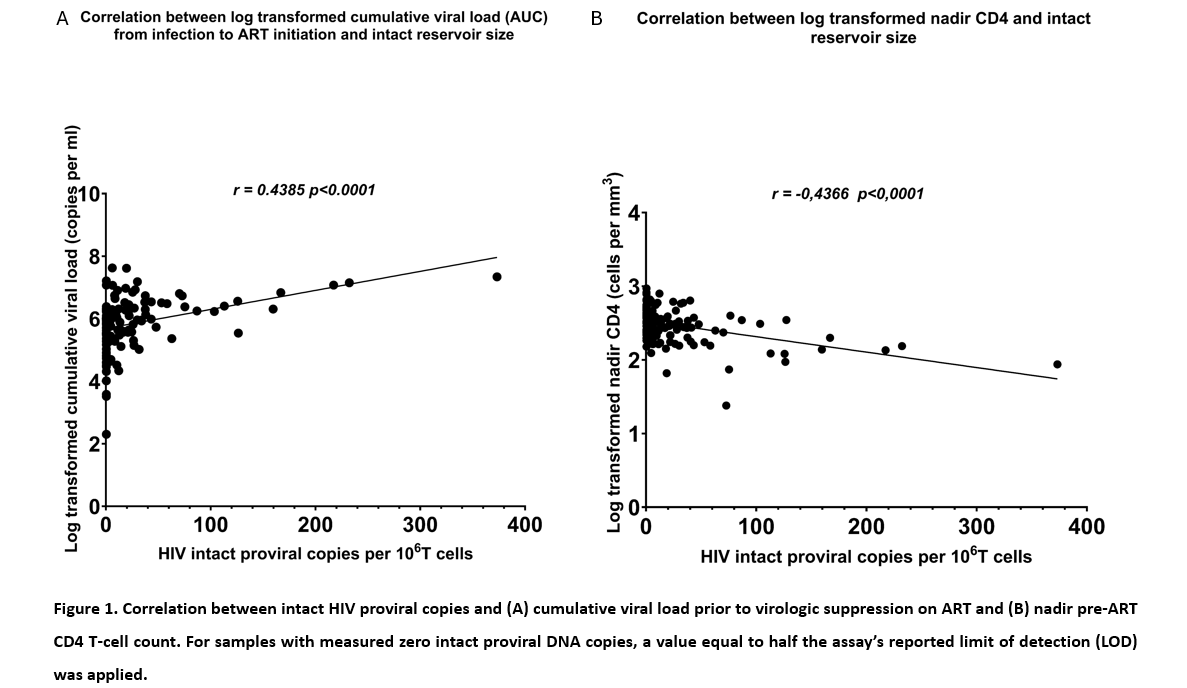
Among 203 samples analyzed, the median proportion of intact proviruses relative to total HIV copies/106 T cells was 0.99% (IQR: 0.00–4.05%). Intact reservoir measurements were below the limit of detection in 38% of samples, with gag most frequently undetected. A positive correlation was observed between log-transformed cumulative viral load from infection to ART initiation and intact proviral DNA copies/10⁶ T cells (n=120, r = 0.4385, p < 0.0001) (Figure 1A). Conversely, a negative correlation was found between nadir CD4 T-cell count and intact proviral DNA copies (n=131, r = -0.4366, p < 0.0001) (Figure 1B). There was no correlation between time from ART initiation to sample collection (in months) and intact proviral DNA copies (n=123, r = -0.1066, p = 0.2405).
Conclusions
To our knowledge, this is the largest reservoir sizing study conducted in a population of African women. These results highlight that, in women living with subtype C HIV, greater viral burden and CD4 decline before ART is associated with a larger intact reservoir size. Our results validate earlier research showing that pre-ART viral dynamics and immune depletion are key determinants of long-term reservoir size and persistence.
Table or Figure