Background
The HIV reservoir persists in CD4+ T cell clones. We hypothesize the clonality of HIV-infected cells resembles that of the underlying population of memory (m)CD4+ T cells. We also sought to understand how provirus or integration site sample sizes affect our ability to compare the clonality of HIV-infected cells to mCD4s.
Methods
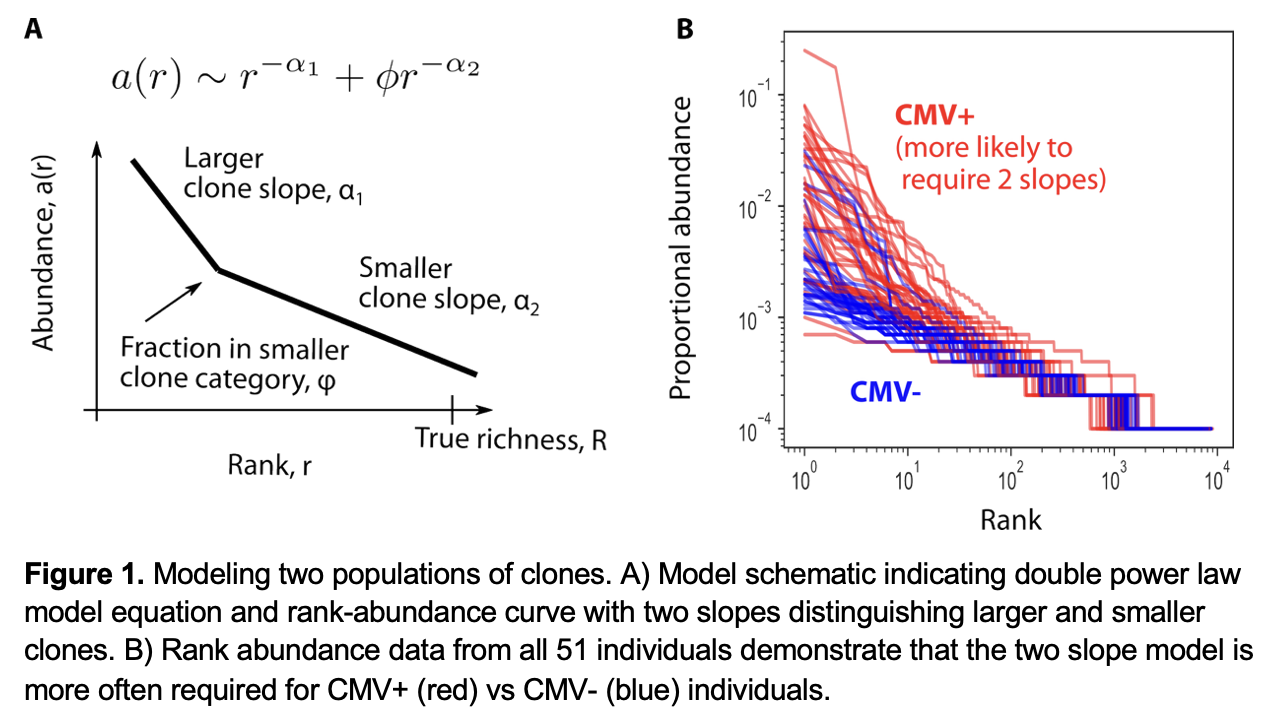
Near-full length provirus sequences (N=5 individuals x 2 time points, avg 57 sequences/time point) or env sequences from replication-competent proviruses (N=7 x 1 time point, avg 74 sequences/time point) were obtained from PWH on suppressive ART. mCD4 TCRβ repertoires (Adaptive Biotech) were obtained from the same PWH samples and from 38 HIV-negative people (N=48, some from MWCCS). We developed power-law models of CD4+ T cell clonal rank abundance distributions using 1 or 2 (Fig. 1A) power law slopes, and we validated a computational fitting approach. We then applied this approach to determine whether a 1- or 2-slope power law model of clonality was more accurate for each HIV provirus or mCD4 clone rank-abundance distribution.
Results
mCD4 clonality was not significantly different between PWH or HIV-seronegative groups. The mCD4s of CMV-positive individuals fit a 2-slope model significantly better than a 1-slope model (Fig. 1B). The median rank differentiating the larger and smaller clone slopes in the 2-slope model was 9, meaning that the top ~9 most highly-expanded (‘larger’) mCD4 clones had a significantly more clonal distribution than the rest of the (‘smaller’) mCD4 clones. The clonality of the larger mCD4 clones was similar to that of HIV-infected cells from the same samples and higher than previously reported from bulk mCD4 clonality. Using our mathematical models, we estimated the sample size of HIV proviruses or integration sites that would be required to observe an underlying HIV-infected clone distribution that fit a 2-slope model, and we found that at sample sizes of 1000 proviruses, this would be identified correctly 50% of the time.
Conclusions
Studies sampling <1000 HIV proviruses or integration sites per time point are unlikely to distinguish between larger and smaller infected clones. Undersampled reservoir studies preferentially identify the largest clones. Thus, these studies may have biased the field towards inferring that the majority of HIV reservoir persistence is predominantly due to antigen-driven proliferation (if this underlies larger clone persistence) vs homeostatic proliferation of (less clonal but more numerous) infected CD4s.
Table or Figure