Background
The persistence of a latent viral reservoir is a major barrier to curing Human Immunodeficiency Virus (HIV) infection. Yet, how this reservoir is established and evolves during acute untreated infection remains poorly understood.
Methods
We developed mathematical models describing the latent reservoir dynamics and fitted them to clinical data from individuals initiating antiretroviral therapy (ART) during acute HIV infection, as well as experimental data from non-human primates.
Results
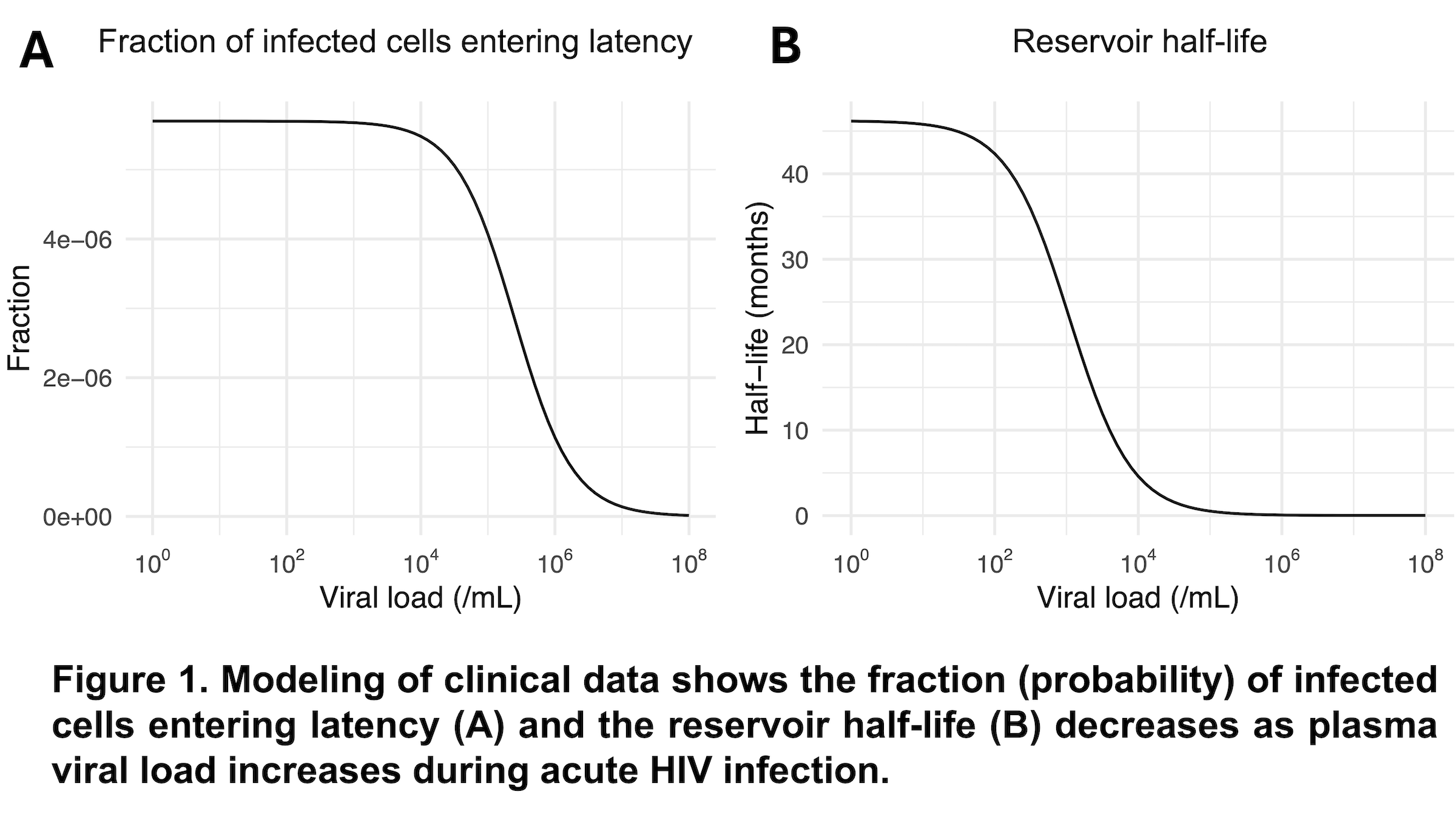
We first show that the size of the reservoir increases sub-linearly with increases in the area under the plasma viral load curve during the acute infection of HIV or Simian Immunodeficiency Virus (SIV), suggesting the reservoir dynamics are more complex than previously thought. Then, we constructed several mathematical models and first evaluated a baseline model where the reservoir dynamics are independent of plasma viral load. We then explored three alternatives in which reservoir seeding, latently infected cell death, or activation rates depend on viral load. Our analyses suggest that a substantial fraction of infected cells enter latency during the earliest stages of infection. As viral load rises, the half-life of the reservoir shortens and/or the probability of entering latency decreases, indicating that the reservoir is highly dynamic during untreated acute infection.
Conclusions
These findings provide valuable quantitative insights into reservoir formation and turnover during acute infection, with direct implications for developing effective HIV cure strategies.
Table or Figure