Background
Compared to people without HIV (PWoH), people with HIV (PWH) have elevated risk of vascular complications that persist despite suppressive antiretroviral therapy (ART). This analysis examines endothelial and hemostasis perturbations during acute HIV infection (AHI) and 6 years after immediate ART initiation.
Methods
The study included 83 RV254 AHI participants who initiated ART during Fiebig stage I-V AHI. We measured endothelial (ICAM-1, ICAM-2, VCAM-1, P- & E-selectin), hemostasis (tissue plasminogen activator (t-PA), tissue factor (TF) & thrombomodulin (TM)), and inflammatory biomarkers (neopterin & myeloperoxidase (MPO)) in plasma collected during pre-ART AHI and week 288 post-ART. Results were compared with cross-sectional data from 32 Thai PWoH. Nonparametric tests were employed to assess group differences, longitudinal changes within RV254 participants, and correlations between biomarkers and HIV-related parameters.
Results
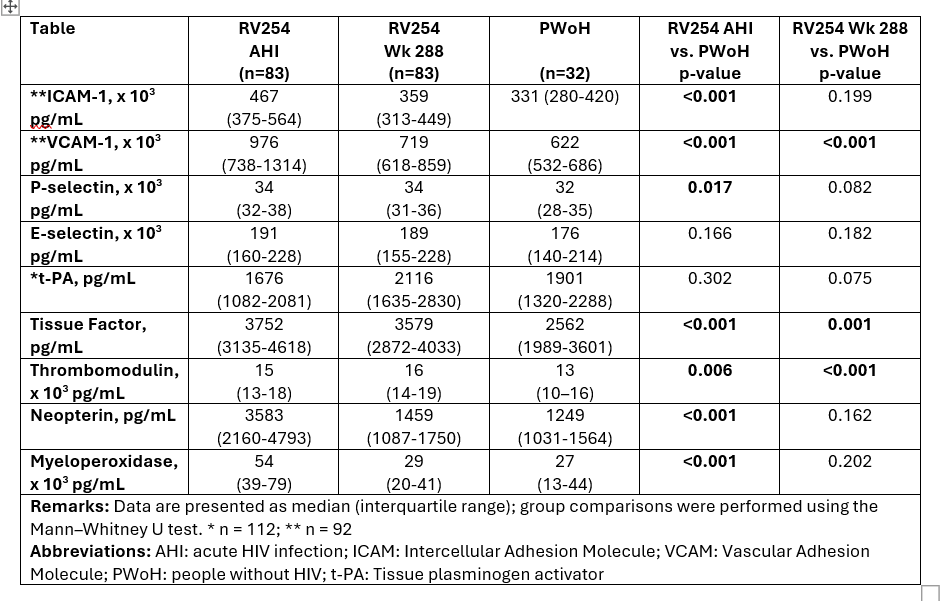
RV254 participants were younger than PWoH controls during pre-ART AHI (median age (IQR) 28 (23-32) vs. 33 (26-39) years, p=0.038) and were nearly all male (98% vs. 75%, p=0.001). During AHI, they exhibited higher levels of ICAM-1, VCAM-1, P-selectin, TF, TM, neopterin and MPO (p<0.05) (Table). Plasma HIV RNA was positively correlated with VCAM-1, neopterin and MPO (p<0.001, correlation coefficient r>0.43), while CD4/CD8 ratio was negatively correlated with ICAM-1, VCAM-1, and TM (p<0.01, r>-0.35).
At week 288, all RV254 participants were virally suppressed (plasma HIV RNA <50cps/ml). They exhibited significant decline in plasma ICAM-1, VCAM-1, neopterin and MPO, as well as significant increase in t-PA post-ART (p<0.001). However, VCAM-1, TF, TBM remained higher in RV254 participants when compared to PWoH (p<0.01) and VCAM-1 continued to negatively correlate with CD4/CD8 ratio (p<0.001, r=-0.37). Adjusting for sex, age and body mass index yielded similar biomarker differences between RV254 and PWoH at AHI and week 288, consistent with prior findings.
Conclusions
Endothelial and hemostasis perturbations emerge and correlate with elevated HIV RNA and T-cell dysregulation during AHI. While immediate introduction and stable use of ART led to improvements in most of these markers, elevation persisted in some endothelial and hemostatsis markers in RV254 participants after 6 years of ART compared to PWoH. The findings warrant further exploration of the relationship between residual endothelial and hemostatic perturbations and vascular complications in PWH on ART.
Table or Figure