Background
People with HIV (PWH), even those who start ART early and restore CD4 counts, remain at higher risk for TB and cancer. HIV induces IDO, an enzyme in the immunomodulatory kynurenine pathway (KP), which leads to increases in kynurenine/tryptophan (K/T) ratios and related metabolites. Whether KP effects underlie the persistent immunosuppression in treated PWH is unclear, as studies to date compare PWH to imperfectly matched individuals without HIV. To address this shortcoming, we used data from the Sabes/MERLIN study. This acute infection cohort provides a rare opportunity to directly compare each participant’s post-infection K/T values to K/T values in the same participant before HIV acquisition.
Methods
2109 MSM and transgender women without HIV in Lima, Peru were followed (2013-2016) with monthly tests for HIV (serology and RNA). 216 participants with incident acute (HIV-seronegative, RNA+) or recent (HIV-seropositive, w/ RNA-negative test in past 3 months) HIV infection were randomized to start ART immediately or defer for 24 weeks (or when Peruvian ART initiation threshold was met). Plasma from 88 participants was analyzed at enrollment, the visit ~1 month before HIV diagnosis (Dx), HIV Dx, and at 6 months, 1 and 4 years after Dx. We measured K/T (nM/µM) ratios by liquid chromatography-tandem mass spectrometry and cytokines by MSD. We used paired t tests and generalized estimating equations for time effects and Pearson’s correlation for relationship of K/T to CD4/CD8, VL, HIV DNA and cytokines.
Results
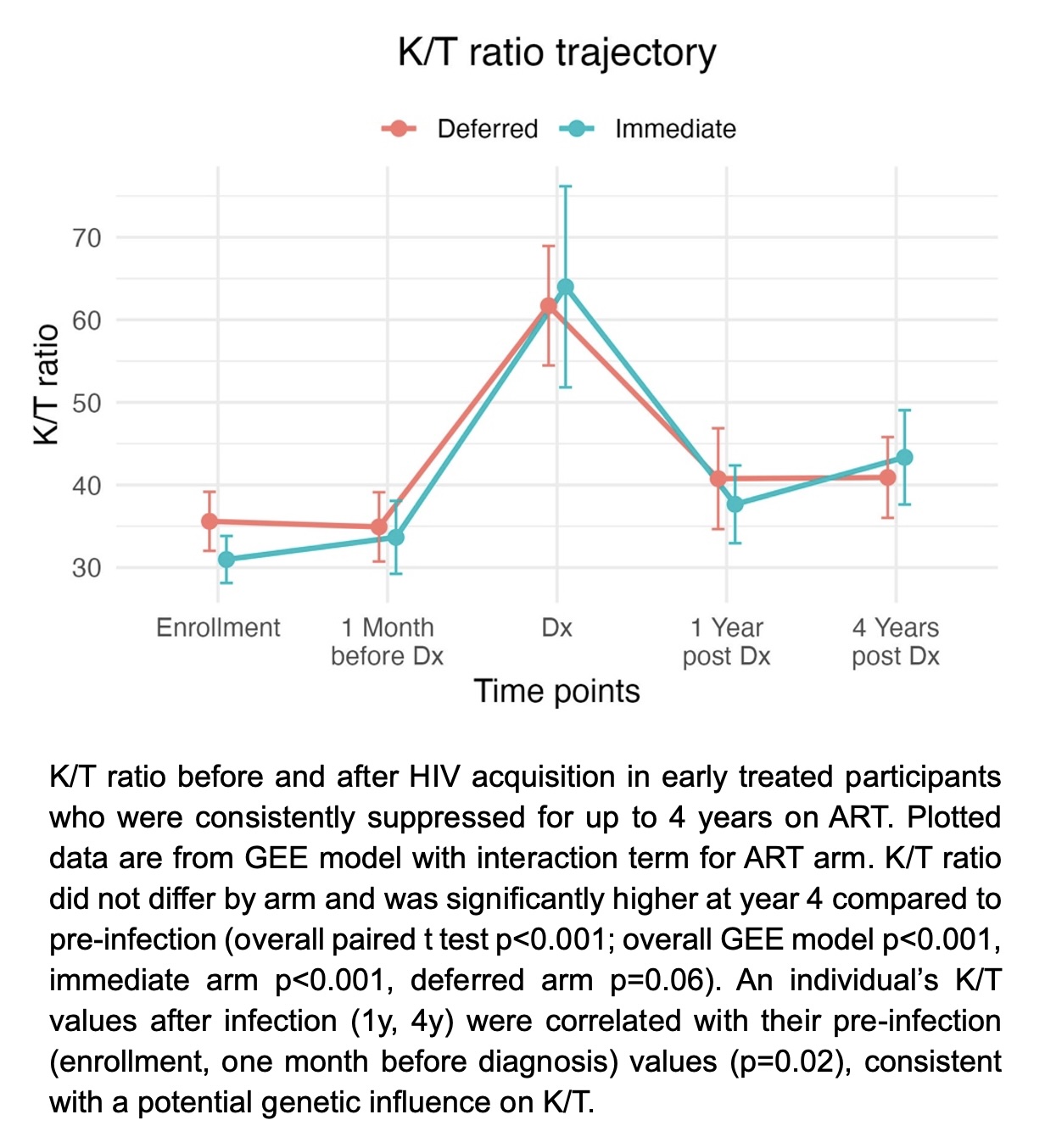
K/T at the two pre-infection timepoints did not differ (p=0.6). Compared to enrollment values, K/T increased significantly (~2-fold) at HIV Dx (p<0.001) and then decreased but remained significantly elevated even at 4 years (p<0.001) (Figure). CD4/CD8 decreased as K/T increased; correlations were significant at HIV Dx (p=0.04) but not at 1 (p=0.09) or 4 years (p=0.6). K/T was correlated with VL at Dx (p=0.02), but not with integrated HIV DNA at 6m or 4y. While K/T and IP-10 were not correlated before HIV Dx, there was a strong positive correlation at Dx (p<0.001) and a trend at 4 years (p=0.08). K/T was not associated with TNFα, MIP-1α, IL-7, IL-12p70, IFNү, or IL-10 at any timepoint (except for TNFα at Dx, p=0.05).
Conclusions
In this exploratory analysis, K/T remains elevated after HIV infection even in virally-suppressed, early-treated individuals and thus may drive persistent immune dysfunction in PWH through other soluble mediators (e.g. IP-10), or effects on Treg and Th17 cells.
Table or Figure