Background
Immunological Non-Responders (INRs) are people living with HIV (PLHIV) who fail to restore normal CD4 T cell counts after initiation of combined antiretroviral therapy (cART). INRs show increased immune activation and exhaustion, possibly driven by the HIV reservoir or co-infections with herpesviruses. Thus, we aimed to identify transcriptional signatures associated with the INR phenotype and to assess their relationship with markers of HIV reservoir size and anti-herpesvirus serology.
Methods
Bulk RNA sequencing was performed on peripheral blood mononuclear cells of virally suppressed PLHIV participating in the 2000HIV study, including 59 INRs (CD4 < 350 c/ml after > 2 years cART) and 982 immunological responders (IRs) (CD4 > 500 c/ml on cART). Differential gene expression analysis was performed using DESeq2, correcting for age, sex, seasonality, inclusion center, plate and the fraction of circulating immune cells. Gene set enrichment analysis (GSEA) was performed using the Reactome database. Pathway scores were calculated by gene set variation analysis (GSVA). HIV-1 DNA in circulating CD4 T cells was measured using the digital PCR based 5-plex Rainbow Assay. Anti-herpesvirus IgG titers were measured by ELISA for cytomegalovirus (CMV), herpes simplex virus (HSV)1 and HSV2 in all participants, and CA-Epstein-Barr Virus (EBV), EBNA-EBV, and Varicella Zoster Virus in a subset of 216 individuals.
Results
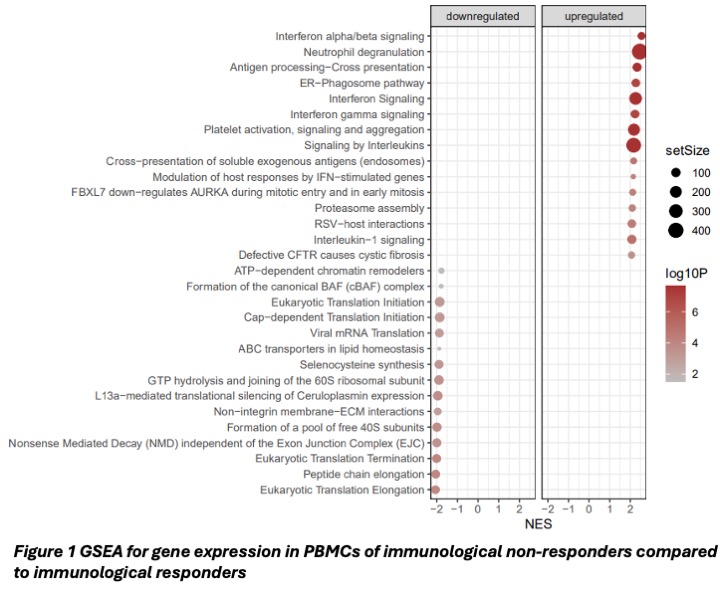
Nine genes were differentially expressed in INRs compared to IRs (Padj <0.05 & log2 fold change > 0.5): IL1R2, GBP1P1, IFIT3, IFI27 and CXCL9 were upregulated, while ADAM23, SOX8, SORC3 and AC005842.1 were downregulated. GSEA showed an upregulation of immune-related pathways, including Interferon signaling in INRs, while transcription and translation pathways were downregulated (Figure 1). In CMV seropositive PLHIV, IFN signaling pathway scores were significantly correlated with anti-CMV IgG (ρ = 0.13, P = 9.1 × 10⁻⁵) and CA-EBV IgG (ρ = 0.34, P = 0.0042) but were not associated with total or intact HIV-1 DNA or other anti-herpesvirus IgG titers. Anti-CMV IgG was significantly higher in INRs compared to IRs (P = 0.0016).
Conclusions
Our data show that increased IFN signaling in INRs is correlated with anti-CMV and anti-EBV IgG titers but not HIV reservoir size. Increased anti-CMV IgG in INRs might reflect increased CMV reactivation, likely due to impaired cellular immunity. Together, these observations indicate a potential role of CMV and EBV reactivation in immune dysregulation in INRs.
Table or Figure