Background
There is limited knowledge on the extent to which awareness of partner HIV serostatus is associated with reductions in population-level HIV incidence.
Methods
We conducted a retrospective longitudinal study of HIV negative participants aged 15-49 years with sex partners in the Rakai Community Cohort Study between February 2010 to November 2020 to examine the association between awareness of all sex partners’ HIV serostatus (primary exposure) and HIV incidence (primary outcome). Number of sex partners and marital status were investigated as effect modifiers. Analysis was stratified by sex. We used modified Poisson regression models with a robust variance and an offset of person years(py) to compute adjusted incidence rate ratios (aIRRs) with corresponding 95% confidence intervals.
Results
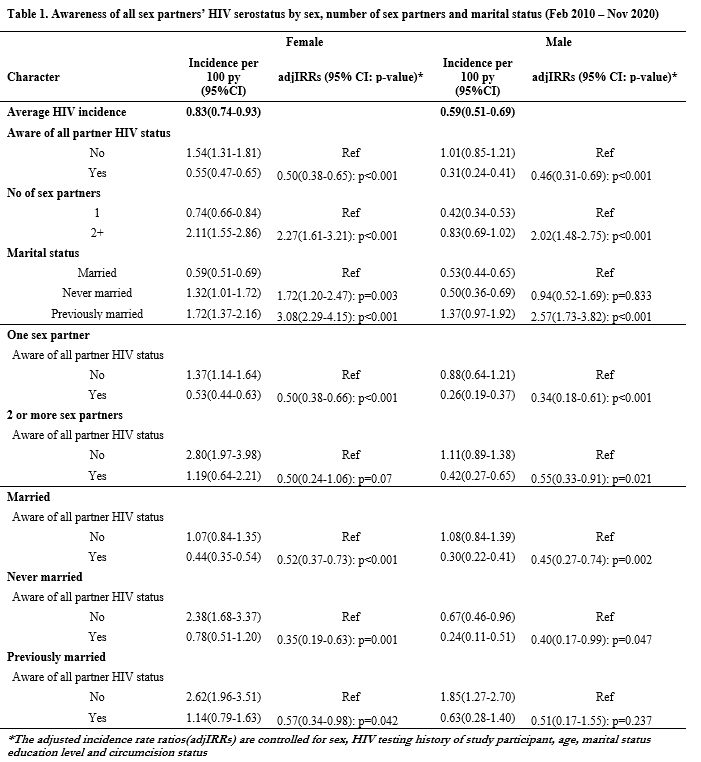
We found 23,547 eligible individuals that contributed 55,611 study visits with 63,203 persons years of measuring HIV incidence. Fifty-six (13,202) percent were female. Awareness of sex partners’ HIV serostatus rose from 44% in 2010 to 73% by 2020, while HIV incidence decreased from 1.1/100 py to 0.38/100 pys over the same period. Awareness of all partners’ HIV serostatus was associated with a 49% risk reduction (aIRR=0.51, CI=0.41–0.64, p<0.001): incidence was 0.45/100py vs. 1.25/100py among the unaware population. Effects were consistent by sex (Table 1): women (aIRR=0.50, CI=0.38–0.65, p<0.001) and men (aIRR=0.46, CI=0.31–0.69, p<0.001). While individuals with ≥2 partners had over twice the HIV risk compared to those with one partner (aIRR=2.18, CI=1.72–2.76, p<0.001), awareness of partner HIV serostatus halved incidence in both groups: one partner (aIRR=0.50, CI=0.38–0.64, p<0.001) and ≥2 partners (aIRR=0.55, CI: 0.36–0.83, p=0.005). Similarly, while the previously married had 2.8 times (aIRR=2.84, CI: 2.25–3.57, p<0.001) the risk of HIV compared to the married but comparable to the never married (aIRR=1.25, CI: 0.91–1.72, p=0.169), awareness of partner HIV serostatus reduced the risk among the married by 50% (aIRR=0.50, CI=0.38–0.65, p<0.001), 63% in the never married (aIRR=0.37, CI=0.23–0.61, p<0.001) and 41% in the previously married (aIRR=0.59, CI=0.36–0.95, p=0.003).
Conclusions
Awareness of sex partners’ HIV serostatus associated with high reduction in HIV incidence across subgroups, (with consistent effects by sex and number of partners). The study highlights partner serostatus awareness as a key protective factor, a critical component in the HIV prevention strategies.
Table or Figure