Background
Transgender (trans) women are disproportionately impacted by HIV and prioritized in the National HIV/AIDS Strategy 2022-2025 in the US. However, shifting federal priorities, erasure of gender identity data collection, and escalating political attacks on trans communities threaten to undermine progress in the HIV response. This study addresses epidemiologic gaps by evaluating HIV incidence in a nationwide cohort of trans women.
Methods
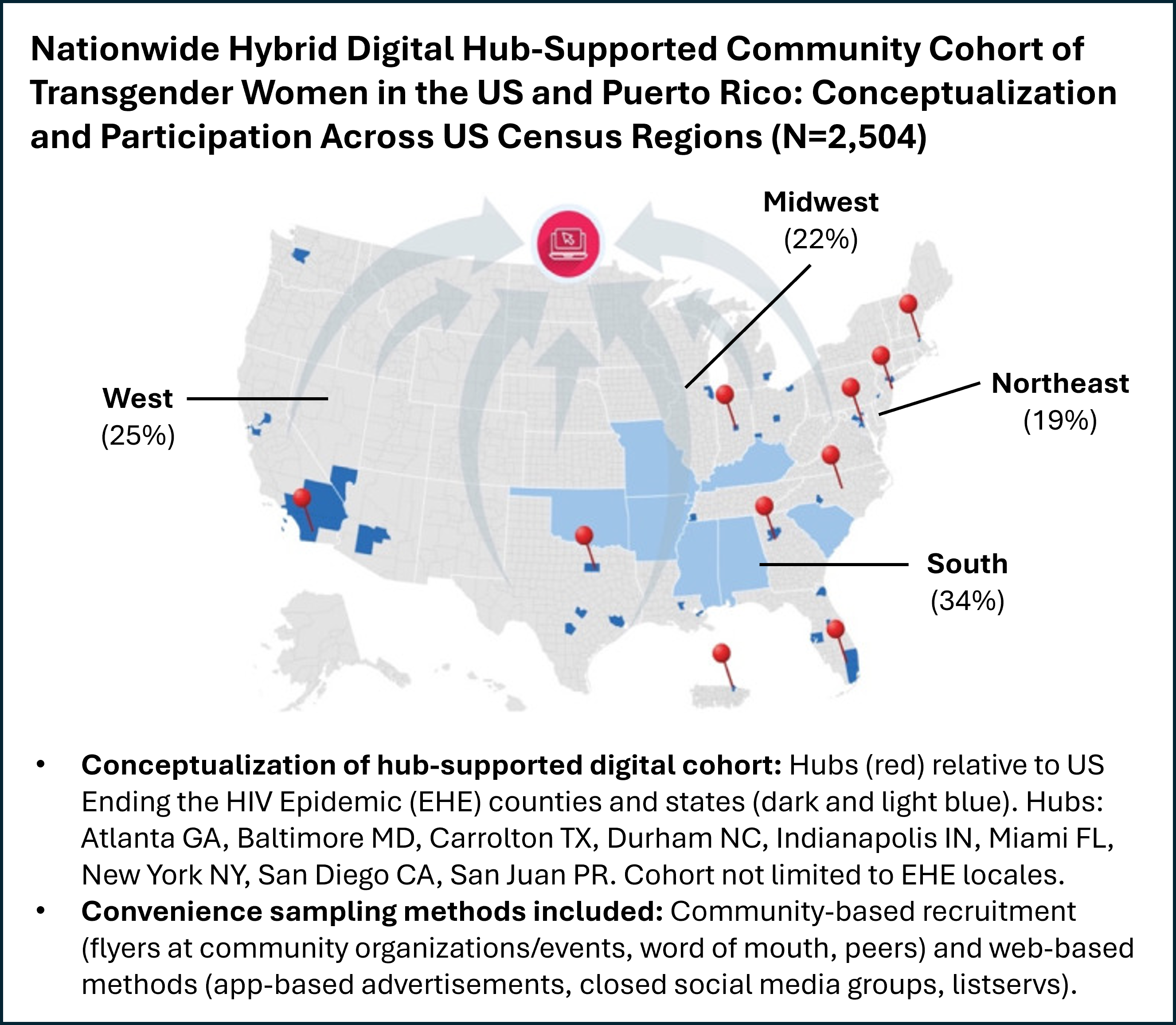
Participants enrolled in a hybrid digital hub-supported community cohort from 3/2023 through 12/2024. Eligibility criteria included: English- or Spanish-speaking, ages ≥18 years, identity as trans women or along the transfeminine spectrum, US or Puerto Rico residency, and not living with HIV (laboratory-confirmed at baseline). Participants consented to 24 months of semi-annual biobehavioral data collection (surveys and HIV testing) conducted completely remotely or at one of the community hubs (Figure). Crude HIV incidence rates with 95% confidence intervals (95%CI) were estimated overall and stratified by race, ethnicity, and PrEP-indication as of 7/5/2025.
Results
Of 7,620 individuals screened, 2,549 met nearly all eligibility criteria and completed a baseline HIV test to confirm negative status. 28 (1.1%) had undiagnosed HIV (ascertained via HIV test and post-test counseling). 2,504 individuals enrolled in the cohort. Median age was 32 years (IQR:26-40); 33% identified as Black, Latina/e, or Multiracial. Residence was evenly distributed in US Census Regions. Participants contributed 2,713.23 person-years, with 11 seroconversions. HIV incidence was 4.1/1,000py (95%CI:2.0-7.3) overall, and 13.8/1,000py (5 cases; 95%CI:4.5-32.2) in Black participants, 10.0/1,000py (4 cases; 95%CI:2.7-25.5) in Latina/e participants (of any race), 7.3/1,000py (1 case; 95%CI:0.2-40.9) in Asian participants, and 1.4/1,000py (3 cases; 95%CI:0.3-4.1) in White participants. At baseline, 404 (16%) were PrEP-indicated (42% of whom were on PrEP); the HIV incidence rate in PrEP-indicated participants was 16.6/1,000py (7 cases; 95%CI:6.7-34.1).
Conclusions
HIV incidence remains high among trans women in the US, especially for those who are Black and Latina/e. Federal de-prioritization of HIV prevention among trans women exacerbates the threat to public health. Trans women need tailored interventions and safe, affirming access to HIV prevention. Continued gender-inclusive research with appropriate protections is needed to address federal gaps.
Table or Figure