Background
Oral PrEP continuation/retention among sex workers (SW) is poor. Pharmacy-based PrEP refills have potential to improve continuation. We report on 12 12-month continuation from the pilot of a pharmacy-based PrEP refill intervention called Together Optimizing PrEP Access in Zimbabwe (TOPAZ).
Methods
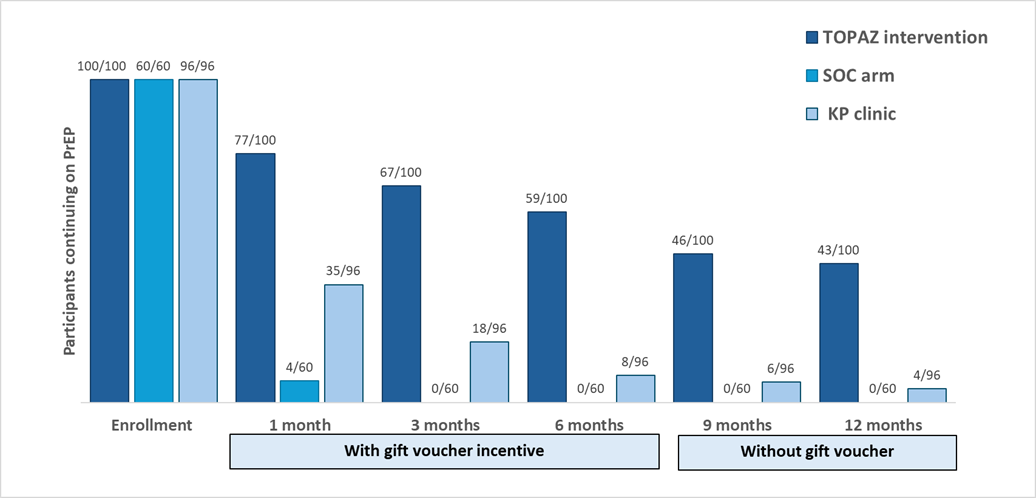
TOPAZ was nested in the nationally scaled Key Populations (KP) program that provides free HIV and sexual and reproductive health services to SW. We performed 1:1 randomization of eight purposively selected KP program outreach/mobile sites in Harare, to standard-of-care (SOC) or TOPAZ. In SOC, female SW (FSW) initiating PrEP collected refills from KP program clinics. In TOPAZ, FSW had choice to collect refills from KP program clinics or selected community pharmacies. To enhance habit formation, pharmacy-based PrEP refill was coupled with incentives at 1, 3 and 6 months valued at US$5, US$6 and US$7, respectively. We measured PrEP continuation at 1,-3,-6,9-, and 12- months. For additional comparison, we measured the same outcomes for participants initiating PrEP during the trial recruitment period at a large KP clinic in Harare. We compared proportions of participants continuing PrEP and risk differences (RD) using logistic regression.
Results
We implemented the study from March/2024-May/2025. We recruited 100 FSW in TOPAZ, mean age (SD) 29.3 (7.3) years, 60 FSW in SOC, mean age (SD) 32.1 (7.6) years. We analysed data from 96 FSW at the large KP clinic, mean age (SD) 27.7 (6.4) years. PrEP continuation was higher in TOPAZ across all months, Figure 1. At month 1, PrEP continuation in TOPAZ was 77/100 (77%) vs 4/60 (6.7%) in SOC, RD:0.70, 95% CI=0.60-0.81, p<0.01, and 35/96 (36.5%) at KP clinic RD vs TOPAZ: RD 0.41, 95% CI=0.28-0.53, p<0.01. By month 3 no participants were retained in SOC arm. Continuation in TOPAZ remained higher after removal of incentives: at month 9 continuation in TOPAZ was 46/100 (46%) vs 6/96 (6.3%) at KP clinic, RD:0.41, 95% CI=0.30-0.52, p<0.01. At Month 12, continuation in TOPAZ was 43/100 (43%) vs 4/96 (4.2%) at KP clinic, RD 0.40, 95% CI 0.30-0.50, p < 0.01. Continuation on PrEP was poorer among young people 16-24 years: in TOPAZ, continuation in 16-24 year olds and in those >25 years was 25% and 49%, p=0.001, with 0% and 6% at KP clinic, p<0.001.
Conclusions
Pharmacy-based PrEP refill collection resulted in high PrEP continuation among FSW, persisting after removal of incentives. Future initiatives could explore more accurate adherence measures such as biomarkers.
Table or Figure