Background
Men in eastern and southern Africa (ESA) have larger gaps in achieving the UNAIDS 95-95-95 care cascade (91% status aware, 79% treated, 74% virally suppressed) than women (95%-87%-82%). We describe these gaps (unaware, untreated, unsuppressed) among subgroups of men with HIV (MWH) in seven ESA countries.
Methods
We pooled data from nationally representative Population-based HIV Impact Assessment surveys conducted after 2019 in Eswatini, Lesotho, Malawi, Mozambique, Tanzania, Uganda, and Zimbabwe. We categorized MWH into the following subgroups: none (zero subgroups), serodifferent couples (SDC: ≥1 HIV-negative partner), recent mobility (RM: lived away for >1 month in past year), adolescent boys and young men (ABYM: aged 15-24 years), older adults (OAd: aged >49 years), sex work (SW: purchased/sold), and Gay or Bisexual (GBMSM: ≥1 same-sex partner). The conditional care cascade and its gaps were estimated. Unweighted proportional differences between subgroups were descriptively examined. UpSet plots visualized groupings with ≥25 observations.
Results
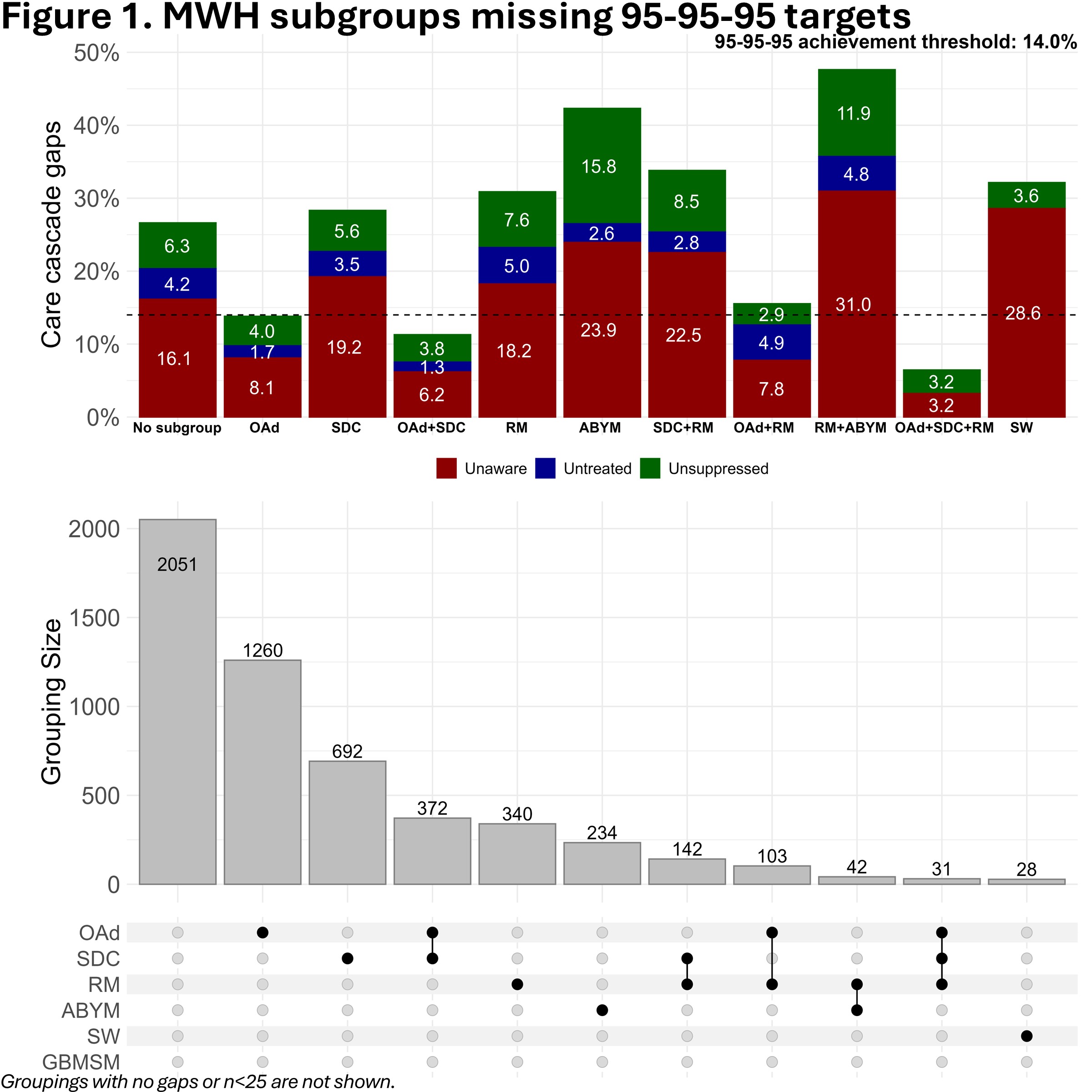
Among 5,390 MWH, the overall care cascade was 85%-82%-76%. Of all MWH, 38% were classified into zero subgroups, 48% into one subgroup, and 14% into multiple subgroups. Most (>58%) MWH who were HIV status unaware (N=800) and virally unsuppressed (N=323) belonged to one or multiple subgroups, while untreated MWH (N=170) were evenly distributed among those in zero and one/multiple subgroups. Compared with MWH in zero subgroups (16% unaware, 4% untreated, 6% unsuppressed), a higher proportion of MWH in the following groupings (Figure 1) were 1) HIV status unaware (SDC, RM, ABYM, SDC+RM, RM+ABYM, SW); 2) untreated (RM, OAd+RM, RM+ABYM); and 3) virally unsuppressed (RM, ABYM, SDC+RM, RM+ABYM).
Conclusions
Care cascade gaps were primarily related to status unawareness. RM, ABYM, SDC, and their joint occurrences consistently had care cascade gaps, necessitating tailored interventions. However, as MWH in zero subgroups was the single largest grouping, there is a need to reach all men in these countries, while tailoring outreach for those in specific subgroupings (e.g. RM, ABYM, and SDC) to achieve the 95-95-95 targets.
Table or Figure