Background
The World Health Organization endorses 3 months weekly isoniazid and rifapentine (3HP) as TB preventive treatment (TPT) in people with HIV (PWH) on once-daily dolutegravir (DTG)-based antiretroviral treatment (ART). Pharmacokinetic (PK) model simulations suggest once-daily DTG with 3HP in pregnancy will result in acceptable DTG trough concentrations, but human data are needed to confirm model projections.
Methods
DOLPHIN-Moms (NCT95122026) is an open-label phase II trial in South Africa investigating safety and pharmacokinetics of DTG in pregnant PWH initiated on 1HP or 3HP. Initially pregnant PWH at 20-34 weeks’ gestation virally suppressed on DTG-based ART initiated twice-daily DTG prior to 1HP or 3HP. Previously reported interim PK analysis with simulations suggested once-daily DTG would be acceptable with 3HP but not 1HP. Subsequently, 38 newly enrolled pregnant women taking once-daily DTG-based ART with 3HP had PK sampling on days 1 (pre-HP), 17 and 52 (23h and 24h post DTG dose) to capture the maximum effect of rifapentine on DTG. HIV viral load was measured at screening, delivery, and treatment completion. We estimated population PK of DTG using non-linear mixed effects models.
Results
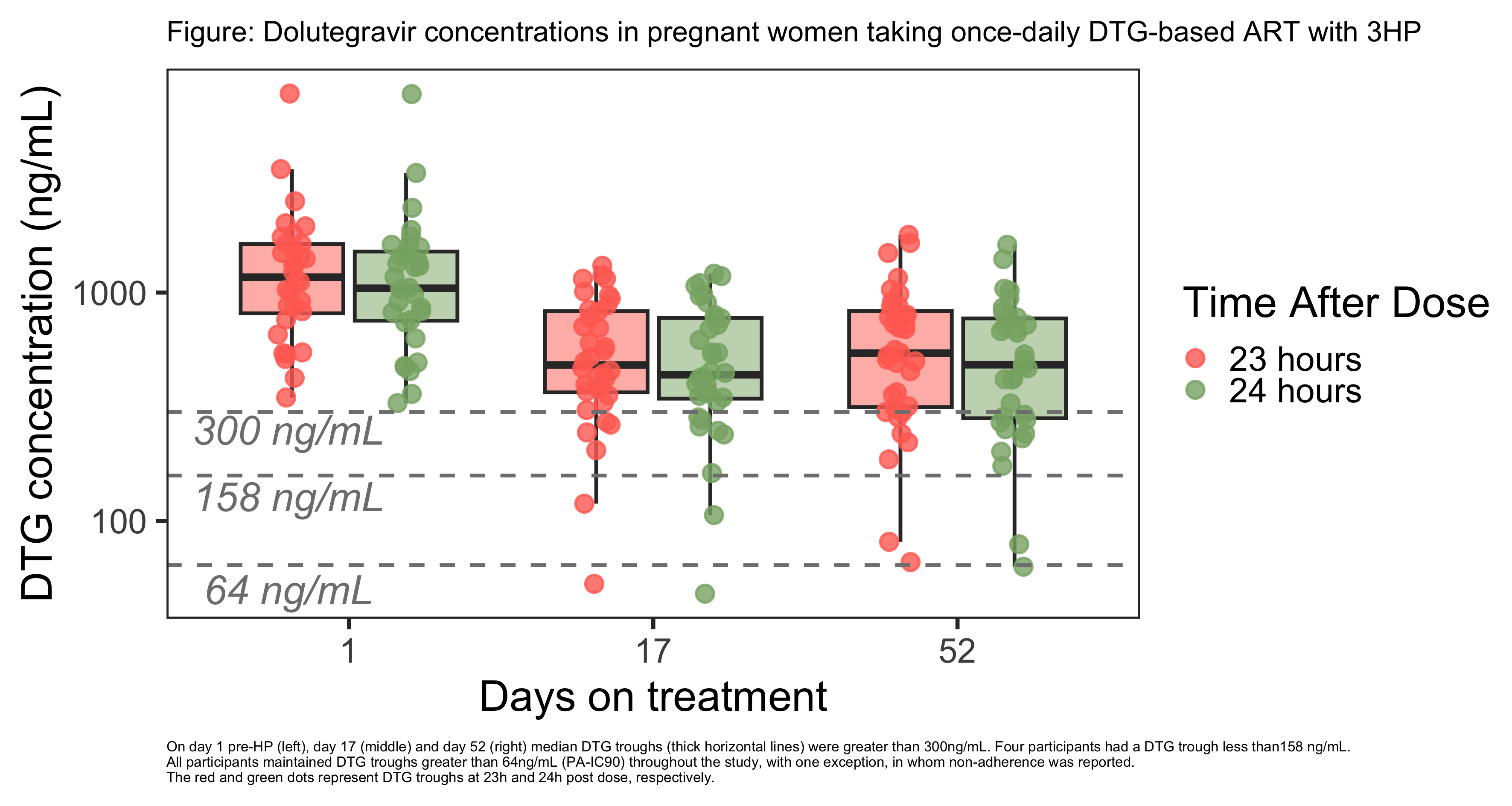
Among 38 participants, median age was 30.5 years (IQR 20–42), gestational age 26 weeks (IQR 20–33), and CD4 693 cells/mm3 (IQR 454–957). Of 228 PK samples collected, 8 (3.5%) had physiologically improbable low DTG levels and were excluded. Of the remaining samples, median DTG trough with 5th and 95th percentile at day 1 (pre-HP) was 1045 ng/mL (41–2795), significantly higher than at day 17 (median 436 ng/mL (148–1120)) and day 52 (median 483 ng/mL (146–1148). DTG clearance was 33% higher on days 17 and 52 compared to day 1 (1.2 L/h vs. 0.9 L/h).
Four distinct participants had at least one DTG trough <158 ng/mL: two at day 17, two at day 52. One had a DTG trough <64 ng/mL at day 17, but reported not taking ART the previous two days. Overall, 3 (7.8%) reported ART adherence <95%. One had a detectable viral load at delivery (DTG levels implausibly low); the infant remains HIV negative. All other participants (97%) remained virally suppressed while on 3HP.
Conclusions
The majority of pregnant PWH adherent to once-daily DTG-based ART while taking 3HP remained virally suppressed, with DTG levels consistent with studies of non-pregnant people. These data support the expansion of TPT guidelines to include 3HP for pregnant PWH on once-daily DTG-based ART, in conjunction with strong adherence counseling.
Table or Figure