Background
As more people with HIV (PWH) transition to tenofovir (TFV)-sparing antiretroviral therapy (ART), increased risk of hepatitis B virus (HBV) reactivation and new infection is a concern.
Methods
We conducted a retrospective cohort study of adult PWH in the CFAR Network of Integrated Clinical Systems with >/= 1 TFV-sparing ART regimen prescribed for >/= 3 months after 5/1/2014 with the following at most recent evaluation prior to first TFV-sparing ART: 1) both HBV surface antigen (HBsAg) and surface antibody (HBsAb) results available (HBV core antibody [HBcAb] results captured but not required), and 2) no evidence of active HBV (HBsAg+ or HBV viremia). We examined episodes of HBV reactivation or new infection defined as new HBsAg+ or HBV viremia. We used Firth penalized logistic regression to obtain adjusted odds ratios and 95% CIs to examine associations of age, sex, race, ethnicity, HBV serologies, lamivudine/emtricitabine (XTC) use, HIV viral load, and CD4 count with HBV reactivation/new infection.
Results
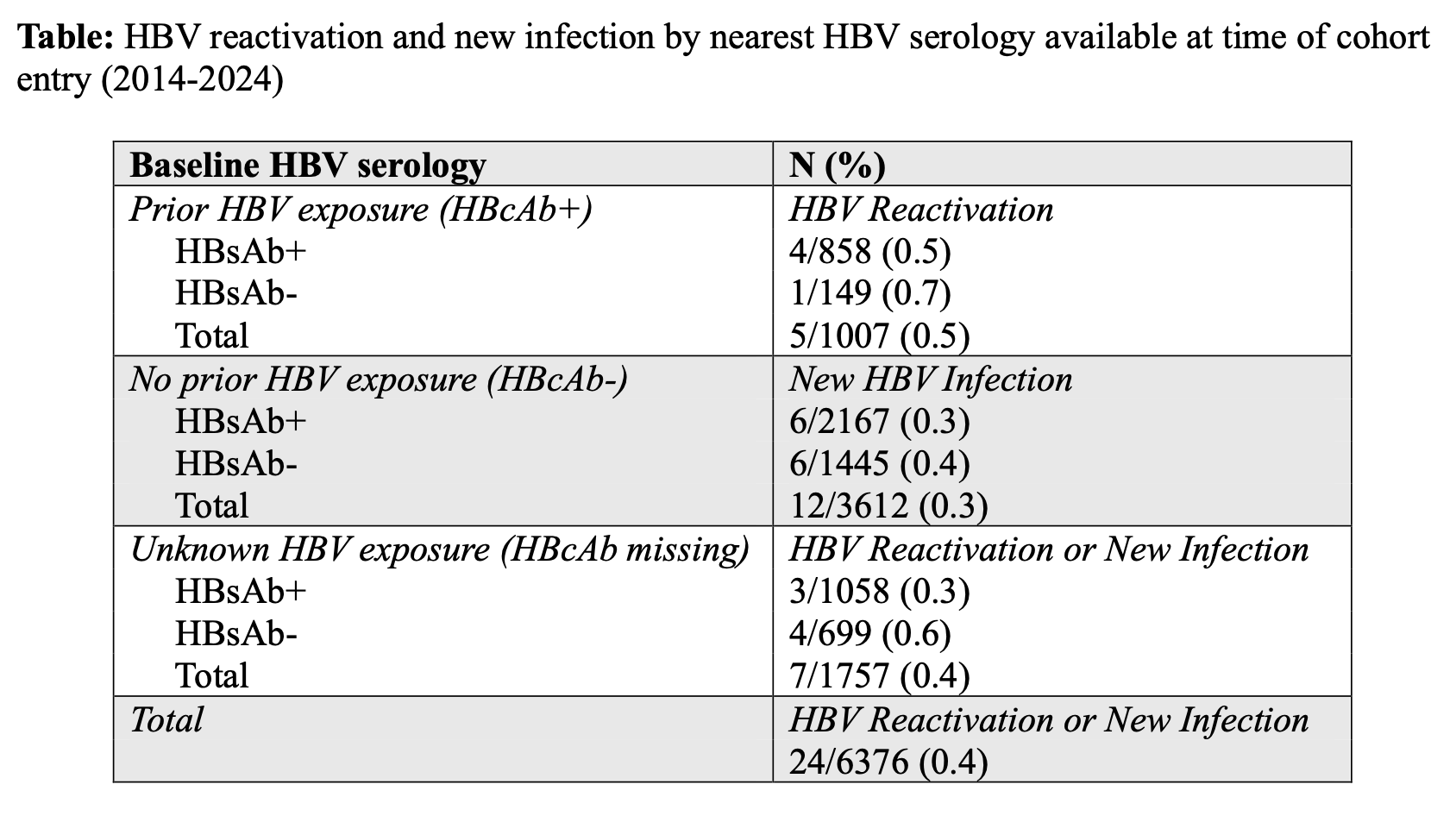
Of 6376 PWH meeting inclusion criteria, median age was 47 years, 1330 (21%) were female, 2866 (45%) white, 2823 (44%) black, 864 (14%) Latinx. At cohort entry, 1007 (16%) had HBcAb+, and 1757 (28%) were missing HBcAb. There were 24 cases of HBV reactivation/infection over a median of 3.4 years of follow up. Among those with HBcAb+, reactivation was similar between those with HBsAb+ (4/858, 0.5%) and HBsAb– (1/149, 0.7%). In those with baseline HBcAb–, presumed new infections occurred in 6/1445 (0.4%) who were HBsAb– and 6/2167 (0.3%) who were HBsAb+. At the time of reactivation/infection, 13 (54%) were on HBV-active ART with XTC and 11 (46%) were on HBV-inactive ART. Liver injury, defined as alanine aminotransferase lab value >100 U/L, occurred within 3 months in all 24 reactivation/infection cases. Black race was associated with significantly higher incidence of HBV reactivation/new infection (aOR 26.43, 95% CI 2.78, 251.17, p = 0.004). Other variables were not associated.
Conclusions
HBV reactivation or new infection on TFV-sparing ART was rare in this study and similar to rates reported in other clinical cohorts. Reactivation/infection may have caused clinically significant hepatic flares and occurred in those with prior HBsAb+. When starting TFV-sparing ART, providers should check complete HBV serologies, which are often missed, offer initial or additional vaccination as needed, and monitor for potential HBV reactivation/infection.
Table or Figure