Background
Bulevirtide (BLV) is approved for treatment of chronic hepatitis delta (CHD). We present data from the Phase 3 MYR301 (NCT03852719) study evaluating BLV treatment, with up to 144 weeks (W) of therapy and 96W of posttreatment follow-up, including data on 2 patients (pts) with HIV-coinfection.
Methods
150 pts with CHD were randomized (1:1:1) into 3 arms: BLV 2 mg/d for 144W (n=49); BLV 10 mg/d for 144W (n=50); no treatment for 48W, then BLV 10 mg/d for 96W (n=51). All pts were to be followed up for 96W after end of treatment (EOT). Efficacy was measured by combined (undetectable HDV RNA or ≥2 log10 IU/mL decline from baseline [BL] and alanine aminotransferase [ALT] normalization), virologic, and biochemical response rates. The inclusion criteria allowed the enrollment of pts with controlled HIV infection (CD4 count >500/mm3, HIV RNA <limit of detection).
Results
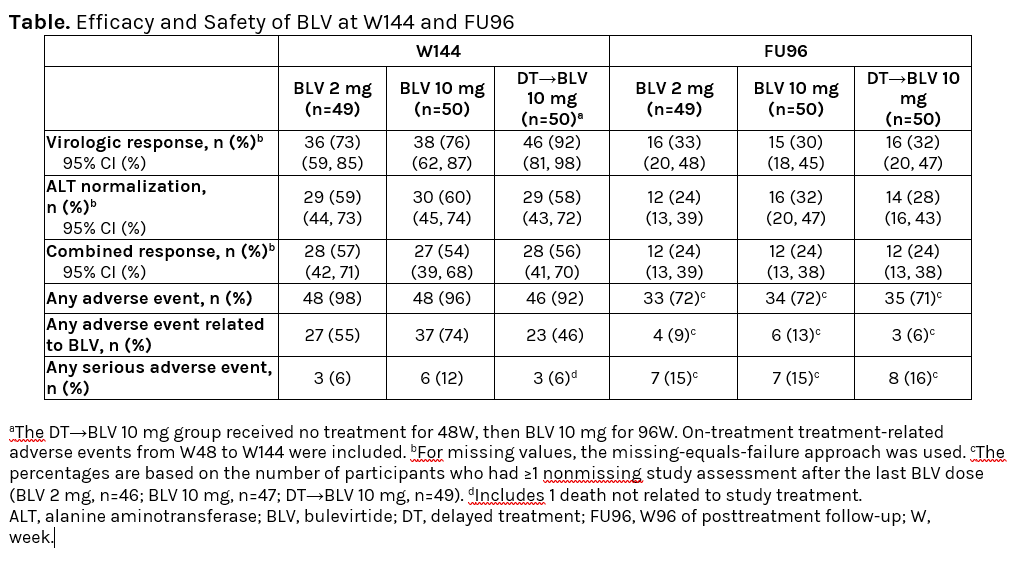
BL characteristics were similar between arms: mean (SD) age 42 (8.4) years; 57% male; 83% White; 47% with compensated cirrhosis; mean (SD) HDV RNA 5.04 (1.34) log10 IU/mL; mean (SD) ALT 111 (69.0) U/L; and 61% on a concomitant nucleos(t)ide analogue. At BL, 2 pts were coinfected with HIV: Pt 1 (BLV 2 mg) was 39 years old, HCV antibody negative, on tenofovir/lamivudine/etravirine, and had undetectable HIV viral load (VL) and a CD4 count of 786/mm3. Pt 2 (BLV 10 mg) was 40 years old, HCV antibody positive (HCV RNA negative), on emtricitabine/tenofovir alafenamide/raltegravir, and had undetectable HIV VL and a CD4 count of 559/mm3. Overall, W144 combined, virologic, and biochemical responses were comparable in the BLV 2 and 10 mg groups (Table). Key parameters that changed from BL to W144 to follow-up W96 for Pt 1 were HDV RNA, 3,345,358 to <50 to 41,635 IU/mL; HBV DNA, 22 to 0 to 10 IU/mL; HBsAg, 18,000 to 8500 to 17,000 IU/mL; and ALT, 289 to 11 to 45 U/L. Key parameters that changed from BL to W144 for Pt 2 were HDV RNA, 425,354 to <50 IU/mL; HBV DNA, 17 to <10 IU/mL; HBsAg, 8100 to 2000 IU/mL; and ALT, 97 to 22 U/L; Pt 2 did not complete the follow-up period of the study due to consent withdrawal. At W144, both HIV/HBV/HDV-coinfected pts achieved combined virologic and biochemical response, and neither required changes to their antiretroviral therapy. BLV was safe and well tolerated. Both HIV/HBV/HDV pts had no serious adverse events.
Conclusions
Virologic, biochemical, and combined responses were similar between arms, without new safety signals. Two pts with HIV/HBV/HDV achieved a combined response at EOT and tolerated BLV well.
Table or Figure