Background
Youth with HIV from low-to-middle income countries (LMICs) experience elevated mental health (MH) distress but limited MH resources exist to meet their needs. Peer-led MH interventions may address the treatment gap if peers can deliver interventions with fidelity. IMPAACT 2016 explored three implementation outcomes, feasibility, acceptability, and fidelity, in a hybrid type 1 study of a culturally-adapted, peer-led, trauma-informed cognitive behavioral therapy (TI-CBT) for African youth with HIV.
Methods
Participants were 15–19-years old, aware of their HIV diagnosis, prescribed ART > 6 months, and self-reported elevated mental distress. Eight IMPAACT sites across four countries (Malawi, South Africa, Botswana, and Zimbabwe) screened, enrolled and randomized participants to TI-CBT or a Discussion Control group. Both arms received six 2-hour sessions led by two trained peer leaders, ranged in size from 6-10 youth, and were single or mixed sex. Peer leaders, 21-30 years-old living with HIV, were from the local community and randomly assigned to lead one arm. Peer leaders assigned to TI-CBT participated in a two-week in-person in-country training led by two expert psychologists. Peer leaders practiced delivering TI-CBT until deemed competent and received twice weekly supervision. To assess fidelity, TI-CBT sessions were observed by a third peer leader who rated the sessions for completion of planned activities (all, part, or none), peer leader competence (1=not very well to 5=very well), and participant engagement (1=poor to 5=excellent). In both arms, acceptability was measured by youth satisfaction (1=not at all to 5=extremely) and fun had/amount learned from 0=none to 10=a lot, and feasibility was determined by enrollment, session attendance, and retention.
Results
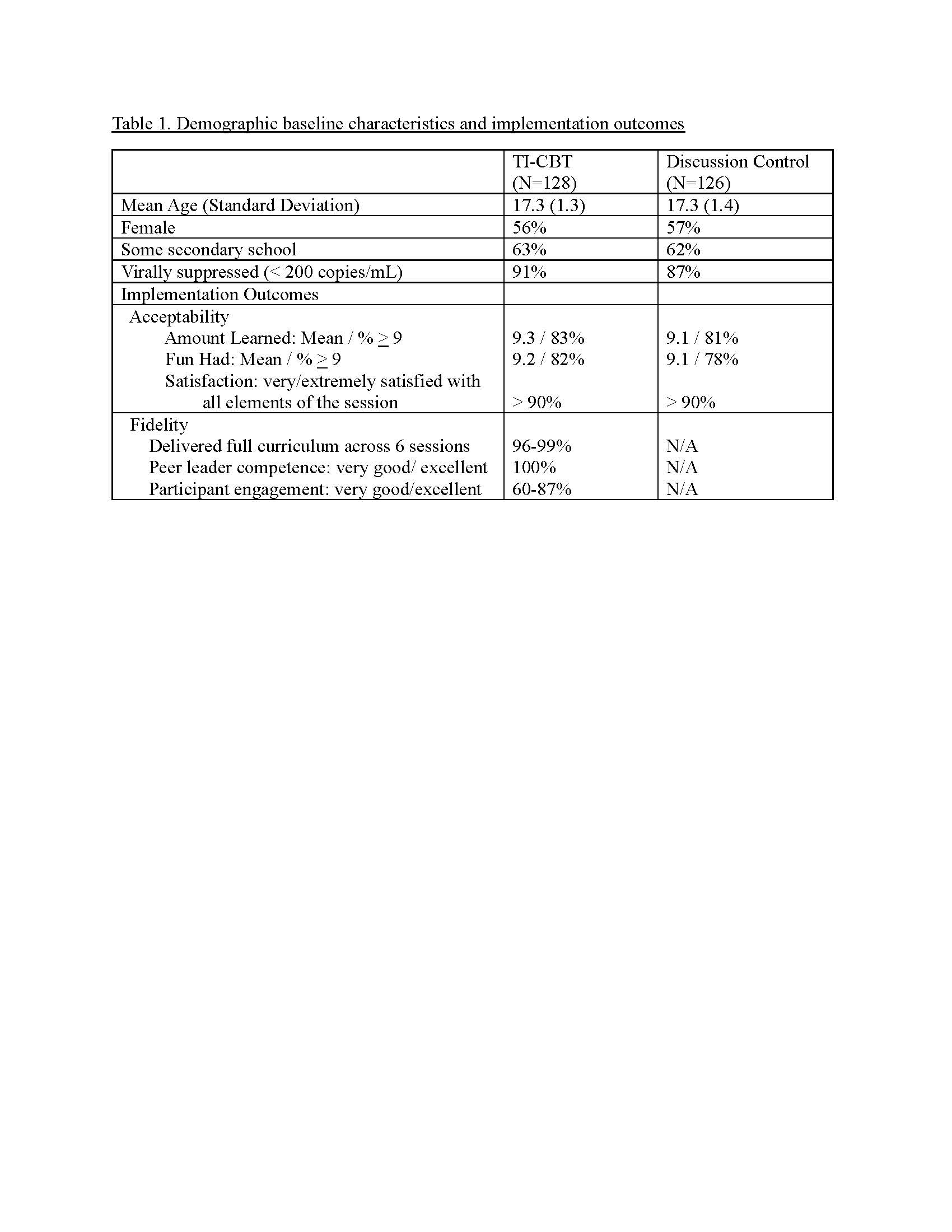
Table 1 presents the select demographic characteristics and implementation outcomes by arm. Feasibility was strong; 275/365 (75%) youth were eligible at screening, and 254/275 (92%) eligible youth enrolled. Very good/Excellent participant engagement ranged from 60-87%, and attendance averaged 89% at all sessions. There were not differences in implementation outcomes by arm.
Conclusions
Peer-led MH interventions for youth with HIV in LMICs are feasible, acceptable, and well-received by youth. Peer leaders can be trained to deliver a complex MH intervention with fidelity, thereby building local capacity to provide mental health care and leveraging a new workforce to address the treatment gap.
Table or Figure