Background
Women living with HIV (WLWH) in sub-Saharan Africa (SSA) are disproportionately affected by cervical cancer, yet population data on screening and treatment in high-burden settings remain scarce. In light of the revised World Health Organization guidelines on cervical cancer diagnostics and care for WLWH, there is a need to assess progress and gaps along the cervical cancer screening and treatment cascade in SSA.
Methods
We pooled data from seven Population-based HIV Impact Assessment (PHIA) surveys (2020-23) in Eswatini, Lesotho, Malawi, Mozambique, Tanzania, Uganda, and Zimbabwe to estimate the coverage and correlates of cervical cancer screening and treatment among WLWH aged 25+ years. Using multistage cluster sampling, PHIAs recruited nationally representative samples of individuals who completed structured bio-behavioral surveys. Cervical cancer screening, abnormal results, and treatment were self-reported. Survey-weighted log-binomial regression with jackknife variance estimation quantified cascade completion overall and by key socio-demographic characteristics and HIV care continuum outcomes, reported as adjusted prevalence ratios (aPR) with 95% confidence intervals (CI).
Results
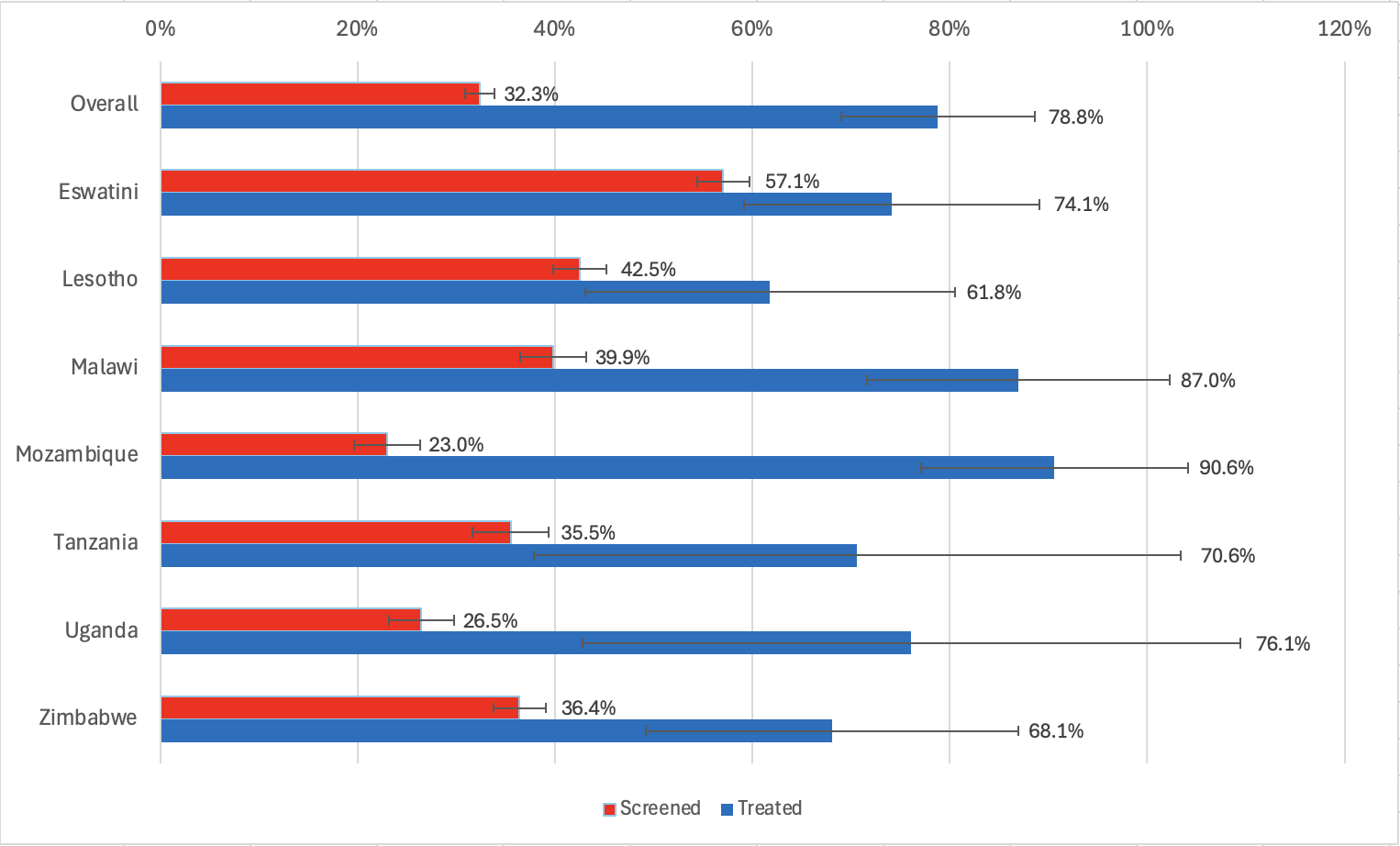
Overall, 32.3% of WLWH (N=10,838) reported ever being screened for cervical cancer, ranging from 23.0% in Mozambique to 57.1% in Eswatini (Figure). Screening was significantly (p<0.001) higher among women aware of their HIV status (35.7% vs. 11.7%), on antiretroviral therapy (36.2% vs. 12.1%), and virally suppressed (36.1% vs. 16.4%). Among those screened, 4.3% reported an abnormal result, 56.4% of whom received treatment. In multivariable analysis, women who were older (aged 45-54 vs. 25-34 years: aPR=1.76, CI: 1.42-2.17, p<0.001), more educated (secondary vs. none: aPR=1.67, CI: 1.25-2.22, p=0.001), wealthier (highest vs. lowest wealth quintile: aPR=1.90, CI: 1.37-2.62, p<0.001), and urban-dwelling (aPR=1.85, CI: 1.60-2.15, p<0.001) were more likely to report lifetime cervical cancer screening.
Conclusions
Despite revised guidelines advocating for universal cervical cancer screening and treatment coverage, population data suggests screening and treatment among WLWH in SSA are remarkably low, with country-level heterogeneities in estimates. Results highlight persistent inequities in cervical cancer screening, underscoring the need to prioritize efforts for younger, rural, less educated, lower-income, and clinically disengaged women to accelerate progress towards global cervical cancer elimination goals.
Table or Figure