Background
Pre-Exposure prophylaxis (PrEP) is a key HIV prevention intervention for high-risk populations. This study assessed demographic, behavioral, and clinical factors associated with PrEP initiation among high-risk populations.
Methods
A cross-sectional study was conducted among PrEP-eligible clients aged 15 years and above who sought HIV testing and counseling services across 11 Coptic hospital facilities in Kenya from 2021 to 2024. Data on demographics, behavioral risk, and PrEP uptake were analyzed using univariate and multivariable logistic regression in Stata 17.0. Statistical significance was set at p<0.05.
Results
Out of 99,682 HIV-negative clients screened, 19,992 (20%) were eligible for PrEP, with an initiation rate of 11% (2,230). The majority (64%) of clients were female and had a median age of 28 to 30 for those who initiated PrEP and those who did not, respectively.
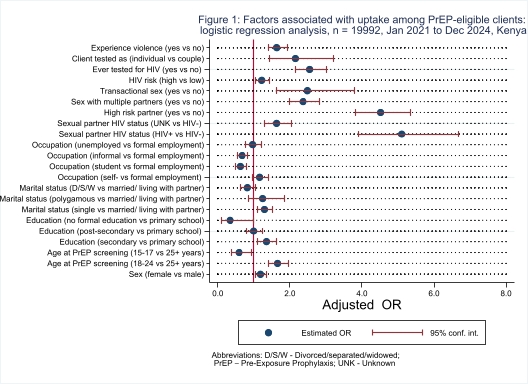
PrEP uptake was more likely among females (adjusted odds ratio (AOR): 1.2, 95% CI= [1.0, 1.3], p=0. 022), those aged 18-24 (AOR: 1.7, 95% CI =[1.4, 2.0], p < 0.001), those with a secondary education (AOR: 1.4, 95% CI = [1.1, 1.7], p=0.001), those never married (AOR: 1.3, 95% CI = [1.1, 1.5], p=0.001), those at high to very high HIV risk (AOR: 4.4, 95% CI = [3.8, 5.2], p <0.001), individuals with sexual partner/s living with HIV or unknown status (AOR: 5.1 95% CI = [3.9, 6.7], p <0.001 and AOR: 1.7 95% CI = [1.3, 2.1], p <0.001), and having multiple sexual partners (AOR: 2.5; 95% CI = [2.1, 3.1], p <0.001). Other predictors with significant positive association included engaging in transaction sex (AOR: 2.8, 95% CI = [1.8, 4.4], p <0.001), having a recent STI (AOR: 3.4, 95% CI = [1.7, 7.1], p=0.001), having a prior HIV test (AOR: 2.6, 95% CI = [2.2, 3.1], p<0.001), those tested for HIV alone (AOR: 2.1, 95% CI = [1.4, 3.2], p<0.001), and having experienced violence (AOR: 1.6, 95% CI = [1.4, 1.9], p<0.001). Conversely, students (AOR: 0.6; 95% CI = [0.5, 0.8], p<0.001), informal employed clients (AOR: 0.7, 95% CI [0.6, 0.9], p<0.001) and those that engaged in sex-under the influence of alcohol (A OR: 0.4, 95% CI [0.3, 0.6], p<0.001) were less likely to initiate PrEP.
Conclusions
PrEP initiation remains low. Targeted, risk-based PrEP interventions and differentiated service delivery may enhance uptake among underrepresented and high-risk populations.
Table or Figure