Background
Same-day (SD) antiretroviral therapy (ART) initiation is promoted to accelerate viral suppression and reduce early disengagement from care. Evidence supporting SD still reveals a discrepancy between randomized and observational studies and primarily comes from low- and middle-income countries (LMICs) and U.S. safety-net programs. Whether SD confers benefit in high-income settings with universal, free-of-charge HIV care remains uncertain.
Methods
Target trial emulation (TTE) comparing SD ART initiation (on the day of first HIV-care contact) with ART started 1–50 days after (SOC) in Italy. Eligible were non-hospitalised adults, no AIDS presenters, enrolled in the ICONA Foundation cohort between 2018 and 2024. Cloning and censoring were used to account for immortal time and confounding bias. Propensity score models included age, gender identity, ethnicity, mode of transmission, geographical region of ICONA site, CD4 count, HIV-RNA and time since HIV diagnosis. Outcomes were time to sustained (2 consecutive) VL ≤200 copies/mL and single VL ≤50 copies/mL. The risk of discharge from care by 1 year from enrolment was evaluated in a sub-cohort enrolled before July 2023. Kaplan–Meier estimates and risk differences (RD) were calculated with and without accounting for bias and 95% CI using bootstrapping.
Results
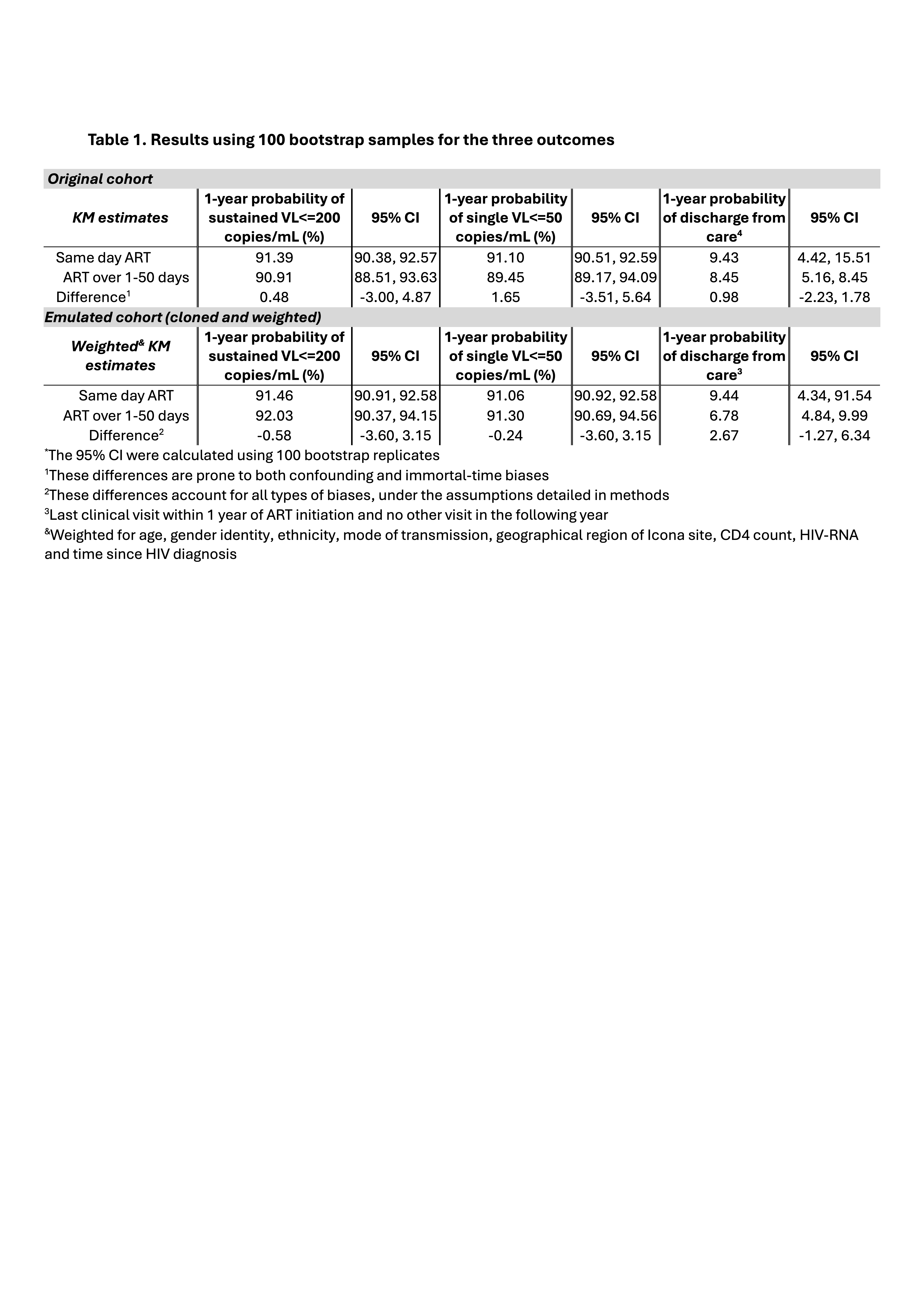
We included 3,144 persons with HIV PWH, 415 SD, and 2,729 SOC: 17% females, median age 39 (IQR:30,49), 80% Caucasian. Gender identity was cis male in 82%, cis female in 16% and transgender/non-binary in <2%. Median time from HIV diagnosis to the first care visit was 5 (1-14) days for SD and 7 (0-18) days for controls. The SOC group started ART on average 11 days (5-19) after the first contact. In both the original and the emulated cohorts, we found no evidence for an advantage of SD over SOC in virological outcomes. Among 2,664 participants with accurate retention in care data, the 1-year risk of discharge from care showed a slight advantage for SOC, albeit with considerable uncertainty around the RD (Table 1).
Conclusions
In TTE, using the data of a large national cohort of PWH set in a high-income country with a universal, publicly funded care system, initiating ART on the same day of the first HIV-care contact did not seem to improve time to viral load suppression or retention in care compared with starting later. Potential benefits in specific populations and at the earlier stage of the HIV cascade in settings not conditioning on ART start warrant further evaluation.
Table or Figure