Background
The Philadelphia Department of Public Health (PDPH) Data to Care (D2C) program identifies people with HIV (PWH) who are out of care (OOC) and provides re-engagement services. A person who is OOC for >1 year after their previous enrollment is eligible for re-enrollment if they still meet all enrollment criteria. We compared the outcomes of those enrolled once to those re-enrolled in 2021-2024. We then compared outcomes between the 1st and 2nd enrollments of those re-enrolled.
Methods
Laboratory and demographic data were extracted from the PDPH HIV database. Chi-sq tests assessed the association of covariates with re-enrollment, including age, gender, race/ethnicity, transmission group, years since diagnosis, HIV stage, and previous VL. Outcomes were relinkage (VL/CD4 <90 days of enrollment), retention (2 VL/CD4s >90 days apart <1 year of enrollment), and viral suppression (VS) (VL <200 c/mL <1 year of enrollment). Chi-square tests compared outcomes of one-time enrollees to the 1st enrollment of those later re-enrolled. Adjusted odds ratios (aOR) from multivariate logistic regressions compared outcomes of these groups, controlling for covariates. For those re-enrolled, AORs from conditional logistic regressions compared outcomes of the 2nd enrollment those of the 1st.
Results
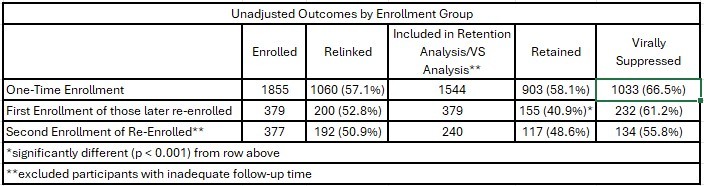
2234 enrollees (1855 (83.0%) enrolled once, 379 (17.0%) re-enrolled) were included. Those re-enrolled were more likely to be younger (<45 years old), diagnosed 5-14 years before enrollment, and cis-men. The re-enrollment group had lower unadjusted retention (40.9% vs 58.1%, p < 0.001) and lower odds of retention (aOR: 0.52[0.41-0.65]) after adjusting for covariates (see Table for unadjusted outcomes by group). At second enrollment, there was a non-significant increase in retention (48.6% vs 40.9%, p = 0.055). For those re-enrolled, controlling for previous VL, there was an increased odds of retention at the second enrollment (aOR: 1.75[1.14-2.68]), but decreased odds of VS (aOR: 0.55[0.31-0.95]).
Conclusions
Only 17.0% of D2C enrollees fell OOC after 1st enrollment by the end of 2024. Younger individuals, those diagnosed 5-14 years ago, and cis-men were more likely to require re-enrollment. While retention improved at re-enrollment, relinkage and VS did not. Additional interventions along the care continuum are needed to improve sustained engagement and VS in OOC PWH. Comparison of barriers to care among re-enrolled individuals at 1st and 2nd enrollment may identify ongoing unmet needs and inform future initiatives.
Table or Figure