Background
Although the Ryan White HIV/AIDS Program (RWHAP) has encouraged people with HIV to seek care at HIV clinics more proximal to their homes, research shows that many PWH bypass their nearest clinic. Some clinics have observed an increase of patients traveling from outside clinic RWHAP service areas to access HIV care. Yet, the effects of increased travel distance to clinics on care outcomes remain poorly understood, particularly among older PWH who often face compounded challenges, e.g., mobility limits and unreliable transportation.
Methods
This retrospective cohort study included older PWH (≥50 years) who initiated care at an urban, academic-affiliated HIV clinic in Alabama between 2010–2022 and resided in the state at care initiation. Patients were grouped by age (50–64 vs. ≥65 years) and travel distance (≤50 vs. >50 miles, one-way). The primary outcome, retention-in-care (RiC), was defined as the completion of at least two HIV primary care visits, spaced at least 90 days apart, within 12 months of the patient’s initial visit. Univariable and multivariable generalized estimating equation (GEE) models were used to investigate the association between RiC and age/distance to care, while accounting for clustering at the census block group-level and controlling for patient- and neighborhood-level factors.
Results
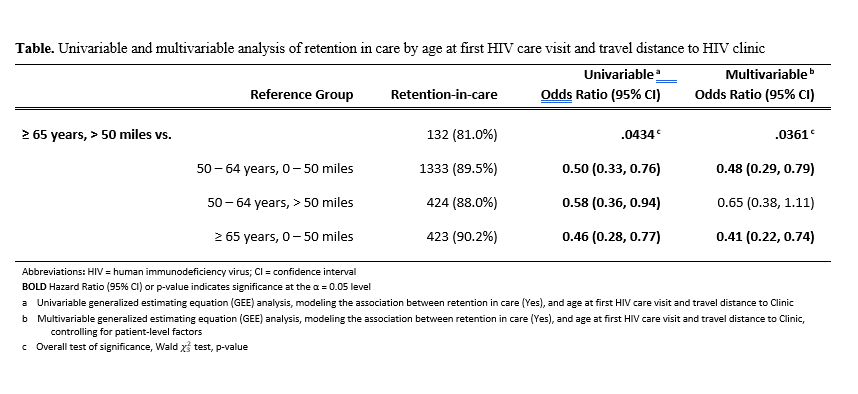
Among 2,604 eligible older participants included in the analysis, 1,972 were aged 50–64, and 632 were aged ≥65 years. Among those aged ≥65, 90.2% living within 50 miles of the clinic were retained in care compared to 81.0% of those living more than 50 miles away [Table]. For those aged 50–64, RiC was 89.5% for PWH ≤50 miles of the clinic and 88.0% for >50 miles. PWH aged ≥65 who traveled >50 miles were significantly less likely to be retained in are (OR=0.50, 95% CI: 0.33, 0.76), compared to those aged 50-64 who traveled up to 50 miles. This association persists when controlling for patient- and neighborhood-level factors (aOR=0.48, 95% CI: 0.29–0.79).
Conclusions
Older PWH traveling long distances—often over 100 miles round-trip—face barriers to consistent HIV care. Clinic travel distances for older PWH can be reduced by choosing care at more proximal clinics, ultimately resulting in more equitable distribution of RWHAP resources across this Deep South region. A better understanding of factors influencing clinic choice by older PWH (e.g., stigma, HIV treatment education) is needed to better serve this expanding group.
Table or Figure