Background
At-home antiretroviral therapy (ART) adherence testing offers a scalable and convenient strategy to support remote HIV care. Urine point-of-care (POC) tenofovir assays and tenofovir-diphosphate (TFV-DP) levels in dried blood spots (DBS) both objectively assess adherence, but their correlation and acceptability in self-collected samples have not been evaluated. We assessed the ability of at-home urine TFV testing to predict adherence, compared to gold-standard DBS TFV-DP concentrations. We also evaluated return rates for both sample types to determine practicality.
Methods
We analyzed longitudinal data from the LetSync cohort of people with HIV in primary relationships. Participants self-collected POC urine tests and DBS samples at baseline and months 2, 4, 6, and 8. Urine TFV detection was recorded via text-messaged submission of test photos. DBS pre-labeled cards were mailed for TFV-DP quantification, with adequate adherence in DBS defined as ≥4 doses/week. Generalized estimating equations evaluated associations between urine detection and DBS adherence and modeled predictors of sample return.
Results
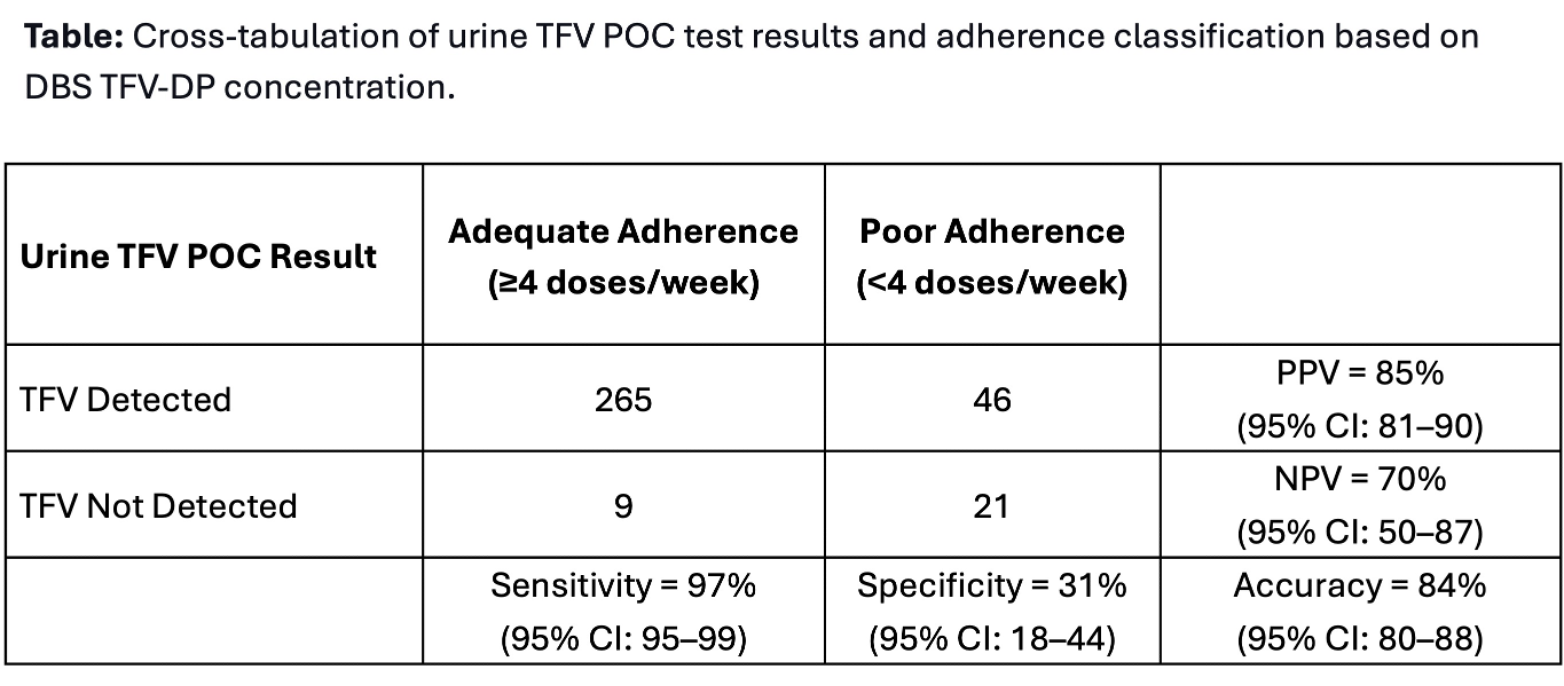
Among 86 participants (mean age 47; 90% men; 55% Black), 341 paired same-day urine and DBS samples were analyzed. After adjusting for timepoint, detectable urine TFV was strongly associated with adequate DBS-assessed adherence (aOR = 6.92; 95% CI: 2.61–18.32; p < 0.001). Urine POC test showed high sensitivity and positive predictive value, with lower specificity (Table). The overall predicted probability of returning any sample exceeded 90%, with urine slightly higher than DBS (94.2% vs. 91.2%). When stratified by viral load (VL), DBS return was significantly lower at month 8 among participants with detectable VL compared to those with an undetectable VL (50% vs. 93%; p = 0.013), while urine return remained high in both groups. No differences were observed by sex, race, or income.
Conclusions
This is the first study to compare at-home urine TFV testing with DBS TFV-DP as a pharmacologic adherence benchmark using self-collected samples. Urine detection strongly correlated with DBS adherence thresholds of ≥4 doses/week, reinforcing its reliability. Predicted return rates exceeded 90% overall and were slightly higher for urine across all time points and VL strata, reflecting the high feasibility of urine self-testing. These findings support urine POC testing as a practical, scalable tool for adherence monitoring, particularly in telehealth and decentralized care settings.
Table or Figure