Background
The Ending the HIV Epidemic (EHE) initiative set ambitious targets for HIV care and prevention to substantially reduce new HIV infections in the US by 75% in 2025 and 90% by 2030. Progress towards these targets varies across US jurisdictions. We seek to assess in the state of Missouri, which has limited investments in public health, how potential epidemic trajectories might be affected by either achievement of targets or disruptions that affect access to HIV care and treatment in public sector programs.
Methods
We adapted an established HIV epidemic model, Goals, to represent the HIV epidemic in Missouri. We calibrated Goals to CDC estimates of HIV prevalence by sex and to prevalence of diagnosed HIV in men who have sex with men and people who inject drugs. We used public data on new HIV diagnoses, access to HIV medical care, viral suppression, and PrEP prescriptions to parameterize the model. We analyzed an optimistic scenario in which EHE coverage targets were reached (95% knowledge of status, 95% linkage to care, and 95% viral suppression among people with diagnosed HIV, and 50% PrEP coverage among people with indications for PrEP) and a pessimistic scenario, in which half of people who were uninsured or insured through Medicaid lost access to ART or PrEP, in comparison to a “business-as-usual” counterfactual in which service coverages remained constant at 2023 levels through 2030. We modeled the effects of reaching EHE targets in 2030, as the latest CDC estimates suggest Missouri was unlikely to reach these in 2025.
Results
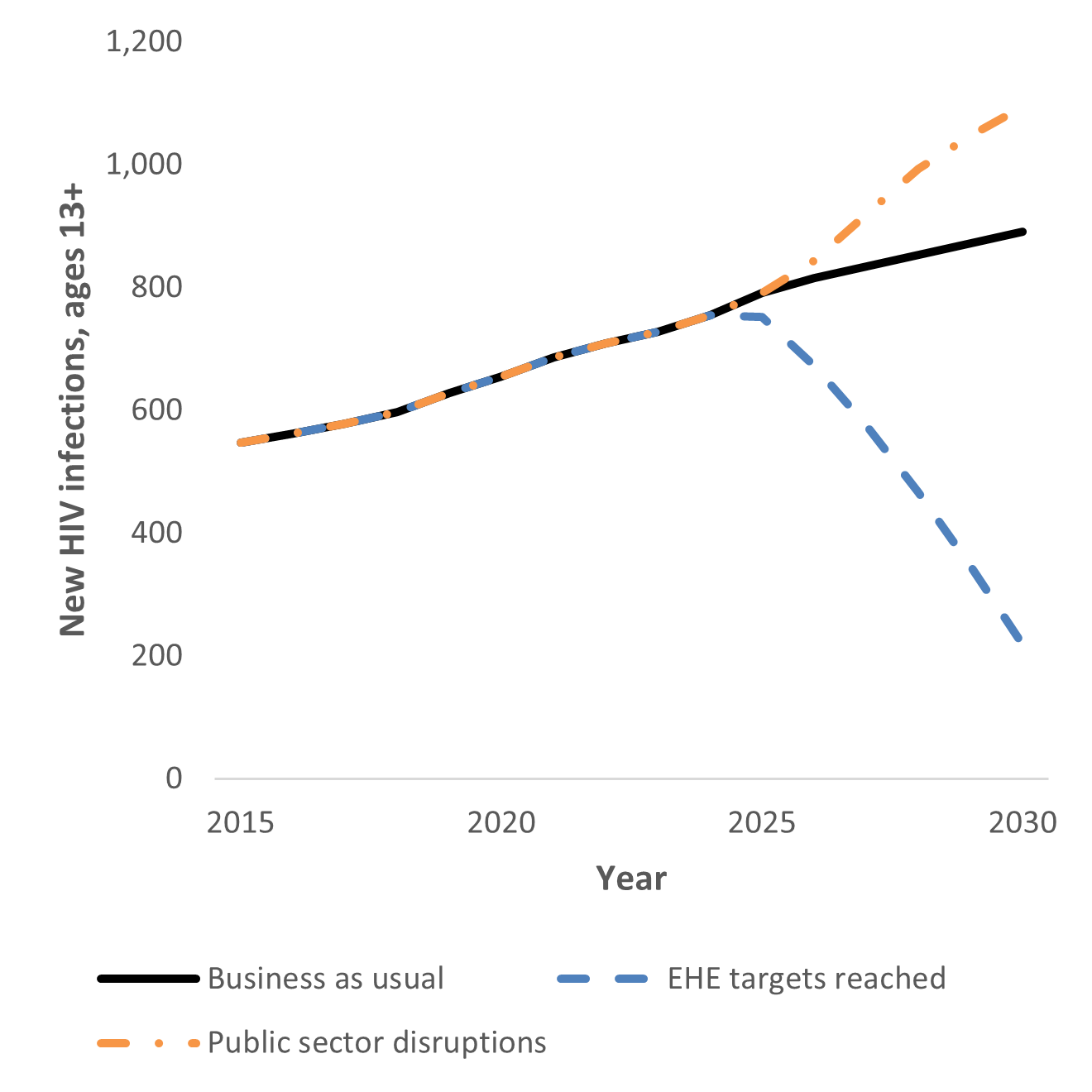
We estimated that 654 new HIV infections occurred in 2020. New infections increased annually in the business-as-usual scenario to 891 in 2030, a 36% increase over 2020 levels (Figure). Reaching EHE coverage targets drove down new infections rapidly, leading to 67% (219) fewer new infections in 2030 than in 2020. Coverage of ART fell by 25% and PrEP by 13% due to modeled disruptions to public sector programs in the pessimistic scenario, which resulted in 1,094 new infections in 2030, a 67% increase compared to 2020. We projected that 5,812 new infections would occur cumulatively in 2024-2030 in the business-as-usual scenario. Reaching EHE targets could prevent 35% of these new infections, while public sector disruptions could increase new infections by 11% in this period.
Conclusions
Reaching EHE targets could substantially reduce new HIV infections, but failure to preserve access to ART and PrEP for those in need could accelerate the HIV epidemic in Missouri.
Table or Figure