Background
Cabotegravir/lenacapavir (CAB/LEN) may reduce ART adherence barriers for breastfeeding (BF) women with HIV, improving maternal health and reducing vertical transmission (VT). Using CEPAC, a validated computer model of mother-child pairs, we estimate the clinical outcomes and cost-effectiveness of CAB/LEN for BF women in South Africa and Côte d’Ivoire.
Methods
For each country, we simulated 4 cohorts of mother-infant dyads defined by maternal status at delivery: 1) VSHA: women with viral suppression (VS) on tenofovir-lamivudine-dolutegravir (TLD) expected to maintain high medication adherence postpartum (PP), 2) VSLA: women with VS on TLD expected to have lower adherence PP, 3) NVS: women not virally suppressed despite being prescribed TLD, and 4) DD: women diagnosed with HIV at delivery (no prior ART). We modeled 2 strategies from the time of delivery: SOC (starting/continuing TLD) and starting CAB/LEN. Key inputs included 6-month probability of viral suppression (viral load [VL]<50c/mL) on CAB/LEN (VSHA/VSLA: 100%, NVS: 94.1%, DD: 97.3%) and TLD (VSHA/VSLA: 100%, NVS: 62.7% DD: 85%); annual ART costs (CAB/LEN: $378, TLD: $37); 24-month PP engagement in care (VSHA: 89%, VSLA/DD: 79%, NVS: 70%); mean BF duration (South Africa: 3 months, Côte d’Ivoire: 10 months); and VT risk (0.06%-0.89%/month of BF, range by maternal VL). Primary outcomes included VT, combined maternal/pediatric life expectancy (LE), combined lifetime care costs, and incremental cost-effectiveness ratios (ICERs: $/year-of-life saved [YLS]), defining cost-effective as ICER<0.5x GDP per capita [South Africa: $3,100/YLS, Côte d’Ivoire: $1,300/YLS]).
Results
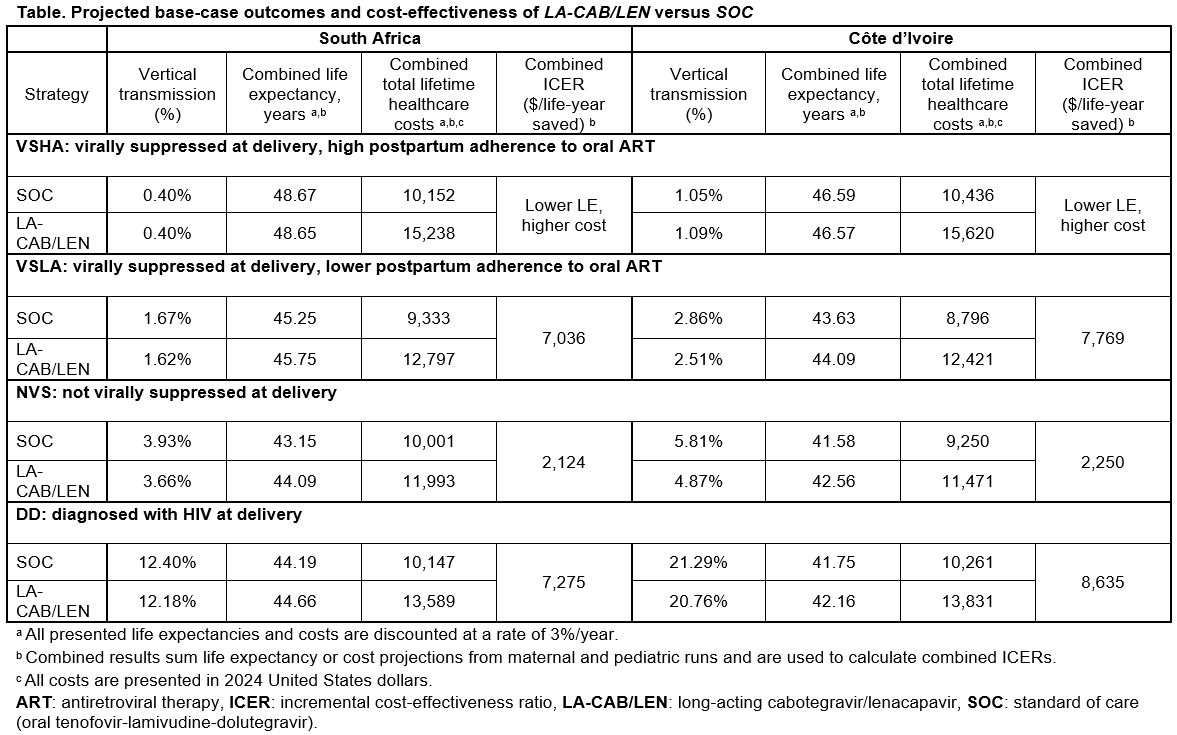
CAB/LEN would provide clinical benefit in the VSLA, NVS, and DD cohorts. In South Africa/Côte d’Ivoire, it would reduce VT by up to 0.27%/0.94% and improve combined maternal/pediatric LE by up to 0.94y/0.98y (Table). At $378/year, the only cohort for which CAB/LEN would be cost-effective is NVS in South Africa (ICER: $2,124/YLS). In sensitivity analyses, yearly cost of CAB/LEN was most influential; CAB/LEN became cost-effective in South Africa at ≤$96 (VSLA) and ≤$84 (DD) and in Côte d’Ivoire at ≤$204 (NVS). It was not cost-effective even at $74 (2x TLD cost) for VSLA and DD in Côte d’Ivoire.
Conclusions
If efficacy is confirmed, CAB/LEN for PP women with adherence challenges to oral ART could improve maternal and pediatric clinical outcomes, reduce infant infections, and be cost-effective under specific price conditions in South Africa and Côte d’Ivoire.
Table or Figure