Background
Implementing appropriate HIV prevention and treatment services for sex workers (SWs) in the U.S. Deep South is critical, given SWs are disproportionally affected by HIV and face complex barriers to care. Yet community-informed implementation strategies remain limited.
Methods
Using a convergent mixed methods design, we explored multilevel determinants of HIV program utilization and unmet needs among SWs across diverse sex work typologies. Quantitatively, we merged program data from 370 SWs reached by the Birmingham AIDS Outreach (BAO) program (2021-2023) with publicly available geospatial data and used poisson regression with cluster robust standard errors, adjusting for age, race and gender, to identify behavioral and geospatial determinants of BAO utilization. Outcomes included uptake of testing services and diagnosis with HIV, bacterial STIs and/or HCV. Qualitatively, we conducted a thematic analysis of in-depth interviews with 14 SWs and 9 key informants from Birmingham (Dec 2023–Jan 2025).
Results
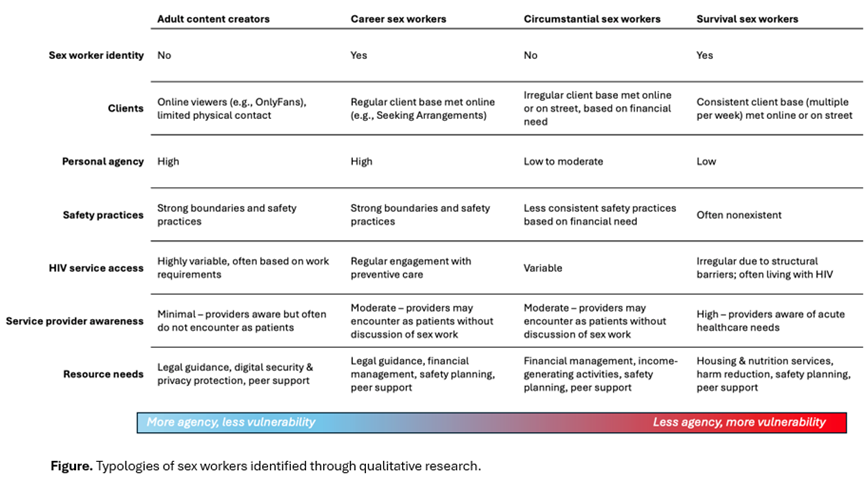
SWs resided a median distance of 9 miles from BAO (Interquartile range: 2.1, 41) with 52% identifying as a cisgender male, 60% non-Hispanic white, and 43% with a history of injection drug use in prior five years. Most (81%) SWs accessed HIV services during offsite outreach. Compared to SWs accessed onsite, SWs reached via outreach lived 6.5 additional miles from BAO, 1.3 extra miles from the nearest harm reduction center, and 2 additional miles from the nearest federally qualified health center. Uptake of bacterial STI tests was lower among SWs reached offsite than those reached onsite (PR 0.08, 95% CI 0.03-0.18). Qualitatively, four typologies of sex work emerged (adult content creators, career SWs, survival SWs and circumstantial SWs), with SWs’ needs and barriers to care differing by typology and risk perception (Figure). For example, survival SWs reported regular drug use, limited safety practices, and structural barriers to healthcare, desiring food, housing assistance and harm reduction. Content creators and career SWs felt less acute health needs, requesting resources on digital security, business development and legal guidance.
Conclusions
SWs in the Deep South face persistent structural barriers to care, including challenges with geographic access to health centers, which limit engagement with preventive services including STI testing. Tailored and integrated services are critical to address the heterogeneous vulnerabilities and unmet needs identified among SWs in the Deep South.
Table or Figure