Background
In 2023, Black women represented ~50% of all HIV diagnoses among cisgender (CGW) and transgender (TGW) US women. Oral PrEP uptake and persistence among Black women is low; <20% persist at 6 months. We present outcomes through Month (M) 12 with long-acting cabotegravir (CAB LA) from the EBONI (NCT05514509) study, the first US implementation study in Black women evaluating CAB LA for PrEP.
Methods
EBONI is a Phase 4 hybrid implementation science and real-world effectiveness trial assessing CAB LA integration at 20 practice sites for Black CGW and TGW. Clinical assessments included HIV incidence, persistence, safety and tolerability. Implementation questionnaires (IQ) at M12 assessed acceptability of CAB LA, injection pain, and local reactions (LR).
Results
From Jan. 2023 to Sept. 2025, 163 women initiated CAB LA, with 84 completing M12 IQ; 25% were TGW, median age was 35 (IQR=29-42) years. Almost half (46%) had not taken oral PrEP in the last 6 months prior to starting CAB LA.
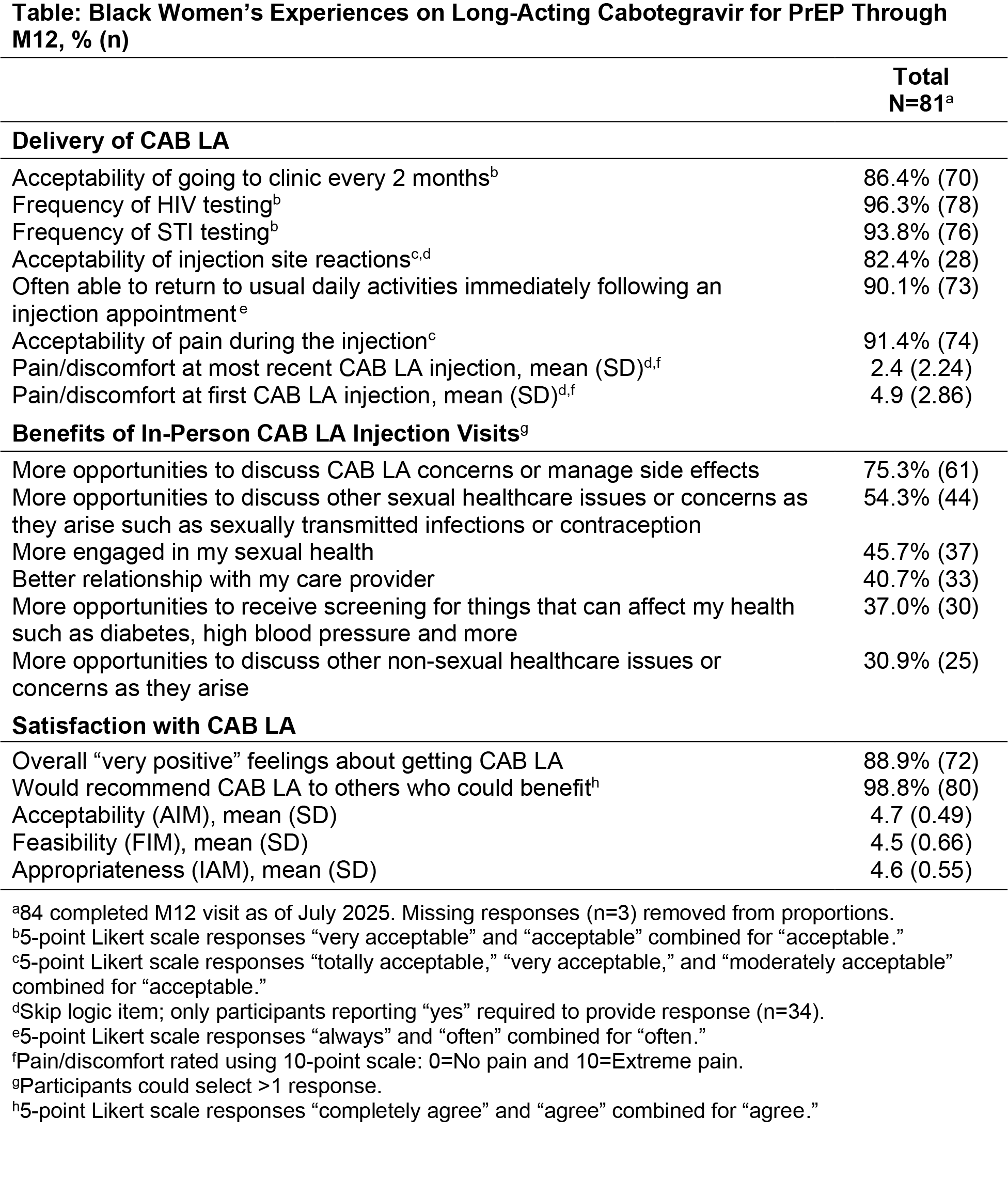
Persistence on CAB LA was 73% at M6 and 57% at M12 (n=93/163), with 69%-89% receiving injections within the ±7-day window through M12. Majority (61%; n=100/163) were of childbearing potential, of whom 4% (n=4/100) experienced a pregnancy. Women found clinic visits every 2 months (86%) very acceptable, noting benefits like better relationships with providers and enhanced screenings for health conditions like diabetes or high blood pressure (Table). HIV (96%) and STI (94%) testing frequency was acceptable; 16 STIs were identified through M12 (gonorrhea, n=7; chlamydia, n=8; syphilis, n=1) among 13 women (8%; n=5 CGW, n=8 TGW). No cases of HIV acquisition occurred during EBONI.
Women who experienced injection pain or LRs found both acceptable (91% and 82%, respectively). Pain decreased for subsequent injections after the first injection. Majority (89%) resumed daily activities immediately after injection appointment. CAB LA-related adverse events (AEs) (2%; n=4/163) were rare, with 1% (n=2) discontinuing due to AEs. Almost all women in EBONI (99%) would recommend CAB LA.
Conclusions
EBONI adds robust evidence showing CAB LA for PrEP is highly effective and acceptable in real-world settings. Discontinuation may highlight variability in perceived need for PrEP or care continuity. High persistence relative to oral PrEP, no HIV acquisition, rare AEs, and ancillary clinical benefits observed in EBONI further demonstrate that CAB LA can meet the needs of diverse populations.
Table or Figure