Background
HIV risk among cisgender women in South Africa is heterogeneous across subpopulations, with adolescent girls and young women (AGYW) and female sex workers (FSW) at disproportionately high risk of HIV acquisition. While PrEP is an effective HIV prevention intervention, its preventive impact in South Africa has been limited by interruptions in PrEP continuation and service engagement. This study used data from the largest PrEP provider to AGYW and FSW in South Africa (TB HIV Care) to examine age-specific differences in PrEP continuation over time.
Methods
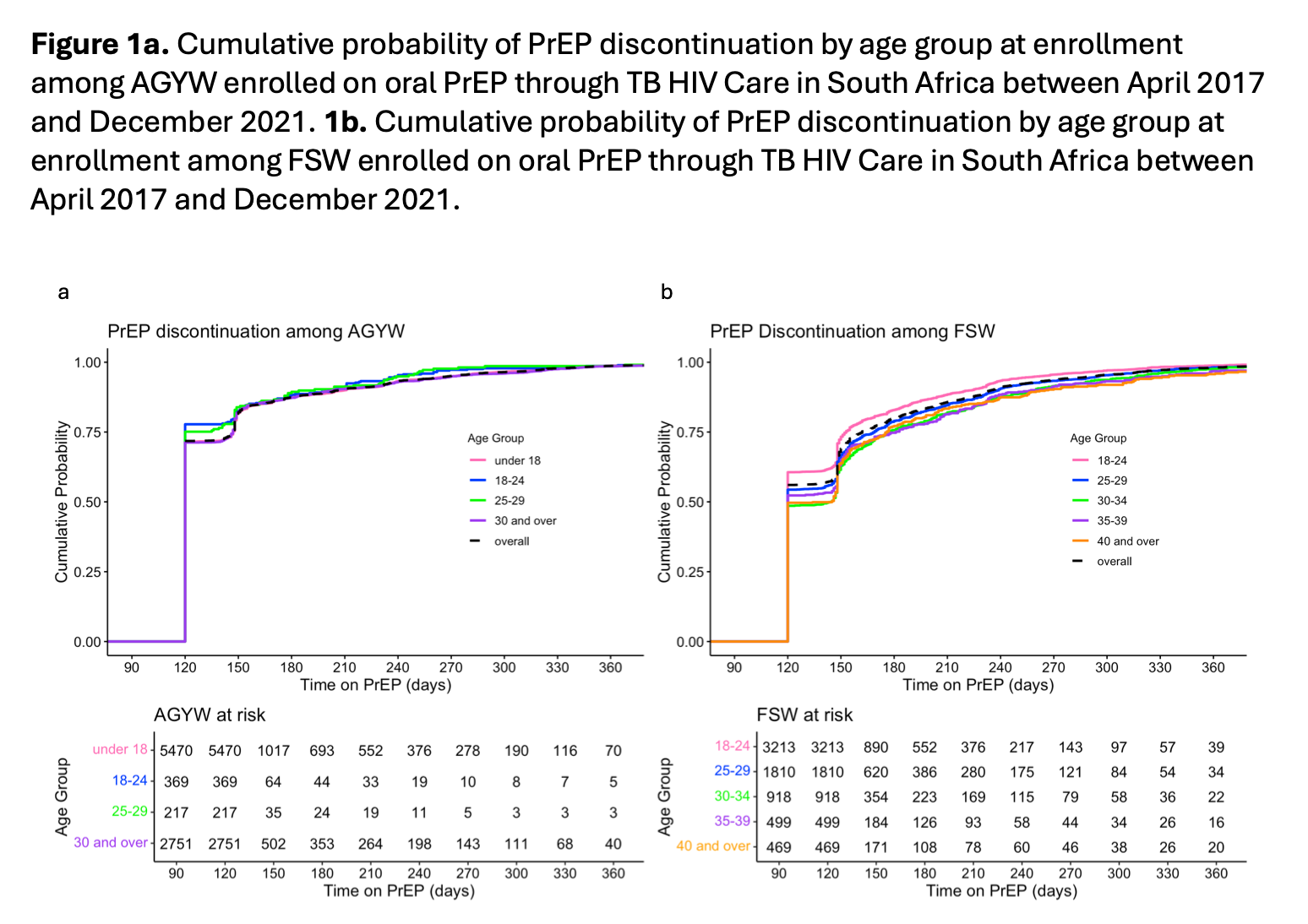
Programmatic clinical files were reviewed for 8807 AGYW and 6909 FSW initiating oral PrEP through TB HIV Care across 9 districts from April 2017-December 2021. Discontinuation was defined as not returning for follow-up with a PrEP service provider within 120 days of last PrEP pick-up (dispensing was ≤90 pills at each visit + 30-day lateness window). Kaplan-Meier survival analyses, stratified by age at initiation, visualized cumulative incidence of PrEP discontinuation. Multivariable logistic regression models using age group, district, and enrollment year as covariates identified correlates of PrEP continuation at 120 days after initiation.
Results
Cumulative incidence of PrEP discontinuation 120 days after initiation was 71.8% for AGYW and 56.0% for FSW (Figure 1). By one year after initiation, nearly all AGYW and FSW had experienced a 120-day gap in PrEP service engagement. Older AGYW (aged 25-29) were less likely to continue on PrEP 120 days after initiation than younger AGYW (aged 18-24) (adj OR = 0.62, 95% CI = 0.48-0.80). Younger FSW (aged 18-24, REF) were less likely to continue on PrEP 120 days after initiation than those aged 25-29 (adj OR = 1.21, 95% CI = 1.07-1.37), 30-34 (adj OR = 1.45, 95% CI = 1.24-1.69), 35-39 (adj OR = 1.30, 95% CI = 1.06-1.58), and ≥40 (adj OR = 1.38, 95% CI = 1.13-1.69).
Conclusions
PrEP continuation trends varied by age across populations of cisgender women at high risk of HIV acquisition in South Africa. Real-world data demonstrate challenges with long-term persistence on daily oral PrEP and underscore the need for PrEP support and retention strategies targeting young women, particularly younger FSW and older AGYW who may be more transient. PrEP choice — including long-acting formulations — and efforts to address structural barriers to PrEP service engagement may also mitigate adherence challenges and help optimize PrEP’s prevention impact in South Africa.
Table or Figure