Background
Lifelong HIV care requires consistent clinic engagement. Identifying patients at higher risk of missing appointments, and providing timely reminders and support before scheduled visits, may improve attendance and clinical outcomes. Addressing this need is an important gap.
Methods
We developed and cross-validated a machine-learning (ML)-based prediction model that uses longitudinal patient- and clinic-level features to quantify risk (probability) of missing the next scheduled clinic encounter. We installed it as an electronic health record (EHR)-based clinical decision support system (CDSS) designed to reduce treatment interruption at the Academic Model Providing Access to Healthcare (AMPATH), a large HIV program in western Kenya. Each week, an interactive clinic-level EHR module displayed a list of high-risk patients for missing upcoming appointments, sorted in descending risk order. Outreach workers were instructed to contact patients categorized as ‘high risk’, starting at the highest risk score, and document process outcomes using the module (called, reached). The primary endpoint is return to care (RTC), defined as attending the visit on or before schedule. Multi-level logistic regression with clinic-specific random effects was used to assess separately the impact of being called (whether or not reached), and being reached, on RTC. To mitigate potential for confounding bias, we adjusted for risk score and patient- and clinic-level variables. The study was carried out at 8 pilot sites associated with a larger randomized trial of the CDSS.
Results
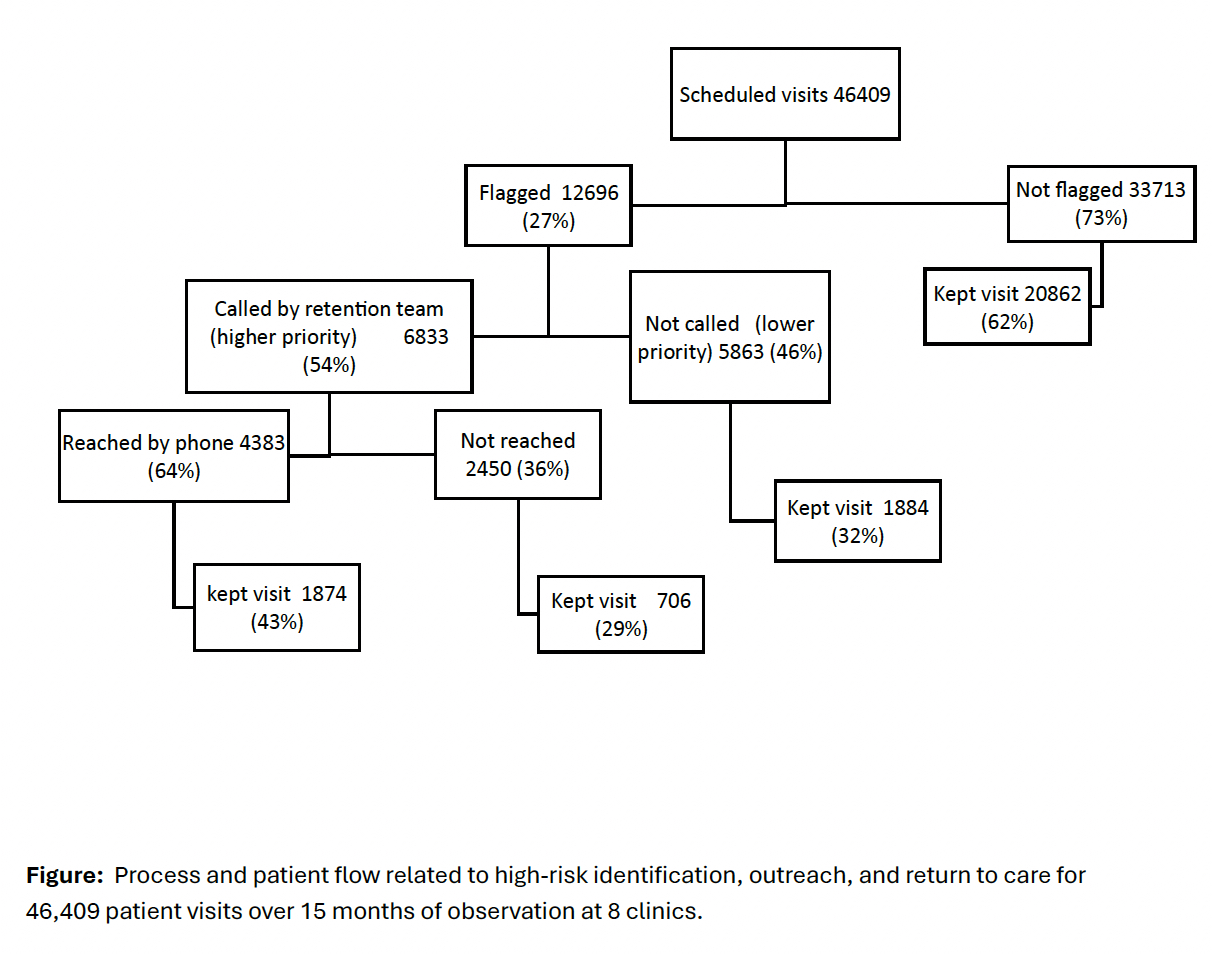
Over a 15-month observation period, 21,255 patients had 46,409 scheduled clinic visits (Figure). The ML algorithm flagged 12,696 (27%) as high-risk; of these, outreach workers called 6833 (54%), with 4383 (64%) reached successfully. Among those reached, 1874 (43%) kept their appointment on time, and 706 (29%) did not. Outreach attempt was highly associated with risk score. Adjusting for risk score, both outreach attempt (adjusted odds ratio (AOR) 1.2, 95% CI 1.1-1.3) and being reached (AOR 1.7, CI 1.5-2.0) were associated with higher probability of RTC. Outreach attempts were more likely among males (AOR=1.3, CI: 1.12-1.4), and older patients (AOR=1.2 per 10 years older, CI: 1.1-1.2).
Conclusions
When delivered, outreach to high-risk patients improved the engagement cascade and the probability of on-time RTC. A comprehensive evaluation of CDSS effectiveness using a stepped wedge cluster-randomized trial is ongoing.
Table or Figure