Background
State health departments (SHDs) play a central and crucial role for the implementation of HIV prevention in the United States. However, funding cuts to core HIV prevention activities threaten to stifle progress in ending the HIV epidemic. Our understanding of how SHD funding relates to new HIV diagnosis rates and cases, along with its association, is limited, hindering efforts to develop strategic funding asks in the budgetary and appropriations process.
Methods
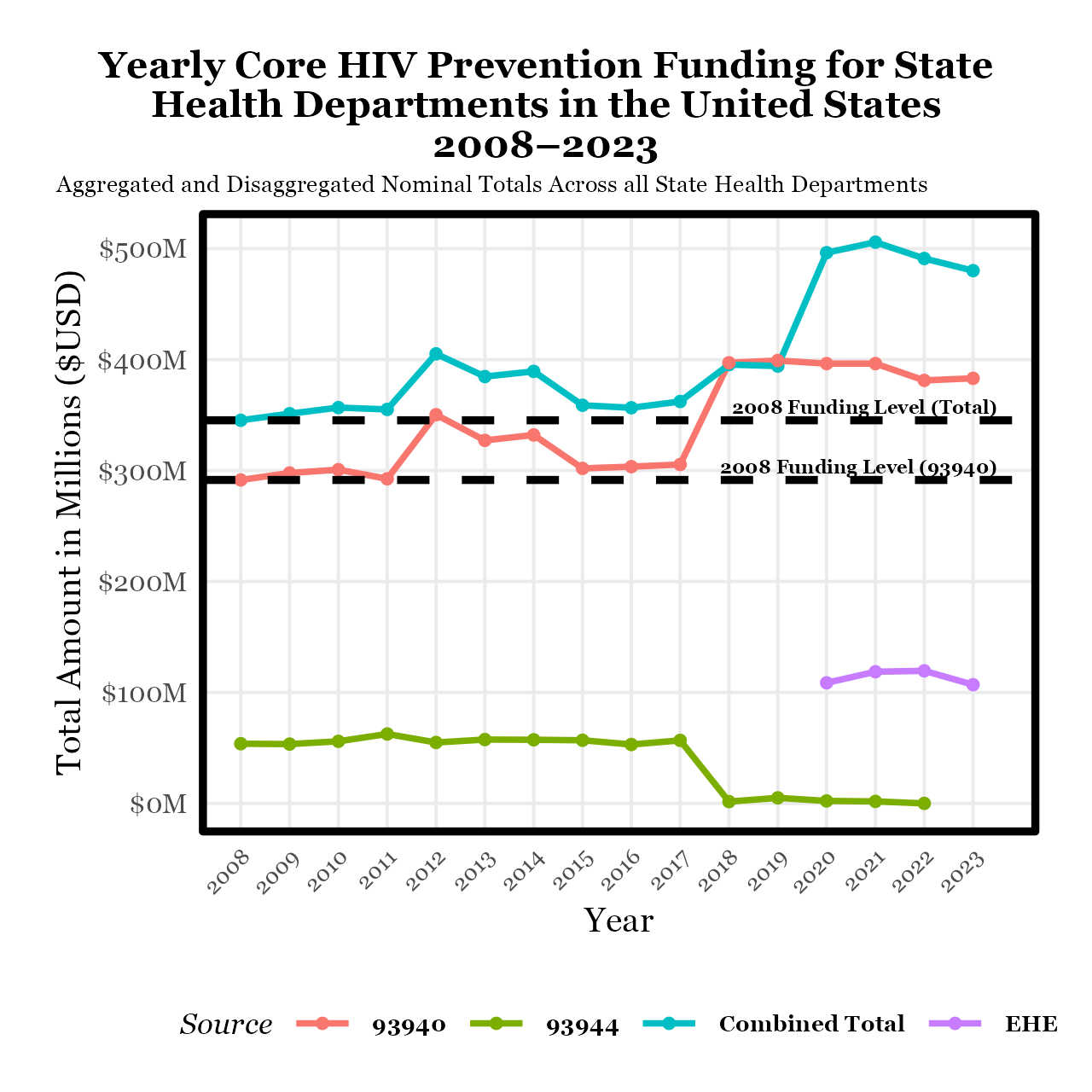
SHD core HIV prevention funding data were collected across two SAM codes (93940, 93940), including Ending the HIV Epidemic (EHE) initiative funding, with aggregated and disaggregated HIV diagnosis rates and cases sourced from AIDSVu databases from 2008 to 2023. Time-series regression models were created for national and state-level data using nominal funding totals and new HIV diagnosis rates. Sex, age, and race were assessed for effect modification at the national level. When assumptions were not met in SHD analyses, appropriate adjustments were employed. The model treats changes in new HIV diagnosis rates as attributable to changes in state health department funding, recognizing that unmeasured factors may also contribute.
Results
The proposed time-series regression model for year-to-year changes at the national level suggests that each $1 million increase in annual funding for SHDs was associated with a 0.015 decrease in new HIV diagnoses per 100,000 (β = –0.0146, p = 0.066, 95% CI: –0.030, 0.001), which is a suggestive but non-significant association.
When stratified by sex, decreases were greater for males compared to females (p = 0.029). By race, Black (p < 0.001) and Hispanic (p = 0.006) populations experienced greater reductions. By age, all groups except lower middle-aged adults (25–34; p = 0.201) showed decreases in rates with funding increases. Compared to national trends, three states (MT, NH, KS) had rate increases, while 12 of 28 EHE jurisdictions (43%) showed greater decreases, with 21 states with national-level decreases.
Conclusions
This is the first modeling study to assess trends in core HIV prevention funding and new HIV diagnosis rates to determine comparative effect size at the national and state levels. Models demonstrate differentiated results for national-level funding across sex, race, and age. Additionally, less than half of EHE jurisdictions showed greater rate decreases compared to the national level, suggesting mixed progress across EHE jurisdictions and possible needs for increased funding.
Table or Figure