Background
Antimicrobial resistance (AMR) is a growing public health concern, driven by excessive antibiotic exposure. People living with HIV (PLHIV) and users of pre-exposure prophylaxis (PrEP) experience high rates of sexually transmitted infections (STIs), potentially leading to disproportionate antibiotic consumption. Comparative, population-based data versus the general population remains scarce.
Methods
We conducted a retrospective, population-based study (January 2024–January 2025) linking the official dispensing database (Farm@drid) with microbiology records. Adults aged 18–65 were classified as: Group A, PLHIV/PrEP with recurrent rectal STIs; Group B, PLHIV/PrEP users without STIs; Group C, age- and sex-matched general population controls from the same administrative area who had never attended the HIV/STI units. Antibiotic exposure was quantified as Defined Daily Doses (DDD) and DDD per 1,000 persons-day (DHD), overall and by WHO ATC class. Between-group contrasts used generalized linear models with log link and offsets, applying overlap weights (ATO) from a multinomial propensity score including age, sex, and their interaction. Multiple testing was controlled with false discovery rate correction.
Results
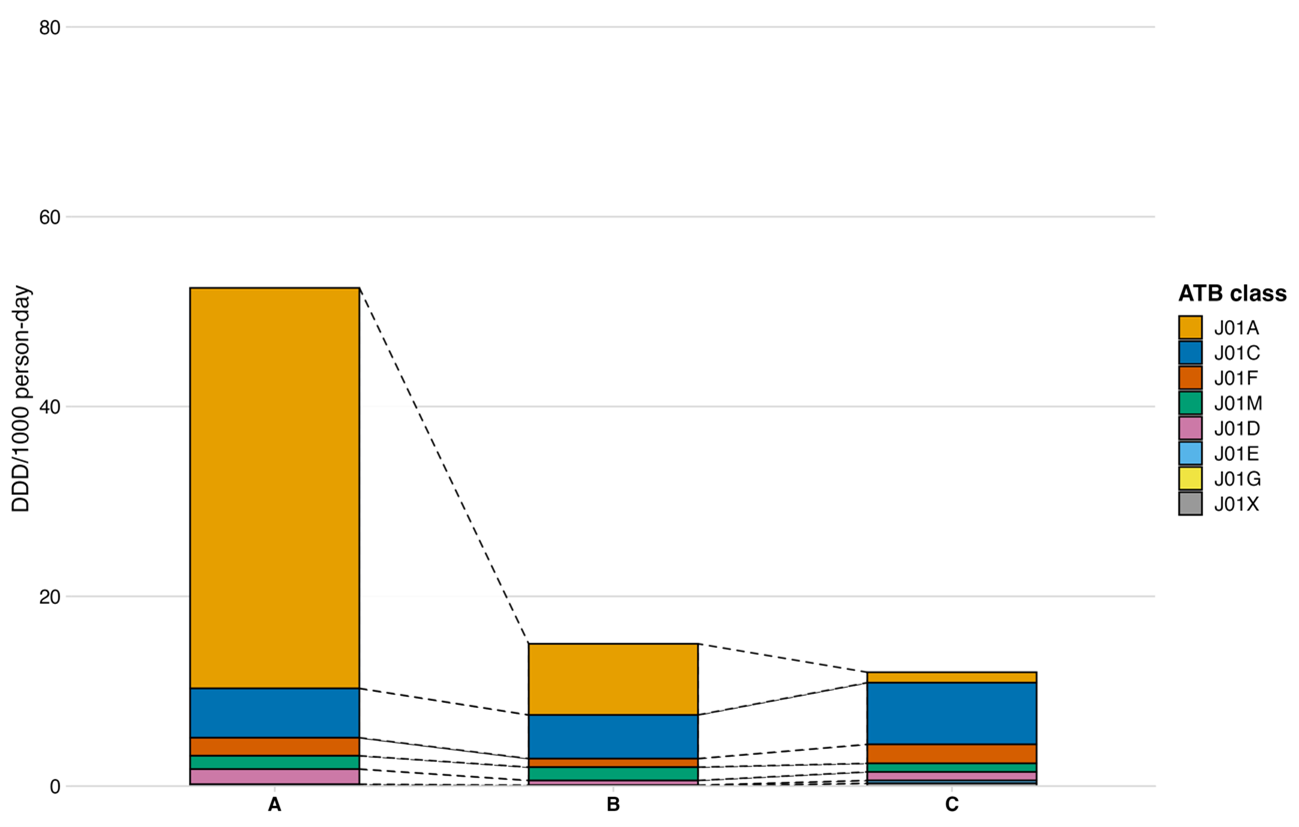
A total of 562,325 individuals were analyzed (Group A: n=1,793; Group B: n=1,978; Group C: n=558,586). Any antibiotic use occurred in 95.3% of Group A, 35.4% of Group B, and 27.3% of Group C (p<0.001). Group A showed a fourfold higher rate of antibiotic consumption compared with controls (rate ratio [RR]-DHD, 4.2; 95% CI, 3.9–4.4; p < 0.001), primarily driven by tetracyclines (RR-DHD, 23.7; 95% CI, 21.8–25.8), equivalent to 1.1 courses of doxycycline per person per year. Group B, in contrast, showed a mild increase compared to controls after correction (+18% [6-33%] increase in DHD, p = 0.004). Direct comparison of Groups A and B revealed markedly higher tetracycline use in Group A (RR-DHD 5.6; 95% CI 4.6–6.7; p<0.001).
Conclusions
PLHIV and PrEP users with recurrent STIs exhibit substantially greater antibiotic consumption, particularly tetracyclines, compared with both PLHIV/PrEP users without STIs and the general population. These findings support the need for tailored antimicrobial stewardship strategies in sexual health and HIV care, with a specific focus on recurrent-STI cohorts.
Table or Figure