Background
DoxyPEP has proven to be highly effective against bacterial sexually transmitted infections (bSTI); however, it is unclear whether it should be used for each sexual contact or limited to specific settings. Aims of this study were (i) to describe the features of individuals who chose to use doxyPEP in our cohort of PrEP users, (ii) to assess the number of doxyPEP doses required to observe a measurable reduction in bSTI incidence, and (iii) to explore the contexts in which its use may be most appropriately targeted.
Methods
This retrospective analysis included all individuals who had at least two visits from January 2024 to September 2025 at Milano Checkpoint, a community-based service that offers free medical assistance to PrEP users in northern Italy. DoxyPEP was prescribed to all participants, but its use was recommended specifically for sexual exposures involving a high number of partners within a short time. Logistic regression was applied to identify individual and behavioral factors associated with doxyPEP uptake. We used generalized linear models with Poisson and negative binomial distributions, including person-years as offsets, robust variance estimates clustered by individual, and probability weights to assess the association between doxyPEP use and bSTI incidence.
Results
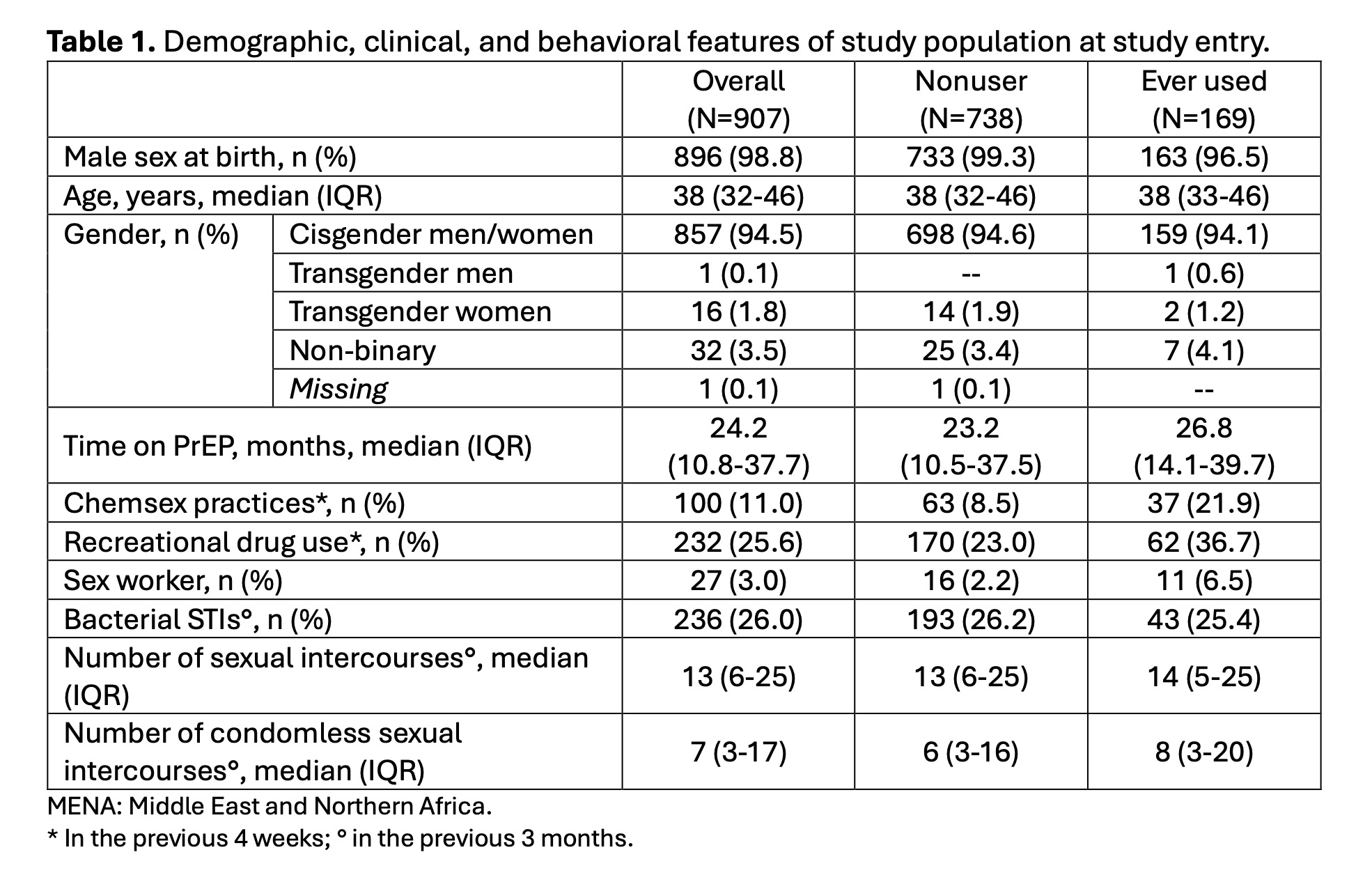
The study included 907 individuals with a cumulative number of 3,381 visits; of them, 169 used doxyPEP at least once (Table 1). The median number of doses taken between visits (i.e., 4 months interval) was 2 (IQR 1-3). Factors associated with doxyPEP use were chemsex (aOR 2.63, 95%CI 1.85-3.74) and having had a prior bSTI (aOR 1.21, 95%CI 1.2-1.44). Poisson and negative binomial models did not find that an increasing number of doxyPEP doses was significantly associated with a reduction in bSTI: the effect started to be protective >4 doses but without reaching the statistical significance (IRR 0.90, 95%CI 0.66-1.22). Regarding the context, doxyPEP use in cruising venues and group sex were at the limit of significance (IRR 0.89, 95%CI 0.78-1.00, and IRR 0.88, 95%CI 0.78-1.00, respectively), while use during sex work or chemsex sessions was not associated with a reduction in bSTI.
Conclusions
In our population, doxyPEP was used very few times by individuals at major risk of exposure; the effect of the number of doses used was limited by the small utilization observed. Our data suggest a trend towards effectiveness with consistent doxyPEP use, especially when participating in group sex and cruising venues.
Table or Figure