Background
To improve HIV and syphilis detection in pregnancy, maternal and child health clinics in Kenya introduced screening with rapid point-of-care (POC) HIV/syphilis dual test kits at first antenatal care (ANC) visits. However, little is known about syphilis screening rates among ANC attendees in the era of rapid POC HIV/syphilis testing.
Methods
We abstracted syphilis screening and treatment data from maternal health records of pregnant women enrolled in an RCT evaluating antenatal STI testing models at 7 public ANC clinics in Western Kenya (PrIMI Study; NCT06203951). Per Kenyan national guidelines, women are screened for syphilis using rapid POC HIV/syphilis tests or laboratory-based non-treponemal tests (Rapid Plasma Reagin[RPR]/Venereal Disease Research Laboratory[VDRL]) at first ANC visits, based on availability. If screened positive via confirmatory testing, three doses of intramuscular benzathine penicillin G (IM pen G) is prescribed. Correlates of missing syphilis results were modeled using Poisson regression with robust standard errors.
Results
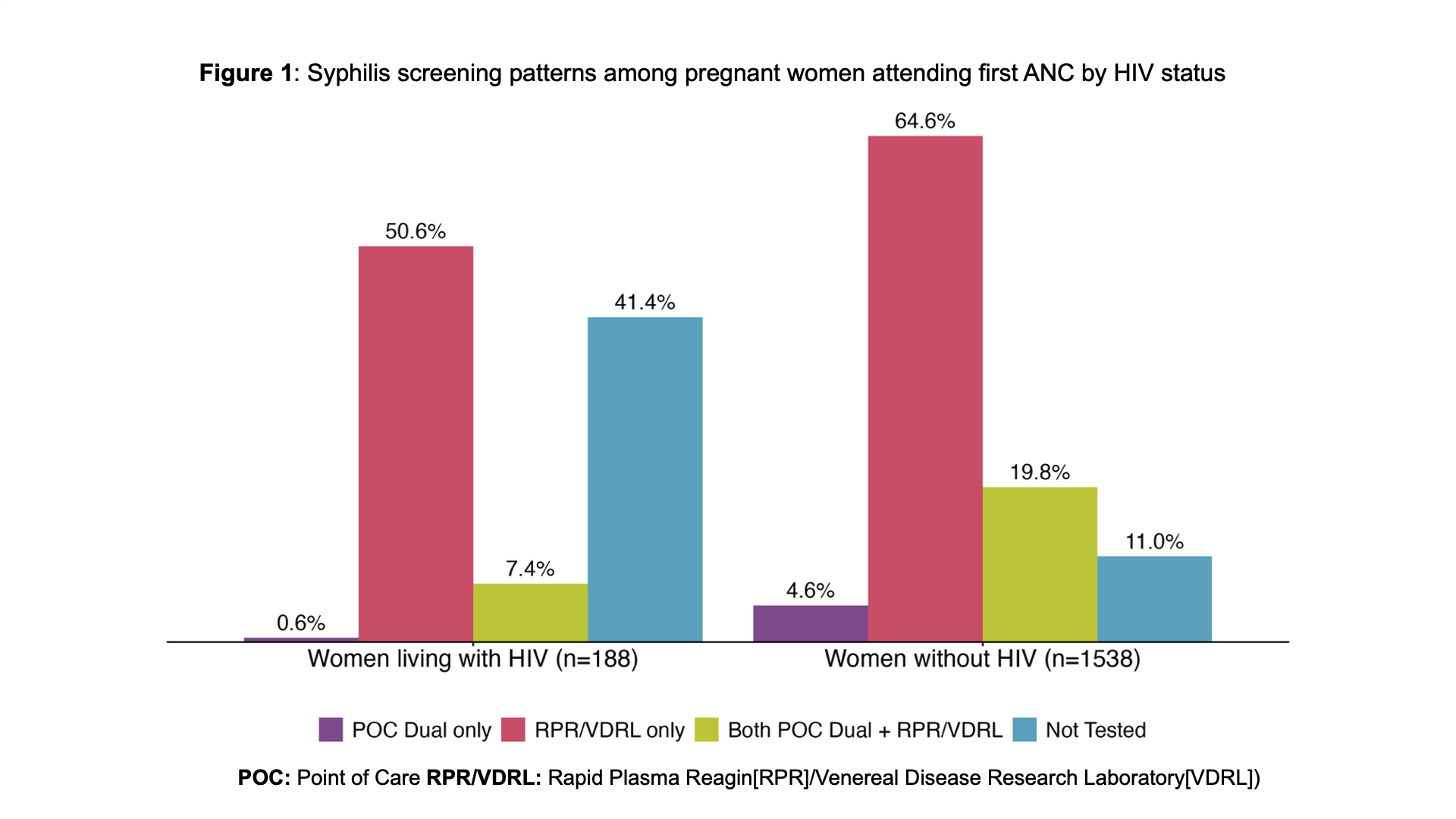
As of September 2025, 1726 pregnant women were enrolled at a median gestational age of 22.9 weeks (IQR 16.9-29.0) and median age of 25.8 years (IQR 22-29.7). Most women were married (77.0%) and 188 (11%) were known to be living with HIV (WLHIV); 5 women were newly HIV diagnosed at enrollment. Overall, 1477 (85.7%) women had syphilis screening at first ANC visit. Compared to women without HIV, WLHIV more frequently had missing syphilis screening results (41.5% vs. 10.9%, prevalence ratio [PR] 3.77, 95% CI: 3.02-4.71, p <0.001). Missing syphilis screening was also more frequent among women >24 years than younger women (15.7% vs. 11.7%, PR=1.34, 95% CI: 1.04-1.73, p=0.022) and multiparous than primigravida women (16.1% vs. 10.2%, PR=1.59, 95% CI: 1.2-2.1, p=0.001). Overall, 4.1% were screened with rapid POC HIV/syphilis tests alone, 63.1% with RPR/VDRL alone, and 18.4% with both POC and RPR/VDRL (Figure 1). Overall, 12 (0.8%) women tested positive; 2 were WLHIV. All women who screened positive completed treatment.
Conclusions
Gaps in syphilis testing were noted for WLHIV, older, and multiparous women despite POC options. Identifying barriers to syphilis testing, particularly among WLHIV, will be important to improve syphilis screening coverage.
Table or Figure